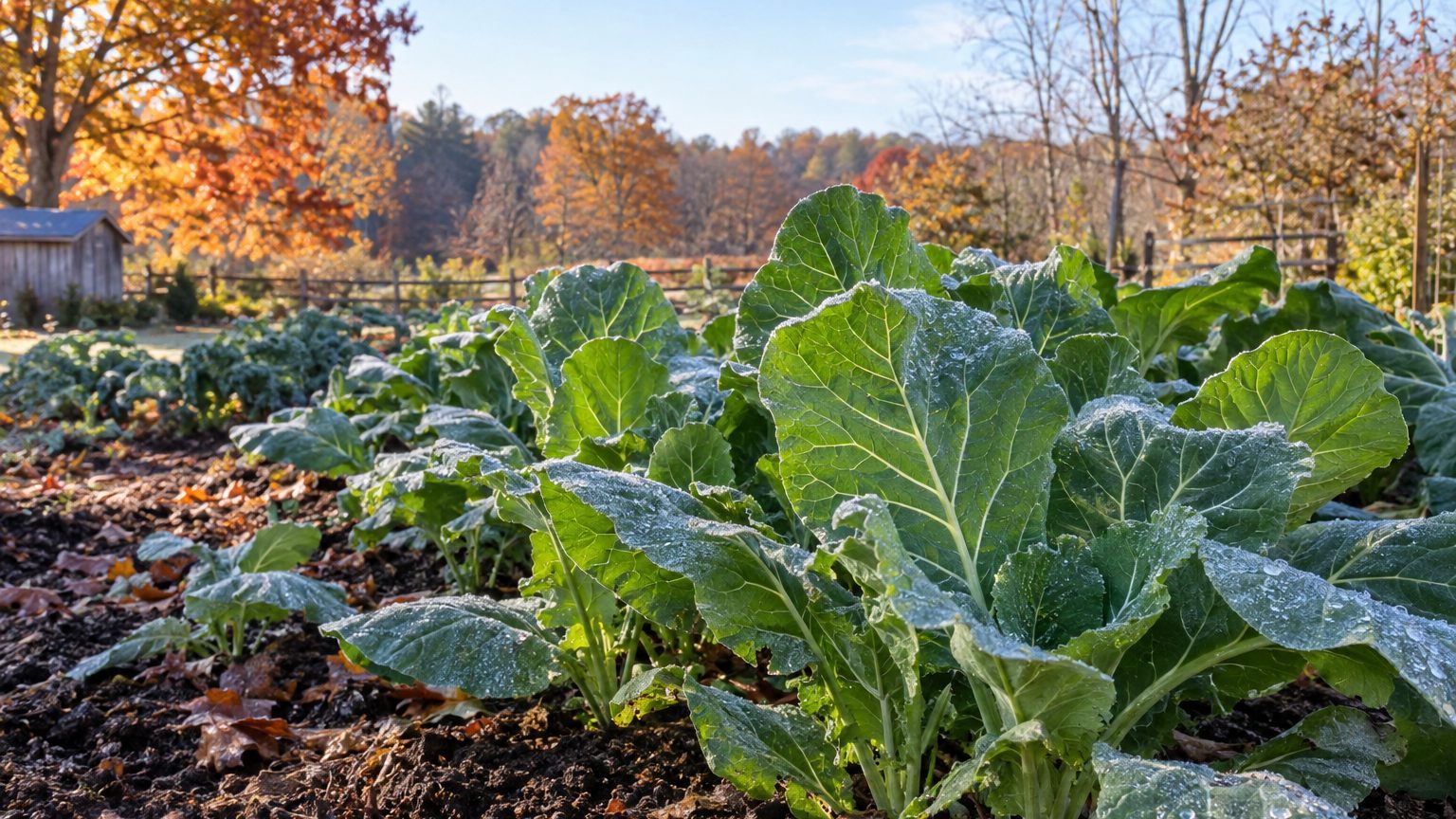

Collards go into New Jersey ground twice a year. Transplants go out from late March through April, and a second planting is started in midsummer for fall and early winter harvest. The second planting usually tastes better, since cold sweetens the leaves. Both windows hang on frost dates, and the published dates describe Newark’s airport, not necessarily the garden where you plant.
The short answer for New Jersey
Start spring seed indoors in February or early March, set hardened-off transplants outdoors from late March through April, and start the fall crop in July. These windows come from NOAA’s 1991-2020 climate normals for the Newark reference station. Its last spring frost falls between March 29 and April 6, and its first fall frost between November 4 and November 16.
Each of those dates is a probability, not a calendar promise. They mark the 30 to 70 percent band for a 32°F freeze. Around March 29, a freeze later in the spring is still a roughly even bet. By April 6, it has become unlikely. In the fall, the same logic runs in reverse: by early November the odds of a first 32°F night are climbing quickly, and by mid-November most years have already delivered one.
The spring window
Collards are among the hardiest garden greens, so you plant them on the frost dates instead of waiting for them to pass. A transplant that has spent time outdoors in a sheltered spot shrugs off a light frost. A seedling moved straight from a windowsill does not. Because Newark’s airport sits on the warm end of the state, gardens in the suburbs and countryside usually see the last frost one to two weeks later. Shift your transplant date accordingly. For more on how the crop behaves once it is established, see Growing Collards in New Jersey.
The fall window
The fall crop is the one that rewards patience. Collards sown or started in July have the long, warm stretch of late summer to build roots and leaf area, then mature as nights cool. The first frost dates of November 4 to November 16 are not a deadline for the plant, since a frost improves the flavor. They are the point after which growth slows to a crawl, so the plant has to be big by then. Inland gardens, where the first fall frost comes a week or two sooner, should sow toward the early part of July.
| Task | Timing |
|---|---|
| Start spring seed indoors | February to early March |
| Transplant spring crop outdoors | Late March through April (later inland) |
| Start fall seed | July |
| Set out fall transplants | Late July into August |
| Harvest fall crop | October through early winter |
What will not work here
Sowing seed outdoors in mid-March because the Newark date says it is time. That date is a reference-city figure. A garden even a short distance inland may still be freezing hard overnight, and a bare seedling bed gives the soil nothing to hold warmth. Cold, wet ground in early spring also works against seed before it germinates. Indoor starts and hardened transplants are the safer way to use the early window.
Planting the spring crop too late
The opposite mistake costs just as much. A spring planting set out in late May gets only a short stretch of mild weather before summer arrives, and the summers are hot and humid. Collards stressed by heat suffer, and crowded plants hold moisture on their leaves. Spacing plants generously matters more here than in a dry climate, because humid air does not clear the leaves quickly after rain.
Counting on winter to be gentle
Newark’s coldest month has a mean daily minimum of 25.5°F. That is a typical night in January, not the worst night, and cold snaps dip well below it. Collards often keep producing through a good part of the winter at that kind of temperature, so a fall crop can feed a household well into the season. Treating them as a dependable overwinter crop is a gamble, though, especially in the colder zone 6 parts of the state, where a hard stretch can finish the plants off. If you want leaves in late winter, mulch heavily and cover plants before the severe nights, and consider anything that survives to be a bonus.
The last failure is planting the fall crop in September. By then, the first fall frost is only weeks away at the airport and sooner in the countryside, and the plants never reach full size. You get a few small, tender leaves and a rosette that stalls in the cold. July is the month that works. For help choosing varieties that suit that timing, read The Best Collards and Greens for New Jersey.
What changes across New Jersey
The USDA Plant Hardiness Zone Map (2023 edition, built on 1991-2020 normals) places New Jersey in zones 6a to 7b. That is four half-zone steps, and it means there is no single answer for the state. The zone system measures one thing only, the average annual extreme minimum temperature, so it tells you how cold the worst winter nights get. It says nothing about when spring settles or how long the fall holds.
The north and higher ground
In the northwestern hills and other higher areas, winters bite harder and spring comes later. The one to two weeks of delay beyond the airport’s last spring frost can stretch longer with elevation. A gardener there should push transplanting toward the later part of the spring window, or beyond it, and sow the fall crop early enough to leave room before an earlier first frost. Overwintering is a long shot at the colder end of the range, so plan to eat everything before deep winter.
The south and the shore
Milder zones in the southern part of the state and near the coast give you more room at both ends. Transplants can go out at the front of the window, and the fall crop has more time to size up before cold arrives. Even so, “milder” does not mean frost-free, and the same hardening-off habits apply. Newark itself sits in the middle of the pack, which is why its frost dates are a starting point for the whole state and not a verdict on any one yard.
To find your own zone, look up your location on the USDA map instead of assuming it from a neighbor or a nursery tag. Then shift the dates above by what the map and your local frost patterns suggest.
Where to check this for your own county
The best next stop is Rutgers Cooperative Extension, part of the New Jersey Agricultural Experiment Station, which runs offices serving each county in the state. A county recommendation beats a state one, and what you are reading is the state version. A county agent knows the local frost pockets, the soils, and which vegetables have actually done well in nearby trial plots.
Two things are worth looking for. The first is the local vegetable planting calendar, which will usually give dates for spring and fall brassicas keyed to your county instead of to an airport. Compare its spring transplant dates with the March 29 to April 6 band here. If the county calendar lands a week or two later, trust it. The second is any variety trial results for collards or related greens in your area. Trials show which varieties handled the local heat, humidity, and disease pressure, and they are more useful than a catalog description.
Extension offices also field plant disease and insect questions. If leaves are yellowing in humid weather, or caterpillars are chewing holes in the middle of the plant, county staff can identify the cause from a sample or a photo. A call or a visit early in the season costs nothing and can save a planting.
Checking this against your own garden
Calendars give a reasonable starting date, but the garden settles the question. Three observations are worth making every year, and none requires equipment.
- Soil warmth by feel. Push your hand a few inches into the bed in the morning. If the soil feels cold and clammy, seeds will sit and sulk. If it feels cool but crumbles easily, you can plant. A bed that warms days before the next one over tells you where your earliest ground is.
- The first true leaves. A seedling’s first leaves are rounded seed leaves. The true leaves that follow look like small leaves of the same plant. When indoor starts have true leaves, they are ready to begin hardening off, and a seedling that is slow to produce them is telling you the room is too cool or too dim.
- Frost on the grass. Check which spots in your yard are still white in the morning after the neighborhood has thawed. Low corners hold cold air and frost sooner in the fall and later in spring. Those spots need later transplanting and a covering ready, while the sunniest wall can carry you further into the season.
A few seasons of those notes will give you a calendar more accurate than anything built on a distant weather station. Write the dates down, because memory blurs by the next spring.
If you follow the almanac, here is when to plant collard greens by the moon. It is a tradition, not a proven method.
Common questions
Can I plant collards in New Jersey in summer?
Yes, and July is the best month for it. Plants started then grow through late summer and mature in cooling weather, giving the sweetest leaves of the year.
Will collards survive a New Jersey winter?
Sometimes. Newark’s coldest month averages a nightly low of 25.5°F, and collards often hold up in that range, but harder cold snaps can kill them, particularly in the colder parts of the territory. Treat winter harvest as a bonus.
Should I use seeds or transplants?
Use transplants for spring, because the early season is short and cold soil slows germination. For the fall crop, seed started in July in flats or sown directly in a bed both work, as long as the plants are well sized before November.
Are the Newark frost dates right for my yard?
They are a reference point. Suburban and rural gardens typically see the last spring frost later and the first fall frost earlier, often by one to two weeks, and more at elevation. Your county extension office can give a closer date.