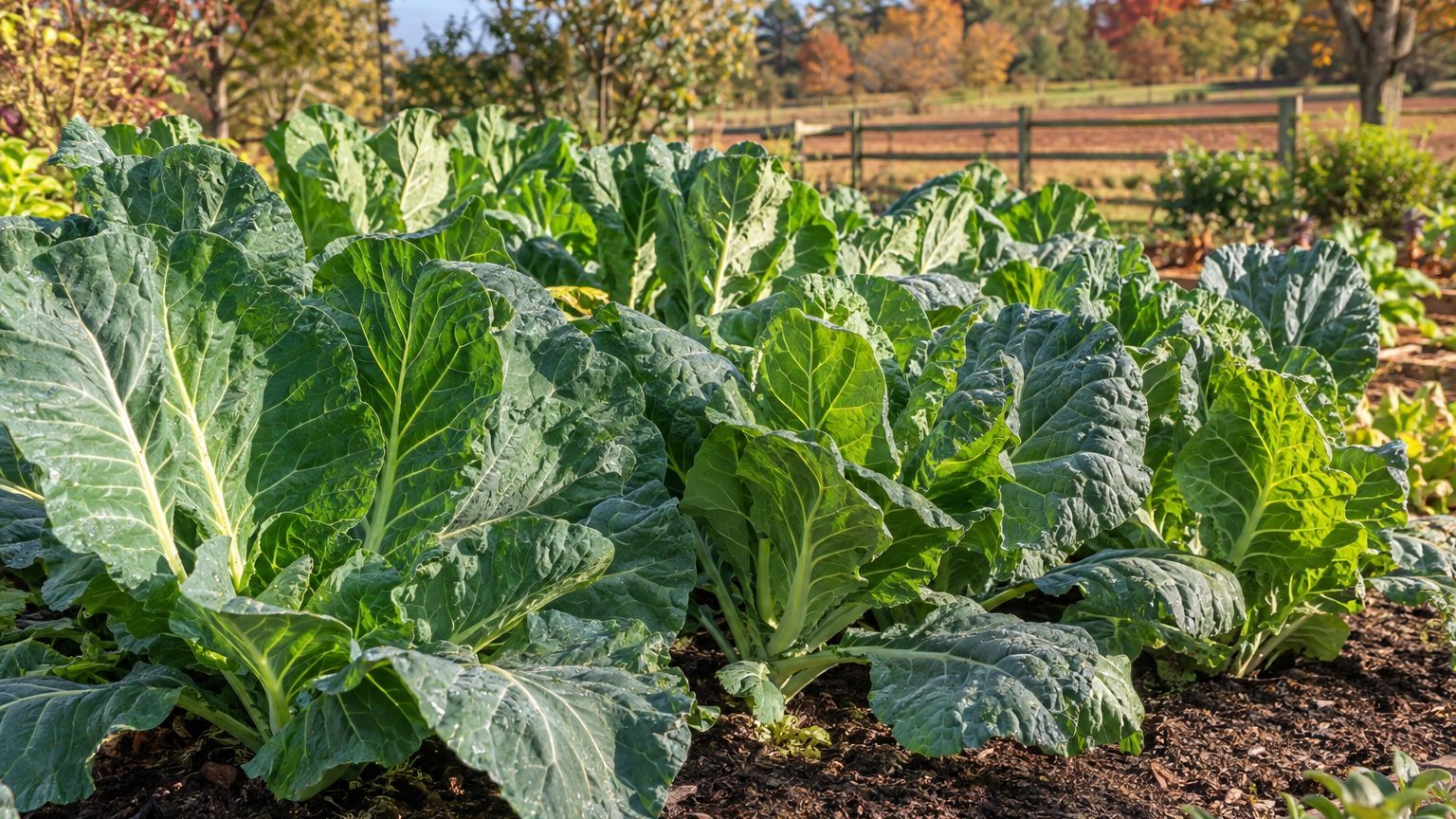

Quebec suits compact, fast collards such as Vates and Champion, backed up by kale and mustard greens. The tall, slow Georgia-type collards of the South are a poor bet here. Average frosts sit roughly five months apart, so choose the quickest types, start transplants indoors, and treat fall frost as a flavor bonus rather than a deadline to race.
The short answer for Quebec
Three numbers frame the decision. Environment and Climate Change Canada’s 1981-2010 normals for the Montreal/St-Hubert airport station put the average last spring frost on May 6 and the average first fall frost on October 5. The coldest month has a mean daily minimum of -14.1 °C. A bit under five months of frost-free growing, then a winter that kills most unprotected leaves.
Both frost dates are averages, so they mark the middle of a window. In one year out of two, the last spring frost falls later than May 6. The October 5 date works the same way: some autumns bring frost earlier, some later. Neither is a safe date. A variety has to reach harvest size with room to spare on both ends of that window.
That favors earlier, smaller plants over big ones. Collards are a cool-weather crop and handle light frost well, so the short season is a problem of plant size and speed, not of cold during the growing months. The table sorts the common choices by type.
| Type | Examples | Fit for Quebec |
|---|---|---|
| Compact, open-pollinated collards | Vates, Champion | Best first choice. Smaller plants reach picking size sooner and tolerate cool weather. |
| Loose-heading collards | Morris Heading | Worth a try with early transplants. Needs a full season to form its heads. |
| Tall Southern heirloom collards | Georgia-type strains | Risky. Built for a long, warm season that Quebec does not give. |
| Kale | Lacinato, Siberian, Russian red | Reliable stand-in, quick and cold-tolerant. |
| Mustard and turnip greens | Mizuna, Southern Giant Curled, Purple Top types | Fast fillers for spring and late summer sowings. |
For a first year, plant one reliable compact collard, one kale, and one fast mustard. You will learn more from the comparison than from any variety list. The basics of bed preparation, spacing and feeding are covered in Growing Collards in Quebec.
What will not work here
The slowest collards fail first. A tall Georgia-type plant wants a long run of warm days to build the big, thick leaves it is known for. Start one from seed outdoors in late May and it may still be half-grown when the first fall frost arrives. That frost has an average date of October 5, and in some years it comes earlier. Light frost improves the taste of a mature collard. On a plant that is still small, it just ends the season.
Winter harvest is the second casualty. With a coldest-month average low of -14.1 °C (6.7 °F), that habit does not carry over. Leaves left standing in an open bed will be frozen solid and finished by midwinter. Hardy kale fares better under snow cover or a thick mulch, but even then plan on the last harvest in late fall, not a winter crop.
Planting by the calendar date alone also goes wrong. May 6 is where the last spring frost falls on average, so in about half of all years the last frost comes later. Setting out unhardened transplants on that date, with no row cover to hand, is a gamble that fails regularly. Collards can take a light frost once they are hardened off, but tender seedlings straight from a windowsill cannot. Cold soil in a wet spring can also hold transplants motionless, which costs more than a short frost does in a season this tight.
Crowding is the quieter failure. Spacing collards tightly to squeeze out more plants works in a dry climate. During humid stretches, packed leaves stay wet longer, mildew and leaf spot settle in, and cabbage worms hide where you cannot see them. Give each plant room for air to move, even if that means fewer plants. A couple of well-spaced rows outyield a crowded bed that gets sick.
Last, a Southern-style sowing schedule does not fit. Seed sown in midsummer to be harvested after frost, as is done in warm regions, leaves too little time before cold stops growth. Timing for the cooler months is laid out in When to Plant Collards in Quebec.
What changes across Quebec
The numbers above describe one airport south of Montreal. The reference city for Quebec on Natural Resources Canada’s map sits in Canadian hardiness zone 5b. That is a Canadian zone, built from seven climate variables, and it does not convert to a USDA zone. NRCan itself states that no simple conversion exists between the two systems.
Quebec is far bigger than one reference city, and its zones spread across several steps. There is no single answer. Moving north toward the Saguenay, the Abitibi or the Côte-Nord, or climbing into the Laurentians, the Appalachian ridges or the Gaspé hills, the zone number falls. Springs arrive weeks later than at St-Hubert, and fall frost arrives weeks earlier. A grower in those places loses more of the growing season than the five months of the reference station suggests.
What should a northern or upland gardener shift? Start with the earliest, most compact types, Vates or a quick kale, and drop the loose-heading collards unless the site is sheltered and sunny. Start transplants indoors earlier and plan to use row cover or a low tunnel at both ends of the season. Put the bed on a south-facing slope or against a wall that holds heat. In the coldest districts, kale and mustard greens are often the more reliable harvest and collards become the experiment.
Do not take a zone number from anyone else. Find your municipality on Natural Resources Canada’s plant hardiness map and read it directly. Then compare it with the 5b reference point to estimate how far you sit from the figures used in this article. A valley town and a ridge town can differ by a full zone.
Where to check this for your own county
Provincial advice stops where your own conditions begin. The Ministère de l’Agriculture, des Pêcheries et de l’Alimentation du Québec (MAPAQ) is the starting point for regional agricultural advice. Look for two things: the planting calendar for leafy brassicas in your region, and any variety trials run locally, which show what actually performed in your climate.
When you find a local calendar, check three details. First, the dates it gives for transplanting cabbage-family crops, since collards follow the same rhythm. Second, whether those dates assume row cover or open ground. Third, which varieties it names. A variety that did well in trials near you counts for more than one praised in a catalog written for the whole continent.
A recommendation from your own county or regional municipality (MRC) always beats a province-wide one. Anything written for all of Quebec, including averages taken from one airport station, is a starting point and nothing more. If your local office gives a different transplanting date or a different variety, follow it. If it gives none, the observation methods below fill the gap.
Local gardening clubs and seed growers in your own region are a useful second source. Those who have grown collards in your soil for several seasons know which varieties bolt early and which sulk in cold springs.
Checking this against your own garden
Your own bed outranks every date in this article. Three observations tell you more about your microclimate than a regional average ever will.
- Soil warmth by feel. Push your hand into the bed to wrist depth in spring. If the soil feels cold and clammy, transplants will sit still, however mild the air feels. Soil that feels cool but not cold means it is time to plant. Beds that warm sooner than your neighbor’s are your early spots.
- First true leaves. On indoor seedlings, the first true leaves appear after the rounded seed leaves. That is your cue to begin hardening off, and the count of days from sowing to that stage tells you how fast your light and warmth really are.
- Where frost lingers. On a clear, cold morning in fall, walk the yard and note where white frost remains longest. Those low pockets frost first and thaw last. The spots that stay green longest are where your late greens belong.
Write the dates down for a season or two. Your own record will replace the average faster than you expect.
Common questions
Are collards hardy enough for Quebec winters?
Mature collards shrug off light frost and keep growing in cool fall weather, but they do not survive a Quebec winter in an open bed. With a coldest-month mean daily minimum of -14.1 °C, plan on harvesting until hard freezes end the season.
Can I grow Georgia-type collards?
You can, but they are a gamble. They are slow and tall, and they depend on a long season. Start them indoors early and transplant on time, or choose a compact variety like Vates or Champion for dependable results.
Is kale a better choice than collards?
In the coldest districts and at altitude, often yes. Kale is quick and handles cold well. In a lower, warmer part of the province, collards earn their place with a long, steady harvest of large leaves, so many gardeners grow both.
Should I sow collards in the garden or buy transplants?
Transplants buy weeks, which matters in a season this short. Direct sowing works for fast greens like mustard and turnip tops, and for collards when sown early, but starting them indoors gives the plants the best chance to reach full size before fall frost.