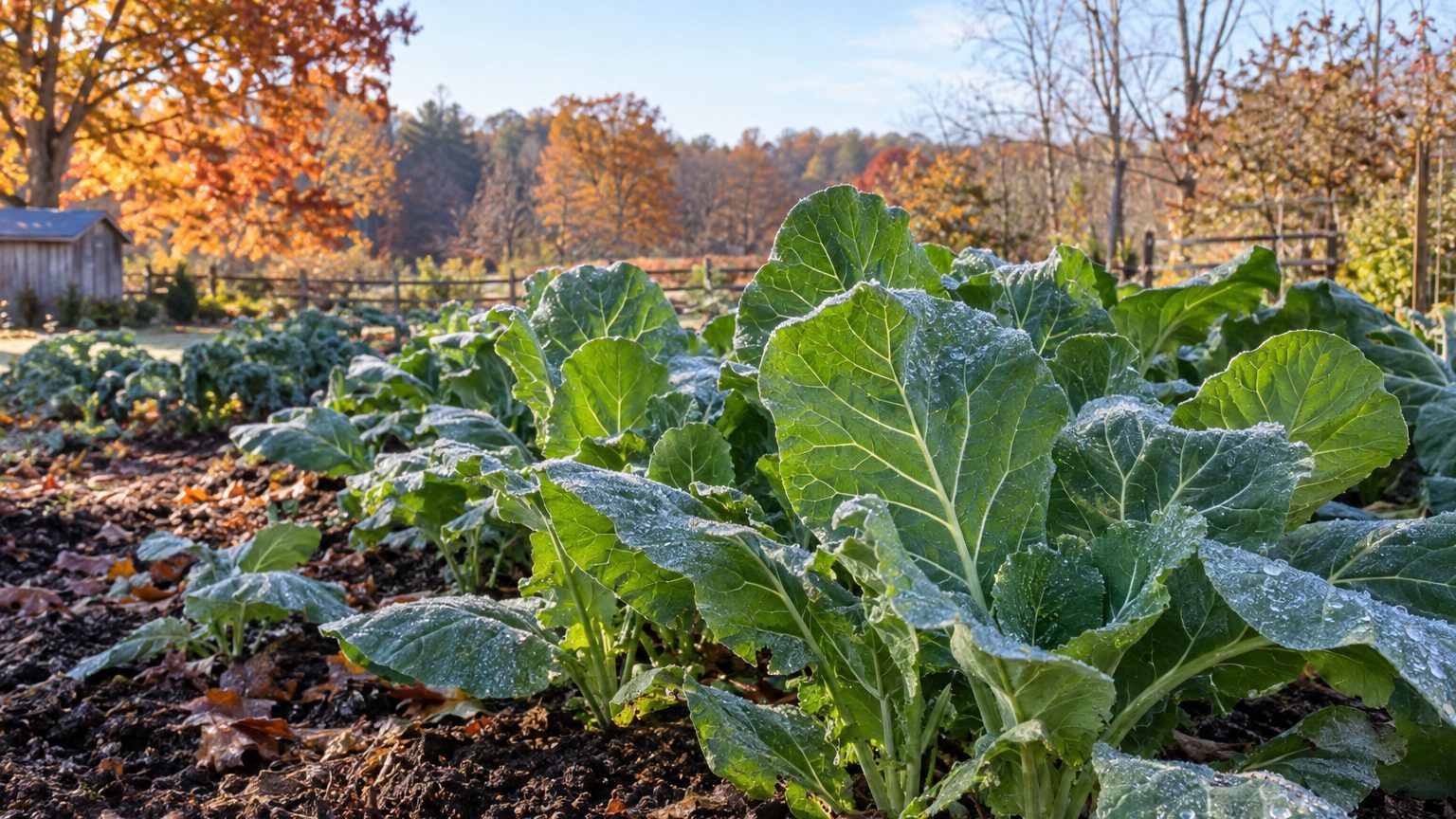

Collards shrug off light frost better than most garden crops, so the Quebec calendar hangs on two dates, not one: the last spring frost and the first fall frost. Around Montreal, those averages fall on May 6 and October 5. Both are midpoints, never guarantees. Time the sowing backward and forward from them, and a spring crop and a fall crop both fit in one season.
The short answer for Quebec
Start collard seeds indoors in mid to late March, transplant seedlings outdoors from late April to mid-May, then sow a second batch from mid-June to early July for a fall harvest. These windows are built on Environment and Climate Change Canada’s 1981-2010 normals for the Montreal/St-Hubert A station: a last spring frost on average May 6, and a first fall frost on average October 5.
Both dates are means. In one year out of two the last spring frost falls later than May 6, and in one year out of two the first fall frost arrives earlier than October 5. Treat each as the middle of a window, not a safe date. Between the two averages lie roughly 150 days, which is enough for a spring crop and a fall crop but leaves little room for slow starts.
Spring sowing
Collards are hardy enough to go out before the last frost, since established seedlings tolerate light frost. Seedlings sown indoors will be ready to harden off when they have several true leaves. Direct sowing, about ½ inch deep, belongs in early to mid-May, once the soil is workable and no longer cold to the hand. For the full growing picture, see Growing Collards in Quebec.
Sowing for fall
The fall crop is where collards earn their keep. Leaves sweeten after a few light frosts, and a plant sown in June or early July has the whole summer to size up before the October 5 average. Count back from that date and leave enough time for the plants to grow. Harvest then continues until a hard freeze finishes the plants.
| Task | Window | Anchored to |
|---|---|---|
| Seeds indoors, spring crop | Mid to late March | About six weeks before transplanting |
| Transplant hardened seedlings | Late April to mid-May | May 6 average last frost |
| Seeds direct in the garden | Early to mid-May | Soil workable, no longer cold |
| Seeds or transplants, fall crop | Mid-June to early July | Counted back from October 5 average first frost |
What will not work here
Overwintering is the first casualty. The mean daily minimum of the coldest month is -14.1 °C (6.7 °F), and that is an average night, not a record low. Collards left in open ground do not carry through that, so the plant is an annual here, whatever a southern gardening book says about picking all winter.
Sowing seed outdoors in April fails for a different reason. Soil is still cold, germination is slow and patchy, and seedlings sit exposed through frosts that arrive after May 6 in half of all years. A seedling stalled in cold ground often ends up behind one sown three weeks later in warm soil.
Treating May 6 as a safe transplant date is the third trap. Established collards handle a light frost, but young seedlings that have not been hardened off can be damaged by a hard one. Keep a sheet of floating row cover handy through mid-May, especially for beds in low spots where cold air settles.
Late sowing runs into the short season. A fall crop sown in late July may not have time before the average first frost, and in half of years that frost comes sooner. The plants end up small, with few leaves worth cutting. The slowest-maturing collards suffer most, which is why the choice of type matters as much as the date. The Best Collards and Greens for Quebec covers which ones finish in time.
Crowding is a quieter failure. Collards sown thick for a spring crop and left unthinned grow into a dense canopy, and after a wet July, leaves that stay damp invite leaf disease. Spacing plants apart keeps air moving. Summer also brings imported cabbageworm and cabbage loopers to the brassica family, so the June-sown fall crop deserves row cover from day one, not after the leaves look like lace.
What changes across Quebec
Quebec is not one garden. The reference city here, Montreal, sits in Canadian hardiness zone 5b according to Natural Resources Canada’s 1991-2020 normals. That is the Canadian system, built on seven climate variables, and it does not convert to a USDA zone. Natural Resources Canada itself says there are no simple conversions between the two systems.
That 5b describes a single city, not the province. Quebec spans several zones, from the mild lowlands along the St. Lawrence to cold northern and upland districts, so there is no single answer for the province. The frost averages above come from one station near Montreal, and districts to the north and at altitude run weeks behind it: later last frosts in spring, earlier first frosts in fall.
A reader in the north or on higher ground should shift in three ways. Start seedlings indoors and skip direct sowing, since the soil warms late. Put the weight on the spring-started crop, and sow the fall batch earlier, in early to mid-June, so plants are large before frost. Choose faster-maturing types and keep row cover on hand at both ends of the season. A garden on a south-facing slope near a large body of water may do better than the averages suggest, and a frost pocket in a valley may do worse.
Your own zone is on the Natural Resources Canada plant hardiness map, searchable by municipality. Look it up there rather than assuming it from a neighbor’s garden.
Where to check this for your own county
Quebec has no county extension system in the American sense, but the province’s agriculture ministry, MAPAQ, is the starting point. Look for regional offices and vegetable-growing advice for your area, then ask two things: what the local planting calendar says for cabbage-family crops, and which brassica varieties have been grown successfully near you.
The regional calendar for brassicas matters because collards follow the same rhythm as kale and cabbage. A local planting calendar for those crops will carry local frost dates, which is precisely what the Montreal averages above cannot do for a garden two hours north.
A recommendation from your own region beats a provincial one every time. The dates here are a provincial-level starting point, taken from a single station. Your municipal or regional office, or the local garden society if there is one, can tell you how many weeks to add or subtract. If someone nearby has grown collards or kale for years, ask when they transplant and how late they harvest.
Checking this against your own garden
Your own observations outrank every date above. Three are worth tracking, and none needs equipment.
- Soil warmth by feel. Push a hand into the bed. If it feels cold and sticky and clumps into a wet ball, wait. Beds that warm and crumble first are well drained or sun-facing, and they can take transplants a week or two ahead of a shaded or clay bed.
- First true leaves. On indoor seedlings, the first true leaves, the ones after the rounded seed leaves, signal that roots are established and hardening off can begin. If they appear late, the spot is too dim or too cool, and the transplant date slips with it.
- Frost on the lawn and in low spots. Note the date of the last white morning in spring and the first in fall, and compare spots across the yard. Low corners that frost late in spring and early in fall tell you where not to put the fall crop.
Write the dates down for two or three seasons. A garden’s own frost record usually settles the question faster than any average, and collards are forgiving enough to reward the adjustment.
The Moon calendar is a separate, older custom: see when to plant collard greens by the moon, written as tradition rather than fact.
Common questions
Can collards be sown directly in the garden in Quebec?
Yes, from early to mid-May once the soil is workable, and again from mid-June to early July for fall. Indoor starts give spring plants a head start, but direct sowing works well in warm soil.
Will collards survive a Quebec winter?
No. The mean daily minimum of the coldest month is -14.1 °C (6.7 °F), and plants in open ground do not survive that. Treat collards as an annual and harvest until a hard freeze.
How late can I plant collards for a fall crop?
Sow early enough that the crop matures before the first fall frost, which averages October 5. Later sowings leave too little growth before frost, and in half of years frost comes earlier than the average.
Is May 6 a safe date to transplant?
It is the average last spring frost, so in one year out of two frost comes later. Hardened-off collard seedlings tolerate light frost, but keep row cover ready through mid-May.