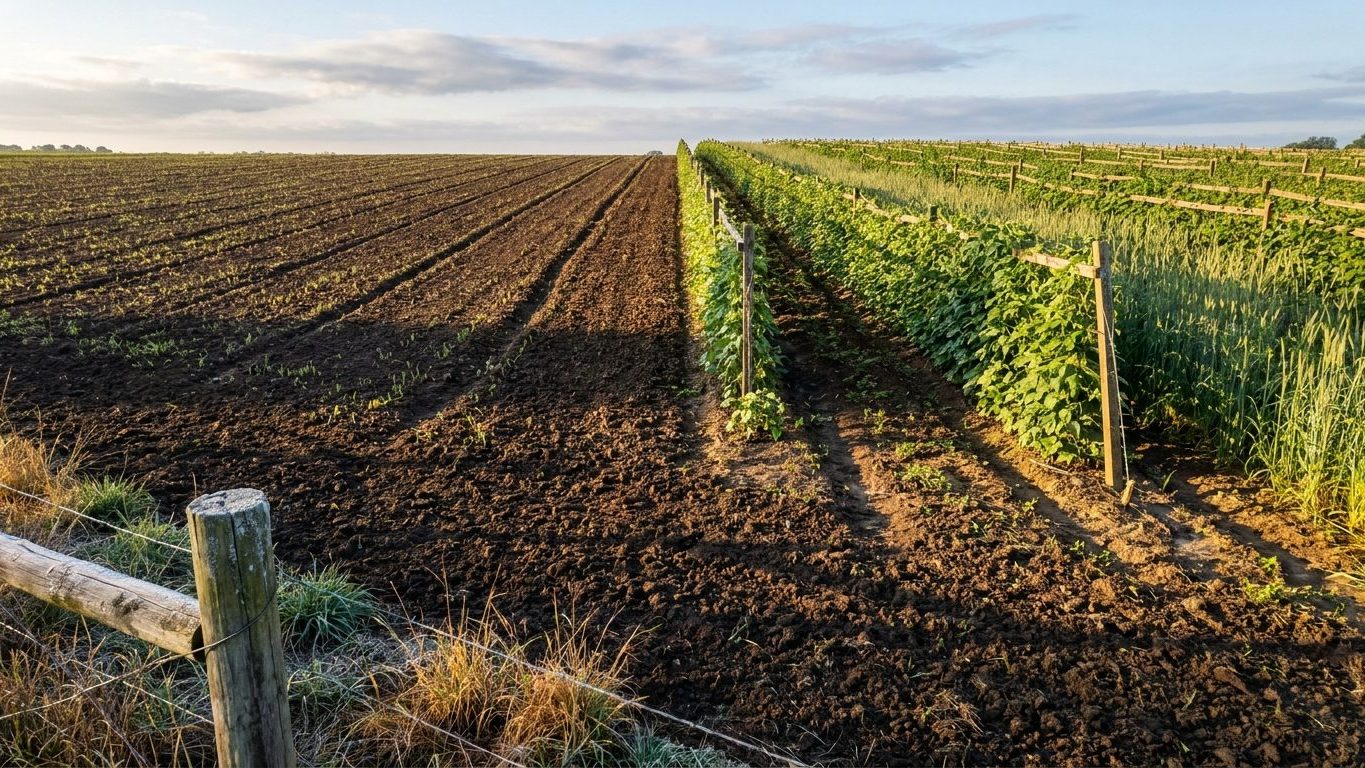

New Jersey gardeners get two sowing windows for cover crops: mid-August through early October for cool-season species like cereal rye, oats, or crimson clover, and late spring through midsummer for warm-season options like buckwheat or sorghum-sudangrass. The exact edges of both windows shift with your local frost dates, not a fixed date on a calendar.
The short answer for New Jersey
For a fall-sown cover crop in New Jersey, the target is to get seed in the ground roughly six to eight weeks before the first fall frost. At the Newark reference station, that first fall frost falls in a window of November 4 to November 16. That range is not a fixed date. It’s the 30-70% probability band for a 32F freeze, pulled from NOAA’s 1991-2020 Climate Normals. In plain terms: by November 4, there’s roughly a 30% chance of having already hit that freeze, and by November 16, the odds climb to 70%. Counting backward from the early end of that window puts the safe sowing deadline for slower species like crimson clover around mid-September, while a fast grower like cereal rye can go in as late as early October and still get enough root and shoot growth before hard cold shuts things down.
On the spring side, the same logic runs the other way. New Jersey’s last spring frost, again at the Newark station, sits in a window of March 29 to April 6. That’s the same style of probability band: a 30% chance of a freeze having already happened by March 29, rising to 70% by April 6. Warm-season covers like buckwheat or sudangrass need soil that’s not just frost-free but genuinely warm, so most growers wait one to two weeks past that last-frost window before sowing, giving the soil time to catch up to the air.
Winter survival for anything left standing over the cold months comes down to a different number: the average daily minimum temperature during the coldest month, which sits at 25.5F at the Newark reference point. That’s not the record low and not a monthly average, it’s specifically the coldest month’s typical overnight floor. A cover crop rated hardy to that range, cereal rye and hairy vetch both qualify, will winter over reliably. One rated for milder winters will thin out or die back hard, which matters if your plan depends on that stand holding ground cover through February.
What will not work here
The biggest mismatch in New Jersey isn’t a short season, it’s timing against humidity and a genuinely cold winter floor. Start with anything sown too late in fall. If cereal rye or oats go into the ground after early October, they’re racing a first fall frost that can arrive as soon as November 4. A seedling with three inches of top growth and a thin root system going into a 25.5F average overnight low in January has a real chance of winterkill, especially with oats, which are far less cold-hardy than rye and often die back completely once temperatures drop into the teens.
On the other end, sowing warm-season covers too early is just as common a mistake. Buckwheat and sorghum-sudangrass both stall or rot in cold, wet soil. Jumping the gun and planting in late March, right at the tail of that last-frost window, usually means replanting in May once the first attempt has failed to germinate evenly.
New Jersey’s humid summers create a separate problem that has nothing to do with frost dates. Cover crops sown at tight spacing, thinking more seed means more coverage, tend to mat down and develop fungal issues in a summer where humidity sits high for weeks at a stretch. Buckwheat in particular is prone to this if oversown; it grows fast enough to shade itself into a damp, still microclimate that invites powdery mildew. Wider row spacing and moderate seeding rates outperform a dense stand here, even though the dense stand looks better for the first three weeks.
Finally, anything advertised as hardy only to zone 8 or warmer is a gamble across most of the state. With a coldest-month average minimum of 25.5F and a hardiness range that runs from 6a to 7b, a plant that needs winters no colder than zone 8 (which typically holds lows no colder than the teens on the coldest nights, not the mid-20s on an average night) is planted on borrowed time. It might survive a mild winter and then get wiped out the next one.
What changes across New Jersey
New Jersey is not one climate wearing a single hat. The USDA Plant Hardiness Zone Map, built on the 1991-2020 average annual extreme minimum temperature, places the state across a spread of 6a to 7b. That’s a meaningful range, not a rounding error. Zone 6a can see extreme minimums down near -10F in a hard winter, while zone 7b rarely drops below 5F. A cover crop that shrugs off winter in the warmer coastal or southern pockets of the state may struggle in the colder inland and northern stretches.
The practical shift for a reader in the northern part of the state, or anywhere at higher elevation in the northwest highlands, is to sow earlier and choose the hardier end of the cover crop lineup. That means leaning toward cereal rye and hairy vetch over crimson clover or oats, and treating the mid-September deadline as a hard one rather than a suggestion. Frost tends to arrive earlier and settle deeper in these areas than at the Newark reference station, which sits close to sea level and benefits from some coastal moderation.
A reader in the southern or coastal parts of the state, sitting closer to the warmer end of that 6a-7b spread, generally has a slightly longer fall window and a milder winter floor, which opens up options like crimson clover with a better survival chance. But this page can’t tell you which zone applies to your own address. The spread is too wide, and elevation, tree cover, and distance from the coast all nudge the number in one direction or the other, sometimes over a distance of just a few miles.
The one useful universal is: check the map for your own ZIP code before locking in a species list, rather than assuming the state average applies to your yard.
Where to check this for your own county
This page gives you the state-level picture, built from one reference weather station. Your own county can, and often does, run a week or two earlier or later on both frost dates, and your local extension office has trial data this page simply doesn’t have. For New Jersey, that office is the Rutgers New Jersey Agricultural Experiment Station.
Once there, look specifically for two things. First, a county-level or regional planting calendar, since Rutgers extension agents adjust sowing windows based on local frost records rather than the single Newark station used here. Second, look for variety trial results, which show you which specific cultivars of rye, clover, vetch, or buckwheat have actually performed well in county-level field trials, rather than just what’s rated hardy on a seed packet.
A county recommendation beats a state one every time, because it’s built on denser, more local data. This page draws on one weather station’s 30-year averages to describe an entire state; a county extension calendar draws on multiple stations and, often, direct field observation from agents working with growers in that specific area. If the county calendar and this page disagree on a date by a week or so, trust the county calendar. That’s not this page being wrong, it’s this page doing what a state-level resource can do, and a county resource doing what it can do better.
Extension offices also tend to post cover crop specific guidance separately from general vegetable planting calendars, so search their site for “cover crop” directly rather than assuming it’s bundled with tomato and pepper dates.
Checking this against your own garden
Every date on this page is an average built from thirty years of weather records at one airport station. Your yard is not that station, and the surest confirmation of timing is what’s actually happening in your own soil and around your own plants, not the calendar on the wall.
Start with soil warmth by feel. Push a finger a couple of inches into bare soil in the bed you plan to sow. If it feels cool and slightly damp but not cold to the touch, similar to a basement floor rather than a refrigerator shelf, that’s a rough sign the soil has warmed enough for warm-season covers like buckwheat to germinate reliably. Soil that still feels genuinely cold means waiting another week, regardless of what the calendar says.
Second, watch nearby weeds and volunteer plants for their first flush of flowers. When common lawn weeds like dandelion or henbit start blooming heavily in your own yard, that’s a signal the soil and air have both crossed a warmth threshold your microclimate needed, and it often lines up better with your actual sowing window than a regional frost date does.
Third, once your cover crop is up, watch for the first true leaves, the second set that follows the small rounded seed leaves. Their appearance tells you the seedling has moved past the fragile germination stage and into active growth, which is the point where a light frost becomes far less threatening. A stand that’s still sitting at the seed-leaf stage when frost risk climbs is more vulnerable than one that’s already pushed out true leaves, and that difference in your own bed matters more than any date printed on a chart.