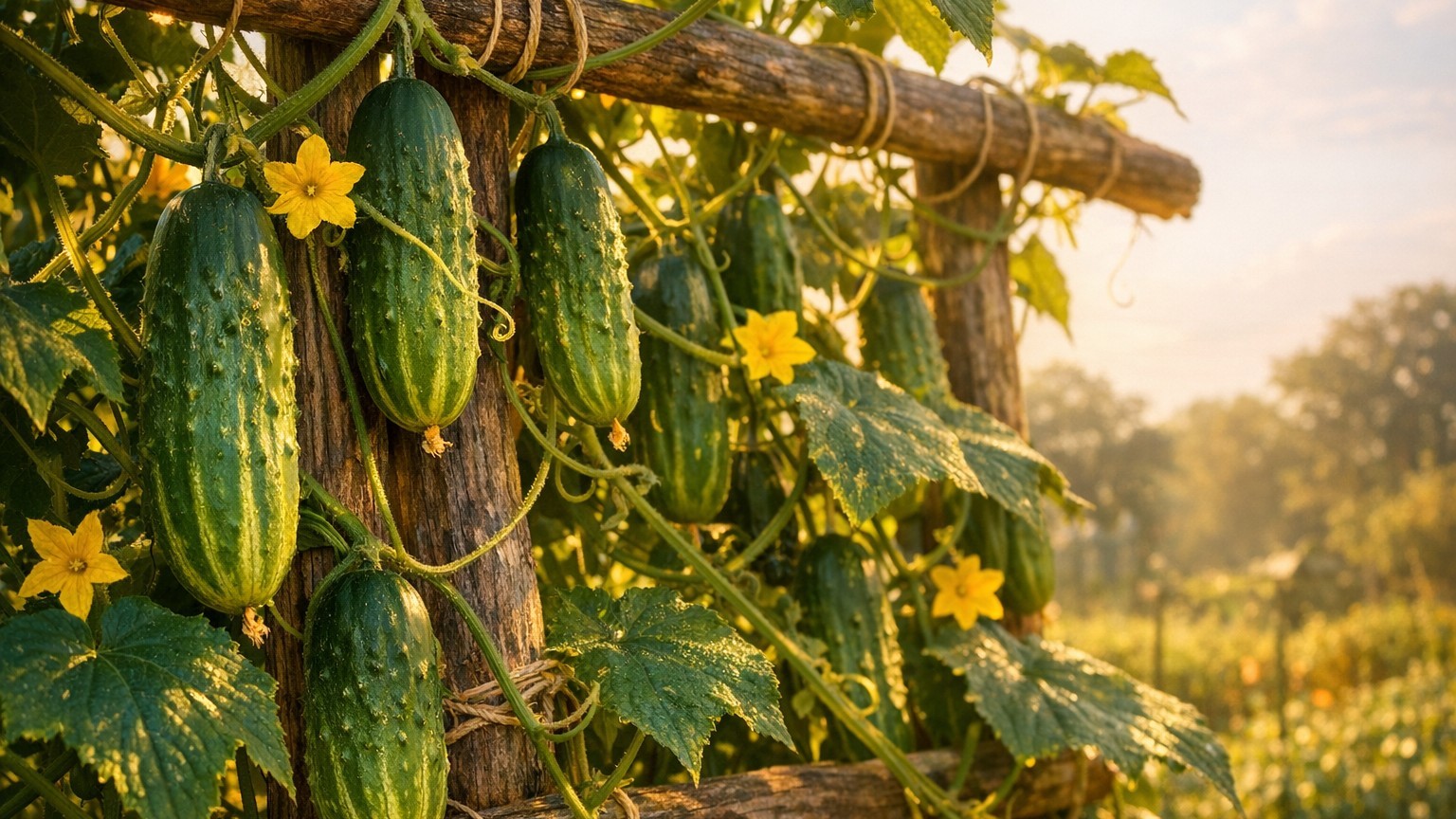

Almost any cucumber type can mature in New Jersey’s roughly seven-month frost-free window, so the choice isn’t really about days-to-harvest. It’s about matching the type to the state’s humid summers: parthenocarpic or burpless slicers and disease-resistant pickling types, trellised rather than left on the ground, handle the season’s mix of heat and moisture best. Check your county extension office for the specific cultivars trialled near you.
The short answer for New Jersey
Start with the calendar. The reference station used for these normals shows a last spring frost landing somewhere between March 29 and April 6, and a first fall frost between November 4 and November 16. That’s a frost-free stretch of roughly seven months, give or take, at that one airport station, longer in the southern coastal counties, shorter and later-arriving in the northwest hills. Compared to a short-season northern state, that’s a wide-open runway. Almost no cucumber type, from a fast pickling variety to a long vining slicer, will run out of season here. Days-to-maturity isn’t the limiting factor in New Jersey. What is: humidity, heat spikes, and how much watering a gardener is actually willing to do in August.
The heat load matters too. The reference station averages 20.8 days a year at or above 90F. That’s meaningful but not extreme, nowhere near the summer of a Gulf Coast state, but enough that cucumbers planted without mulch or consistent water will stall, turn bitter, or drop blossoms during the hottest stretches of July and August.
Given that, here’s how to think about type rather than variety name:
- Slicing cucumbers, trellised: the long frost-free window supports vigorous vining slicers without any risk of running out of season, and a trellis keeps fruit off wet soil.
- Pickling cucumbers, bush or vining: because the season is long, a first planting can be followed by a second sowing in early summer for a fall pickling batch.
- Parthenocarpic or burpless types: these set fruit without needing pollinator visits, which is useful under row cover early in the season and tends to pair with better resistance to the mildews that thrive in humid air.
- Bush types: the practical choice for raised beds, containers, or any garden where trellis space is tight.
None of this replaces a look at your county’s own variety trials. The Rutgers New Jersey Agricultural Experiment Station tests cucumbers under local conditions every year, and that list beats any generic type recommendation.
What will not work here

Season length isn’t what trips people up in New Jersey. Disease pressure is. Summer rainfall at the reference station averages about 13.2 inches across June, July, and August, with August, the hottest stretch, still delivering 4.15 inches. That’s not a drought pattern. It’s a humid one, and humidity plus warm nights is exactly the combination that fuels powdery mildew and downy mildew on cucumber leaves. Vines sprawled directly on the ground, with leaves touching damp soil after every storm, are the ones that collapse by mid-August. Trellising isn’t a cosmetic choice here; it’s the difference between a productive vine and one that defoliates before it finishes fruiting.
Tight spacing compounds the problem. Cucumbers planted close together on the ground trap moisture between leaves and slow airflow, which is precisely what a fungal spore needs to spread from one plant to the next. In a drier western state this might not matter much. In New Jersey’s rainfall and heat combination, it does.
The other failure mode is inconsistent watering during heat spikes. With 20.8 days a year reaching 90F or higher, and August being the driest summer month even as it’s also one of the hottest, cucumbers that get watered only when it rains will show it: bitter fruit, blossom drop, or fruit that stays stunted and misshapen. Shallow, frequent watering doesn’t fix this either. Cucumber roots want a deep, even moisture supply, and a single weekly soak that only wets the top inch of soil leaves the plant stressed by Thursday.
Direct-seeding too early is a smaller but real mistake. The reference station’s last spring frost can land as late as April 6, and inland or elevated gardens away from that station typically see their own last frost later still, sometimes by a week or two. Cucumber seed sown into cold soil either rots or germinates so slowly that transplants set out three weeks later actually catch up and pass it. There’s no advantage to rushing the sowing date here the way there might be in a state with a genuinely short season.
What changes across New Jersey
New Jersey isn’t one climate. The USDA Plant Hardiness Zone Map, built on average annual extreme minimum temperature, places the state across a 6a to 7b range. That’s a real spread, not a rounding error, and it means there’s no single frost date or season length that applies to the whole state.
In practical terms, the northwest counties, up toward the higher ground of the Skylands region, sit at the colder end of that range. Extreme minimum winter temperatures run lower there, which usually pairs with a later last spring frost and an earlier first fall frost than the reference station used for these normals. A gardener in that part of the state should expect to push cucumber planting a bit later in spring and wrap up harvest a bit earlier in fall than the airport-station dates suggest.
The southern coastal plain counties sit at the warmer end, closer to zone 7b, with milder winter extremes and typically a longer effective frost-free window. That’s where a second, later planting for a fall pickling crop has the best odds of finishing before frost.
None of this tells any individual reader which zone applies to their own yard; elevation, distance from the coast, and even how a property sits relative to a valley or a ridge all shift the number. The only reliable way to know is to look up your own address on the USDA Plant Hardiness Zone Map rather than assume a county-wide average applies to a specific lot.
Where to check this for your own county
Everything above is a state-level picture, built from one reference station’s normals and a state-wide hardiness zone range. New Jersey has 21 counties spread across two hardiness zones and several distinct microclimates, from the Pine Barrens to the Delaware River valley to the Shore. A state-level answer is a starting point, not a substitute for local data.
Rutgers Cooperative Extension, through the Rutgers New Jersey Agricultural Experiment Station, is the source built for that next step. Their site is njaes.rutgers.edu, and it’s organized by county office, each with its own local planting guidance and variety recommendations drawn from trials run under New Jersey conditions rather than a national average.
Two things are worth pulling from that site before planting. First, the local planting calendar for vegetables, which will reflect the frost pattern of your actual county rather than a single reference station. Second, the list of cucumber varieties that Rutgers or your local county office has actually trialled, since that list accounts for the specific mildew pressure, soil types, and heat pattern of your area in a way no state-wide article can.
A county recommendation beats a state one every time. A certain type of cucumber tends to do well in New Jersey generally; your county extension office can name the actual varieties that performed best in trials near you, which is a different and more useful piece of information.
Checking this against your own garden
Every date and average describes a reference station and a statewide range. Your own garden will tell you something more specific, and it outranks all of it.
Start with soil warmth, checked by hand. Cucumber seed wants soil that feels warm and dry when you push a finger a couple of inches down, not cool and damp even on a sunny afternoon. If the soil still feels cold in early May despite a warm week, that’s a sign your particular plot, maybe shaded, maybe low-lying, is running behind the general pattern for your area, and seed sown now will sit and rot rather than sprout.
Watch for the first flush of male flowers. Cucumbers produce male blossoms before female ones, and a strong early flush without any fruit-set is normal, not a problem. It’s the plant’s own signal that it’s shifting into reproductive growth, and it usually shows up a couple of weeks before the first fruit appears.
Finally, track how quickly true leaves develop after the first seed leaves. Slow, stalled growth in the first couple of weeks, even with adequate water, often points to soil that’s still too cool at root depth, one more confirmation that your microclimate is running behind the general pattern described here, and that patience now saves a replant later.