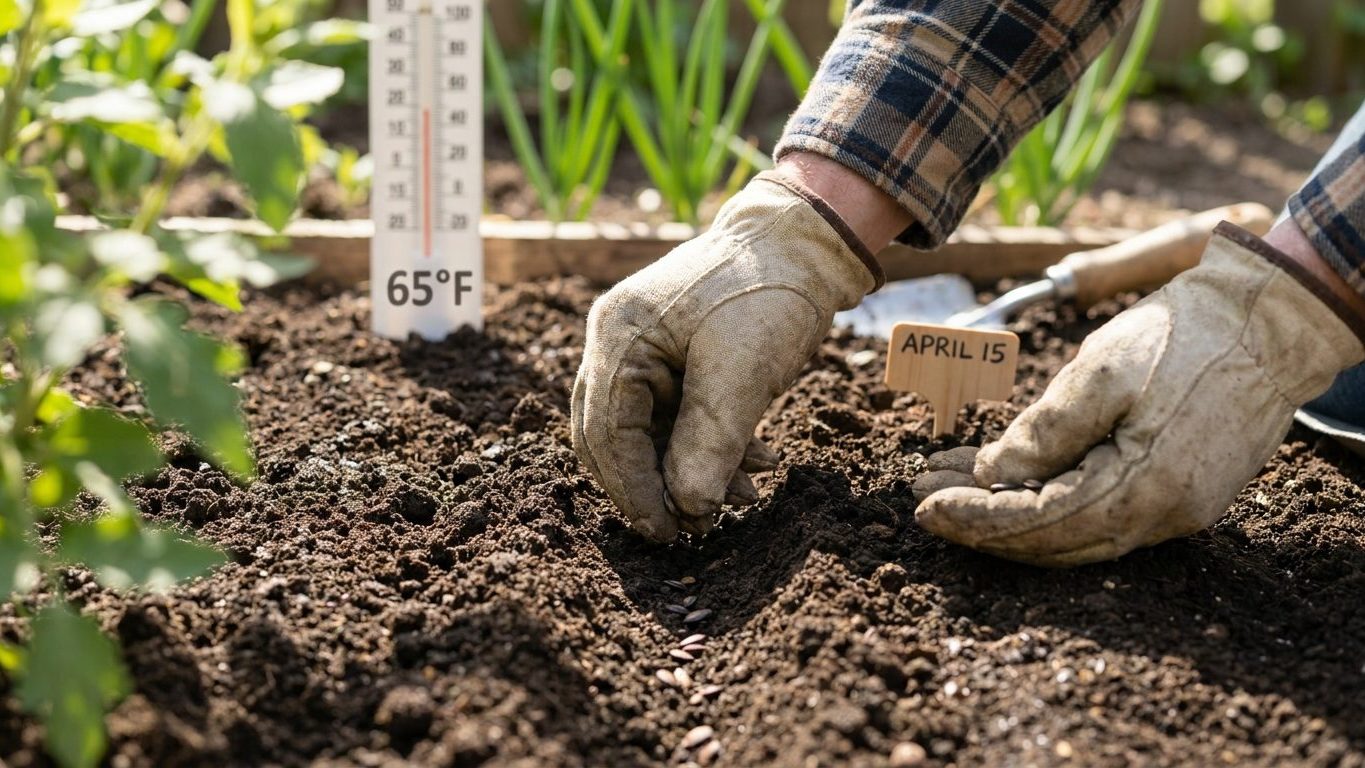

Melons go into New Jersey gardens once the soil has held steady warmth for a week or two past the last spring frost, which lands between March 29 and April 6 at the Newark reference station. That’s a probability window, not a guarantee: outdoor planting for most home gardens realistically opens in the last half of April and runs into May.
The short answer for New Jersey
The last spring freeze at the Newark reference station has a 30-70% chance of falling between March 29 and April 6, according to NOAA’s 1991-2020 Climate Normals. That’s the probability band for a 32F freeze, not a promise the cold stops there. On the other end of the season, the first fall freeze at the same station carries the same 30-70% probability between November 4 and November 16.
Melons are frost-tender from seed to fruit, so the frost dates only tell you what to avoid, not when the soil is actually ready. Seed sown into cold, wet ground rots before it sprouts, and transplants set out too early just sit there, stunted, waiting for warmth that hasn’t arrived. Because of that gap between “frost has passed” and “soil is actually warm,” most New Jersey gardeners aim for a window that starts two to three weeks after that early-April frost date and stretches through May, giving the ground time to bank heat.
Do the math on the growing season this creates. Counting from the earliest plausible last frost (March 29) to the latest plausible first fall frost (November 16) gives a theoretical stretch of about 232 days. Even using the more conservative pairing (April 6 to November 4), that’s still roughly 212 days of frost-free growing. Either way, New Jersey’s season is long enough that melon variety choice isn’t dictated by a race against the calendar the way it would be in a shorter-season state. The bigger constraints here come from heat and moisture, which the next section gets into.
One more piece worth flagging before moving on: these dates come from a single airport weather station, not from your backyard. Suburban and rural gardens across the state typically see their own last spring frost arrive later and their first fall frost arrive earlier than the reference station shows, sometimes by one to two weeks, more if you’re at elevation. Treat the March 29 to April 6 window as a starting point for conversation with your own soil, not a hard rule to plant by.
What will not work here

Two numbers from New Jersey’s climate record explain most melon failures here, and neither of them is “the season is too short.”
The first is heat load. The reference station averages 20.8 days a year at or above 90F. That’s real, sustained summer stress, concentrated in July and August, and it drives water demand hard. A melon patch watered on a fixed weekly schedule, regardless of what the soil actually needs, is a common way to lose a crop here. During a stretch of 90-degree days, a once-a-week soak can leave roots gasping by day five, especially in sandy soil that drains fast. The fix isn’t a stricter schedule, it’s checking the soil itself before deciding whether to water.
The second number is summer rainfall, and it’s deceptively generous on paper. New Jersey’s reference station logs about 13.2 inches of rain across June, July and August, split roughly 4.34 inches in June, 4.66 in July, and 4.15 in August, the driest of the three. That sounds like plenty of water for a melon vine. The problem is how it arrives. Summer rain in this region tends to come as thunderstorms, not steady drizzle, so a lot of it runs off the surface rather than soaking down to the root zone, particularly on clay soil that seals over in a downpour. That same rainfall pattern, combined with humid air, is exactly what fuels powdery mildew and other foliar disease on melon leaves.
This is where spacing becomes a real failure point rather than a nice-to-have. Melons planted close together, the way a catalog photo might suggest, trap humidity in their canopy. Combine tight spacing with a wet August thunderstorm and a run of 90-degree afternoons, and disease pressure builds fast on leaves that never fully dry out between rain events. Wider spacing than the seed packet’s minimum, and airflow through the row, matters more in New Jersey’s humid summers than it would in a drier climate where the same spacing might be fine.
What changes across New Jersey
New Jersey isn’t one climate. The USDA Plant Hardiness Zone Map places the state across a 6a to 7b range, and that spread, built on the average annual extreme minimum winter temperature, tells you the difference between the coldest and mildest corners of the state is substantial, not a rounding error.
A 6a to 7b range covers roughly three full zone steps. In practical terms for melon growing, that means a gardener in the coldest pocket of the state is working with a meaningfully shorter and cooler season than one near the milder end, even though both are technically in “New Jersey.” The dates and figures in this article come from a single reference station and don’t split out that difference, because a state-level page can’t respond to a single garden’s zone. What it can do is tell you the range exists and is wide enough to matter.
The practical shift for a reader gardening toward the colder end of that 6a-7b range is straightforward: push planting later than the general window, and expect the first fall frost to arrive on the earlier side of any range you find. For a reader closer to the milder end, the opposite adjustment applies, with more room on both ends of the season. Neither adjustment can be made accurately from a state-wide article. The state’s spread is wide, but it can’t tell you which zone your own plot falls into.
Find that out on the official USDA Plant Hardiness Zone Map, using your ZIP code, rather than guessing from a regional description. Elevation, distance from the coast, and even a north-facing slope versus a south-facing one can shift which side of that 6a-7b range a particular garden actually sits on.
Where to check this for your own county
New Jersey spans a wide range of growing conditions. It doesn’t and can’t describe your county, and that gap is worth taking seriously before you finalize a planting date.
Rutgers Cooperative Extension, part of Rutgers New Jersey Agricultural Experiment Station, is the state’s land-grant extension service, reachable at njaes.rutgers.edu. Extension services exist specifically to translate state-level climate normals into recommendations tied to actual county trial data, local frost records, and soil surveys, work that a state-wide article can’t replicate at this level of detail.
Once there, look for two specific things. First, a county or regional planting calendar for vegetables, which will reflect frost patterns actually observed near you rather than at the single Newark reference station used throughout this article. Second, look for melon variety trial results or recommendations specific to New Jersey growing conditions; extension programs regularly test which cultivars hold up to the state’s humidity and disease pressure, information that goes well beyond what a general planting-window article can offer.
A county-level recommendation from your local extension office will outrank any statewide average, every time. This article works from statewide climate normals and a single reference station’s frost probabilities; a county extension agent works from local trial plots, local soil surveys, and years of grower reports specific to your area. That’s not a small difference.
Checking this against your own garden
Start with the soil itself. Push a finger a few inches into the planting bed. If it feels cold and damp rather than merely cool, the ground hasn’t banked enough heat yet, regardless of what the calendar says the frost-free date should be. Melon roots stall in cold soil even when the air feels warm enough, so this simple check catches a mismatch the frost dates can’t.
Next, watch for the first male flowers on any melon vines already growing nearby, whether yours or a neighbor’s. Male flowers typically appear before the female flowers that actually set fruit, and their timing is a real-time signal of how much heat has accumulated in your specific spot this season, something no regional average can tell you directly.
Finally, watch how fast true leaves develop on young plants, as opposed to the initial seed leaves. Slow, stalled true-leaf growth after transplanting usually points to soil that’s still too cool or nights that are still dipping lower than the plant likes, even if the calendar says frost season has passed. Quick, vigorous true-leaf growth is a good sign the local conditions have caught up to the calendar. Taken together, these three observations tell you more about your own patch of ground than any date range built from an airport weather station ever will.
Some gardeners also time melons by the Moon: when to plant watermelon and cantaloupe by the moon, as almanac tradition rather than fact.