
New Jersey gardeners can expect a workable pepper season if they respect two limits at once: the state’s heat load and the plant’s own tolerance for cold nights. With 20.8 days a year hitting 90 F or higher at the Newark reference station, fruit set gets stressed on the hottest stretches but not shut down for the whole summer. The bigger variable is what happens after dark, and that part depends on the garden, not the state average.
The short answer

Start with the number that actually drives the answer: 20.8 days a year at or above 90 F, measured at Newark over the 1991-2020 normals period. That’s the benchmark for summer heat load in this part of the state, the thing that pushes water demand up and makes cool-season crops sulk. For peppers, it also matters directly. Fruit set fails when daytime highs climb above 90 F, because the flowers abort or fail to pollinate properly under that kind of heat stress. Twenty and a half days isn’t a heat wave that lasts all August. It’s scattered stretches, usually clustered in July, when a grower might notice blossoms dropping for a few days and then resuming once temperatures ease back down.
That’s one end of the failure window. The other end matters just as much, and it’s the one growers tend to forget about because they’re watching the thermometer for heat, not cold. Pepper fruit set also fails when nighttime temperatures drop below 55 F. A plant can look perfectly healthy, be loaded with flowers, and still drop them if the nights turn cool, which happens in New Jersey in early spring right after transplant and again in early fall as the season winds down.
Here’s the limit of what this article can tell you: this site tracks daytime heat, specifically the count of 90-degree-plus days, but it does not carry summer night minimum temperatures for New Jersey locations. That’s not a small gap. A garden in a low-lying valley or near a river can run several degrees cooler at night than a station reading a few miles away, and that difference is exactly what determines whether pepper flowers hold or drop in a given week. Don’t guess at this from latitude, and don’t assume a spot is warm at night just because it’s warm during the day. Watch your own thermometer, ideally one placed in the garden itself, not on a porch or near pavement that holds heat. If you see a run of nights dipping under 55 F in June or September, expect flower drop and don’t panic about disease or nutrient problems that aren’t actually there.
Put together, the practical picture is this: New Jersey’s daytime heat is moderate enough that most pepper varieties ripen fruit in a normal year, but the real swing factor is cold nights at the shoulders of the season, and that variable has to be measured locally, not looked up.
When to start seed here
The timeline for pepper seed starting works backward from the transplant date, and the transplant date itself depends on two things happening together: the last frost passing, and the soil warming to 60 F. Here’s how to build that calendar for your own county.
- Find your local last spring frost window. At the Newark reference station, the 32 F freeze probability falls between March 29 and April 6. That’s an airport-station figure, and suburban and rural gardens typically see their last frost later than this, sometimes by one to two weeks, more if the garden sits at higher elevation or in a low frost pocket. Add that buffer before you commit to a transplant date.
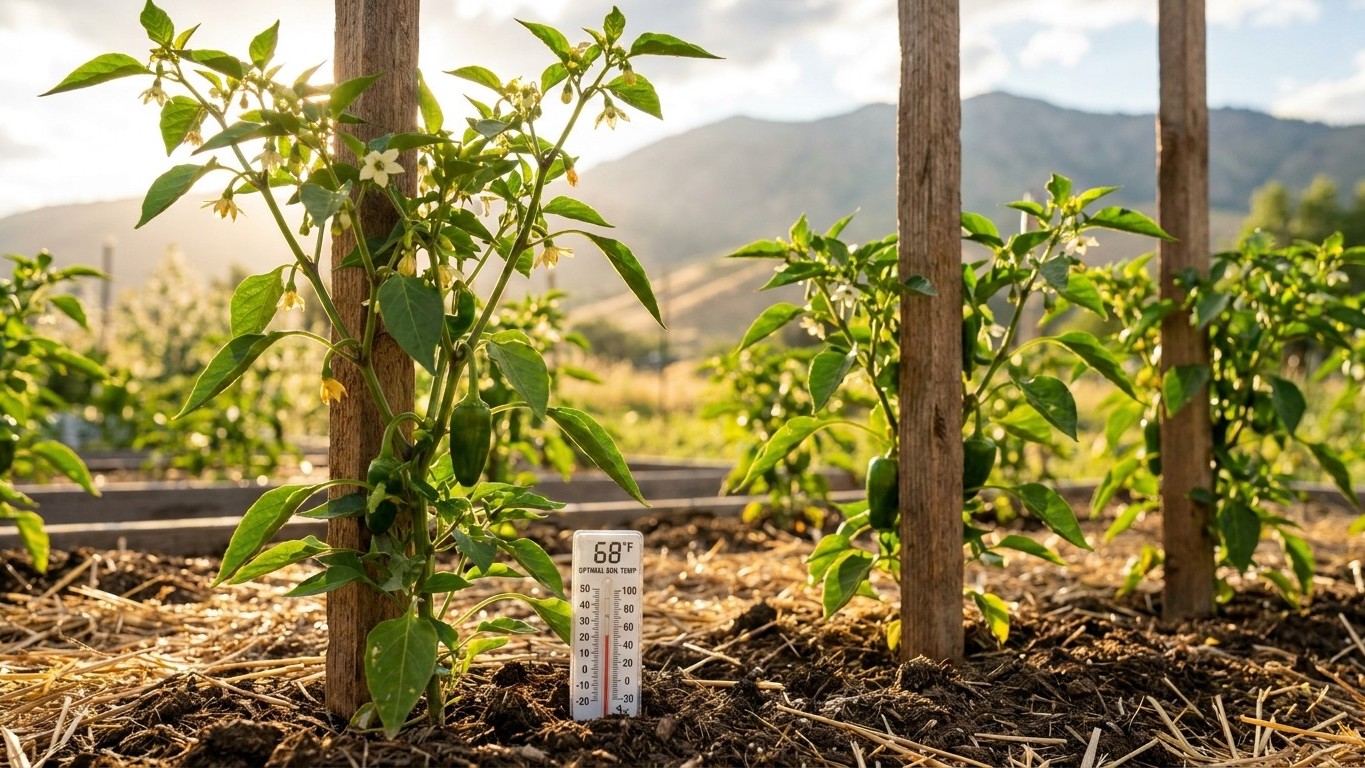
- Wait for 60 F soil, not just a frost-free calendar date. Air temperature can clear frost risk before the soil is actually warm enough for pepper roots to grow. Soil at 60 F usually trails the last frost date by one to three weeks depending on how sunny and well-drained the bed is. A raised bed with dark soil warms faster than a low, shaded corner of the yard. Check with a soil thermometer pushed a few inches down rather than guessing from the air temperature.
- Set your transplant date as the later of those two conditions. If your local last frost lands in mid-April and your soil doesn’t hit 60 F until the first week of May, May is your transplant date, not April. Peppers set out into cold soil sit and sulk for weeks even if they survive.
- Count back 8 to 10 weeks from that transplant date to find your seed-starting date. If transplant falls in the first week of May, seed starting indoors falls in the last week of February to the first week of March. That window gives the seedlings enough time to build a root system and a few true leaves without getting leggy from sitting indoors too long.
- Recheck the whole chain every year against your own conditions. Frost dates and soil warm-up shift year to year, and a grower who tracks their own last-frost date and soil temperature over a couple of seasons will get a far more accurate seed-starting date than one who relies on a fixed calendar day.
The arithmetic is simple once you have your two local numbers: transplant date minus 8 to 10 weeks equals seed-starting date. Everything else is local observation, not a fixed rule.
What goes wrong here
- Blossom drop from a hot spell. On days that push past 90 F, which happens on average 20.8 days a year at the Newark reference station, flowers can abort before they set fruit. The remedy is timing more than intervention: avoid heavy nitrogen feeding right before a forecast heat spell, since lush growth makes plants worse at handling stress, and provide afternoon shade cloth over the hottest stretch if the plants are otherwise healthy and just getting cooked by direct sun during peak hours.
- Blossom drop from a cool night. The flip side of heat stress is cold stress, and it happens when nighttime lows fall under 55 F, most likely right after an early transplant or as nights cool down heading into fall. Since summer night minimums aren’t tracked here, the fix starts with watching your own garden thermometer after dark. If a cool snap is forecast, row cover thrown over plants in the evening and removed in the morning can buy a few degrees of protection during the flowering stage.
- Sunscald on exposed fruit. Where sun exposure is strong and foliage is thin, ripening peppers can develop pale, papery patches on the side facing direct sun, especially after a plant loses leaves to disease or aggressive pruning. Keep foliage full through the season rather than stripping leaves for “better air circulation,” and if a plant’s canopy has already thinned out, drape a light shade cloth over exposed fruit clusters during the hottest part of the day.
- Blossom-end rot on developing fruit. This shows up as a sunken, leathery brown-black spot on the blossom end of the fruit, and it comes from inconsistent water delivery that disrupts calcium uptake, not usually a lack of calcium in the soil itself. Mulch beds to even out soil moisture between waterings, and water deeply and on a regular schedule rather than letting the soil swing between bone-dry and soaked, especially during the weeks when fruit is sizing up.
Common questions
Can I just go by the calendar date instead of checking my own soil and frost?
You can, but you’ll likely transplant too early. The Newark station’s last-frost window of March 29 to April 6 already comes with a caveat: rural and suburban gardens tend to see frost later than that, sometimes by one to two weeks. Add the soil-warming lag on top, and a fixed calendar date almost always undershoots the safe transplant window.
Does 20.8 days above 90 F mean I’ll lose flowers most of the summer?
No. That figure is spread across the whole season, often in short clusters rather than one long stretch. Expect occasional flower drop during the hottest few days in a typical July, not a summer-long shutdown of fruit set.
How do I know if my garden’s nights are staying above 55 F?
Place an outdoor thermometer directly in the garden bed, away from pavement or walls that hold heat, and check it after dark during the early weeks after transplant and again as fall approaches. This site doesn’t carry night minimum data for New Jersey, so this has to be a direct, local check rather than a lookup.
Is blossom-end rot a soil calcium problem I need to fix with additives?
Usually not. It’s most often a symptom of uneven watering that interrupts how the plant moves calcium into the fruit. Consistent watering and mulch to buffer soil moisture swings address most cases without needing a soil amendment.