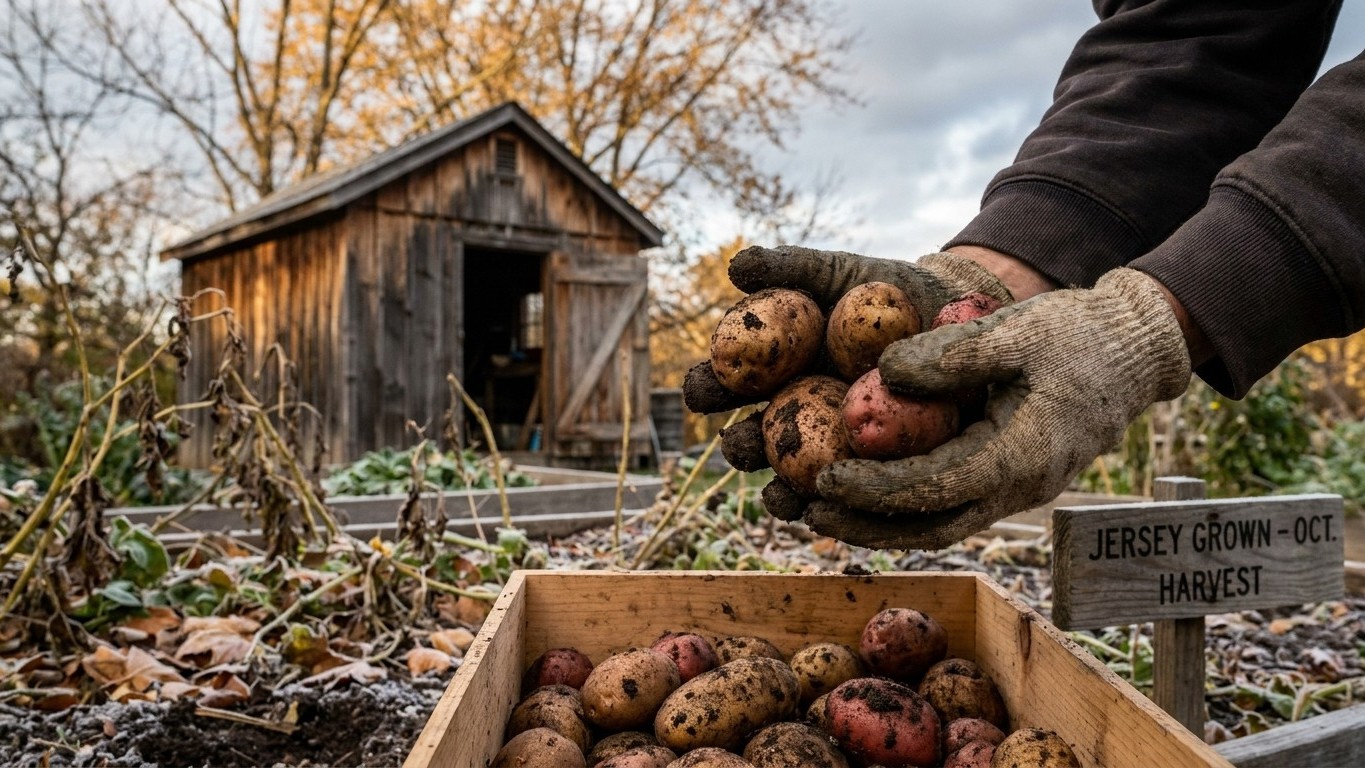

Get New Jersey potatoes out of the ground before the first fall frost lands, which at the Newark reference station falls between November 4 and November 16, and plan on a curing spot before they ever touch long-term storage. That storage spot needs to hold 40 to 45 degrees Fahrenheit all winter, and in a state where the coldest month averages a nightly low of 25.5 degrees, most unheated garages and sheds simply won’t do it without help.
The short answer
Two numbers drive everything here. The first is the frost window: November 4 to November 16 at the Newark-area station used by NOAA NCEI for the 1991-2020 Climate Normals. That’s a freeze probability band, not a hard date, and it comes from an airport weather station. Gardens in the Pine Barrens, up in Sussex County, or down in low-lying river valleys tend to see that first freeze arrive a week or two earlier than the reference figure, sometimes more at higher elevation. Check your own county’s frost history before you set a dig date on the calendar.
The second number is the mean minimum of the coldest month: 25.5 degrees Fahrenheit. That’s not the record low for the season, and it’s not an average of highs and lows blended together. It’s the typical overnight low during the coldest stretch of a New Jersey winter, and it’s the figure that actually decides whether an unheated space holds above freezing or not.
Put those two together and the harvest math gets simple. Potato foliage dies back with the first hard frost, and once the ground itself starts to freeze, digging gets difficult and the tubers close to the surface risk cold injury. Most New Jersey gardeners are pulling potatoes sometime in the weeks leading up to that November frost window, whenever the vines have yellowed and died back on their own, rather than waiting for a freeze to force the issue.
The storage question is where a lot of home growers get tripped up. An unheated garage or garden shed in New Jersey will track outdoor temperatures closely, and with a coldest-month mean minimum of 25.5 degrees, that structure is going to spend a good part of December through February below freezing on cold nights. Freezing turns a potato to mush. So the honest answer is: no, a bare unheated outbuilding will not reliably hold the 40 to 45 degree range this crop needs through a full New Jersey winter. Something with more thermal mass, insulation, or partial heat has to be part of the plan.
Curing, and where
Curing is the step that toughens the skin and heals over any nicks from the fork or spade, and it matters more than most gardeners assume. Utah State University Extension specifies a curing period of 2 to 3 weeks at 55 to 60 degrees Fahrenheit with high humidity, done before potatoes go into long-term storage. Skip it, and bruised or thin-skinned tubers rot within weeks of being stored.
The good news for New Jersey growers is that harvest generally happens well before the hard freeze window, so outdoor and near-outdoor temperatures in late September and October often sit close to that 55 to 60 degree curing range on their own. A shaded porch, an attached but unheated garage, or a cool basement corner can all work, provided the space stays out of direct sun and doesn’t spike into the 70s on a warm autumn afternoon.
- Dig on a dry day and let the tubers sit on top of the soil for an hour or two to air-dry, brushing off loose dirt without washing them.
- Move them out of direct sunlight immediately. Even a couple of hours of exposure can turn skins green, and green-tinged potatoes should not go into storage or onto a plate.
- Spread them in a single layer, not stacked in a bin, somewhere that holds 55 to 60 degrees Fahrenheit with humidity on the higher side. A shaded porch in late September, an unheated but enclosed garage, or a basement stairwell in New Jersey’s early fall climate can all land in that range.
- Leave them there for 2 to 3 weeks, checking airflow so moisture doesn’t pool and invite mold.
- Once the skins no longer scuff or peel under light thumb pressure, they’re cured and ready to move into cold winter storage.
Where this falls apart in New Jersey is timing against an early cold snap. If digging happens close to that November 4 frost date rather than in warmer September or early October, outdoor curing spots may already be too cold, and the load shifts indoors to a basement, which is usually the more dependable option once fall temperatures start sliding.
Storing through this winter
Once cured, potatoes want darkness and a steady 40 to 45 degrees Fahrenheit, according to Utah State University Extension. The University of Maine Cooperative Extension gives a tighter target for longer-term storage: 38 degrees Fahrenheit at 95 percent humidity. Both ranges sit well above freezing and well below room temperature, and that middle zone is exactly what’s hard to find naturally in a New Jersey home once winter sets in.
Here’s the conflict a New Jersey grower is actually managing. An unheated garage or shed tracks outdoor air, and with the coldest month’s mean minimum at 25.5 degrees, those structures spend plenty of nights well under the 40 degree floor, and likely dip toward or below freezing on the coldest stretches. That ruins potatoes just as fast as heat does, turning the inside of the tuber soft and black once ice crystals form and break down the cell walls. On the other end, a heated basement or a kitchen pantry usually runs 60 to 70 degrees, which is warm enough to trigger sprouting and slow shriveling well before winter is over.
The workable middle ground for most New Jersey homes is an unheated but insulated space: a basement corner away from the furnace, an interior closet on an exterior wall, a root cellar if the property has one, or a well-insulated bin inside a garage that’s built into or attached to the house rather than fully detached. Insulated coolers or heavy blankets wrapped around storage bins can buy a few extra degrees of protection on the coldest nights without adding real heat. The goal is a space that ignores the swings between a 40-degree December afternoon and a 15-degree January night, staying inside that 38 to 45 degree band the whole season rather than following the thermometer outside.
Checking the stored potatoes every few weeks matters too. Pull out anything that’s gone soft or started sprouting before it spreads to the rest of the bin, and keep the storage area dark, since light exposure during storage causes the same greening problem as light exposure right after harvest.
What goes wrong here
- Digging too late and hitting a hard freeze first. A frost that kills the foliage doesn’t necessarily hurt tubers still underground, but a freeze that penetrates the top few inches of soil will. Watch your own county’s frost history rather than relying only on the Newark-area window, since many New Jersey gardens see that first freeze a week or two earlier.
- Curing in a spot that’s already too cold. If harvest slides close to the November frost date, an outdoor porch or unheated garage may have already dropped below the 55 to 60 degree curing range Utah State University Extension recommends. Move curing indoors to a basement stairwell or spare room if outdoor temperatures have already fallen.
- Storing in a detached, unheated shed or garage. With a coldest-month mean minimum of 25.5 degrees, these structures will freeze on a regular basis through a New Jersey winter, and a single hard freeze night can ruin the whole batch.
- Storing in a warm basement or kitchen. Anything above 45 degrees Fahrenheit encourages sprouting and shrivels the tubers faster than they’d otherwise last, undoing the benefit of a careful cure.
- Wet, humid falls encouraging rot and blight before harvest. New Jersey’s late-summer humidity can favor fungal disease in the foliage. Utah State University Extension recommends appropriate fungicide applications and prompt removal of dying vines to limit disease pressure before digging.
- Insect damage weakening plants before the dig. Extension guidance calls for appropriate insecticides where pest pressure is heavy, since damaged foliage means smaller, weaker tubers at harvest time.
Common questions
Can potatoes stay in the ground past the first frost in New Jersey?
A light frost that only kills the foliage usually doesn’t harm tubers still covered by soil, but waiting risks a deeper freeze reaching the top layer of ground, especially once the season moves past the November 4 to November 16 window at the Newark reference station. Local gardens often freeze earlier than that airport-based figure.
Is a root cellar necessary for New Jersey potato storage?
Not necessarily, but the space needs to mimic what a root cellar does: dark, steady, and within the 38 to 45 degree range described by Utah State University Extension and the University of Maine Cooperative Extension. An insulated basement corner or interior closet can substitute if a true root cellar isn’t available.
What happens if potatoes freeze in storage?
Freezing breaks down the internal cell structure, and the tuber turns soft, discolored, and often sweet-tasting as starches convert to sugar. There’s no reversing this once it happens, which is why an unheated detached structure is risky during a New Jersey winter with a 25.5 degree average nightly low in the coldest month.
How long does curing take before New Jersey potatoes are ready for winter storage?
Utah State University Extension specifies 2 to 3 weeks at 55 to 60 degrees Fahrenheit with high humidity. Rushing this step or curing in a space that’s too cold or too dry leaves the skins thin and more prone to rot once potatoes move into cold storage.