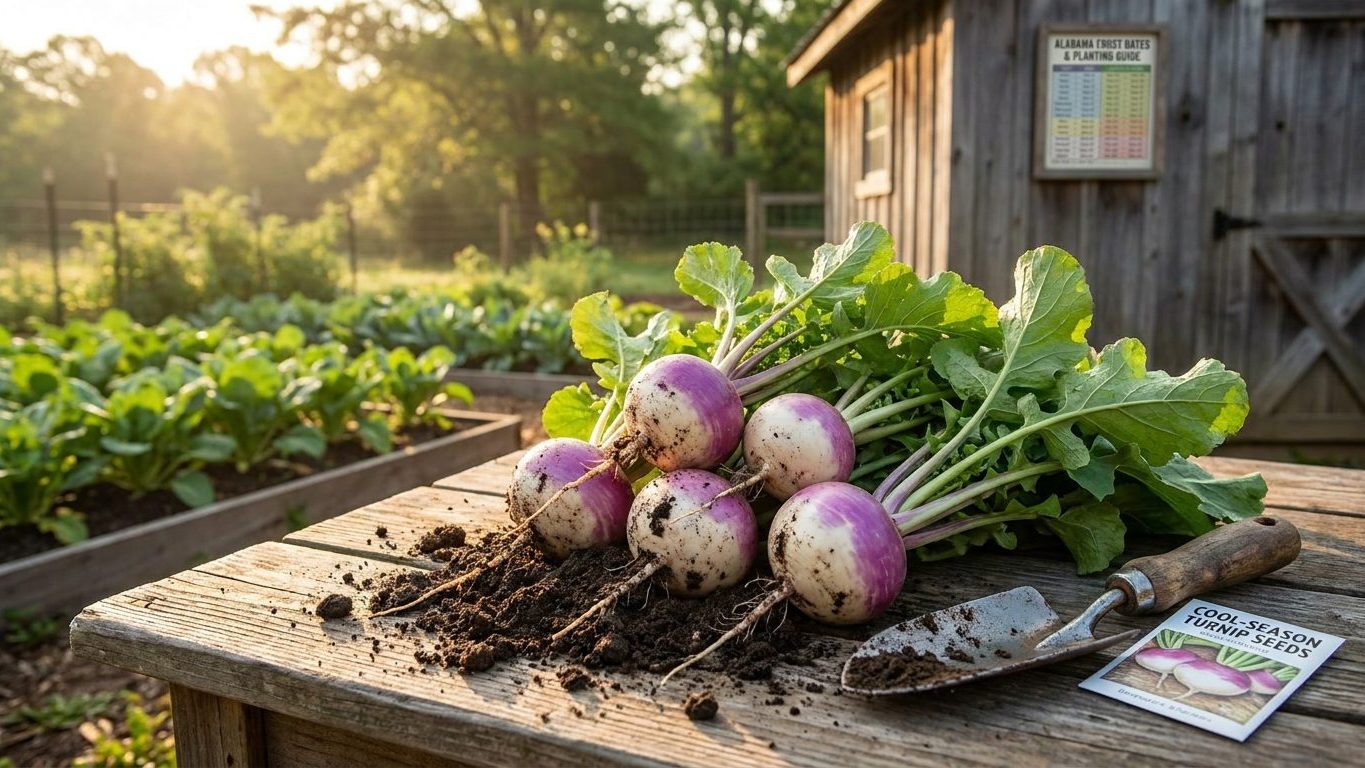

Sow turnips for a spring crop from mid-March into mid-April, and sow the better fall crop from August 1 to September 5, counting back from Newark’s average first fall frost. Rutabaga needs the earlier end of that fall window because it takes three months to bulk up, not six weeks.
The short answer for New Jersey
Two sowing windows work for turnips here, and they’re not equal. Spring sowing gives you fast greens and small roots before summer heat forces the plants to bolt. Fall sowing gives you the crop most New Jersey gardeners actually want: roots that size up in cool weather and sweeten after a light frost. At the Newark reference station, the average last spring frost falls between March 29 and April 6, and the average first fall frost falls between November 4 and November 16. Those are 30 to 70 percent probability bands, not hard cutoffs, so a frost outside that window in a given year is normal, not a fluke.
For spring turnips, seed goes in the ground two to three weeks before that last frost date, since turnip seedlings shrug off a light freeze that would kill tomatoes or peppers outright. That puts spring sowing in mid to late March for most of the state, with a second and third sowing every two weeks until roughly mid-April, after which rising temperatures push the plants toward flowering instead of root growth.
Fall turnips are counted backward from frost, not forward from spring. Standard turnip varieties need 30 to 60 days depending on whether you’re growing for greens or for roots, so sowing through late August and into the first days of September lands root harvest right around the first frost window, when flavor peaks. Rutabaga is a different plant on a different clock. It typically needs about 90 days to bulk properly, which means the sowing date has to land in the first week of August at the latest if you’re using the Newark station’s average frost dates as your guide.
None of these dates are guarantees. They come from one airport weather station, and gardens outside that immediate area, especially inland and at any elevation, tend to see frost arrive later in spring and earlier in fall, sometimes by one to two weeks. Treat the window above as a starting point to adjust from, not a date to circle on the calendar and forget.
What will not work here

Sowing rutabaga in July and expecting a mid-September harvest is the most common miscalculation. Rutabaga’s 90-day maturity window doesn’t leave slack against a first frost that can show up in early November at the reference station, and earlier than that inland. A late-July sowing might squeak by in a mild year, but it’s gambling with a crop that takes three times as long as a quick turnip green to finish.
Spring sowing dragged into May is the second failure pattern. Once daytime highs push consistently into the 80s, which happens across New Jersey by late May in most years, turnip roots stop bulking and the plant shifts energy into flowering. You’ll get spindly, woody roots and a fast bolt to seed instead of the sweet, dense turnip you were after. The fix isn’t more water or more fertilizer, it’s timing: get spring turnips in by mid-April and treat anything sown later as a greens crop only, harvested young before the heat takes over.
Leaving roots in the ground through winter, hoping to dig them as needed, is riskier in New Jersey than gardeners sometimes assume. The mean daily minimum temperature in the coldest month at the Newark reference station runs around 25.5°F, cold enough to damage unprotected roots left in unmulched ground through a hard stretch of winter. Turnips and Rutabaga tolerate a light frost on the leaves just fine, but a sustained cold snap at that temperature range without several inches of mulch over the row is a different story, and it’s a common reason gardeners lose a fall crop they thought was safely banked.
Dense spacing is the quieter failure. New Jersey’s growing season carries real humidity through late summer, and turnip foliage packed too tightly holds moisture on the leaves overnight, which is exactly the condition that lets downy mildew and other foliar diseases take hold before the roots have finished sizing. Thinning to the spacing on the seed packet, not skipping it because you’re impatient for a full row, matters more here than in a drier climate.
What changes across New Jersey
New Jersey isn’t one garden, and its official hardiness range makes that clear on paper: the USDA Plant Hardiness Zone Map places the state between zone 6a and zone 7b, based on average annual extreme minimum temperature. That’s a wide spread for a state this size, and it means there’s no single sowing date that fits the whole state equally well.
The general pattern runs colder in the northwest highlands and milder along the southern coastal plain and the immediate shore. A gardener working land at higher elevation or further inland in the north should expect both frost dates to shift against them: spring frost arriving later, fall frost arriving earlier, sometimes by a couple of weeks compared with the Newark reference figures used above. That compresses the whole growing season from both ends, which matters more for rutabaga’s long 90-day clock than for a quick turnip green crop that finishes in a month.
A gardener in the milder southern zone gets the opposite adjustment: a bit more room on both ends of the season, which can mean squeezing in an extra spring sowing before the heat arrives, or pushing the fall sowing date a week later than the Newark figures suggest and still beating frost.
None of this tells you which zone applies to your own yard, and it shouldn’t. Elevation, distance from the coast, and even which side of a valley you’re on can shift the practical frost dates in ways a statewide range can’t capture. The USDA’s map is built for exactly this kind of check, and it’s worth five minutes to look up your own address rather than assume the state average applies to your particular plot.
Where to check this for your own county
Everything above is a state-level starting point, built from one weather station and one statewide hardiness range. Rutgers Cooperative Extension, the state’s land-grant extension service, publishes planting guidance closer to the county level, and that’s the resource to check next, not a second opinion to skip. The address is njaes.rutgers.edu, and it’s the official New Jersey Agricultural Experiment Station extension site, run through the land-grant university system that every state maintains for exactly this kind of local growing question.
Once there, look specifically for two things. First, a county or regional planting calendar, since Rutgers extension offices operate at the county level and often publish sowing windows tuned to local frost data rather than a single statewide figure. Second, look for variety trial results or recommended cultivar lists specific to New Jersey conditions, since not every turnip or rutabaga variety sold nationally performs the same way in this state’s mix of humid summers and variable winters.
A county-level recommendation beats a state-level one every time, for the simple reason that it’s built on data closer to your actual soil and microclimate. This page works from the best statewide figures available, a single reference weather station and a broad hardiness zone range, and that’s useful for a first pass at your calendar. It is not a substitute for what your local extension office knows about frost pockets, soil drainage, and the varieties that have actually performed well in trials run in your part of the state.
Checking this against your own garden
Every date on this page is a probability from a weather station that isn’t in your yard. Your own garden will tell you more than any calendar, if you know what to watch for.
Soil warmth is the first check, and you don’t need a thermometer for a rough read. Turnip seed germinates reliably once the soil has lost its raw, cold-clay feel and crumbles a bit when you squeeze a handful, typically a week or two after the coldest snap has passed regardless of what the calendar says. If the ground still feels like a refrigerator shelf in late March, hold off a few more days even if the date on this page says go.
The first true leaves are the second signal. Turnip seedlings push up rounded seed leaves first, then a set of true, slightly fuzzy leaves that look more like a miniature version of the mature plant. Once you see that second set of true leaves, the plant has settled in and is growing on its own root system, a good sign the sowing timing was close enough for that particular bed.
The third signal, and the one that tells you if you sowed too late in spring, is an early flower stalk. If turnips push up a central stem with small yellow flowers before the roots have any real size to them, that’s the plant bolting from heat stress rather than finishing normally. Seeing that in a spring crop is useful information for next year, a sign that particular bed warms faster than the state average and needs an earlier sowing date than the calendar above suggests.
If you follow the almanac, here is when to plant turnips by the moon. It is a tradition, not a proven method.