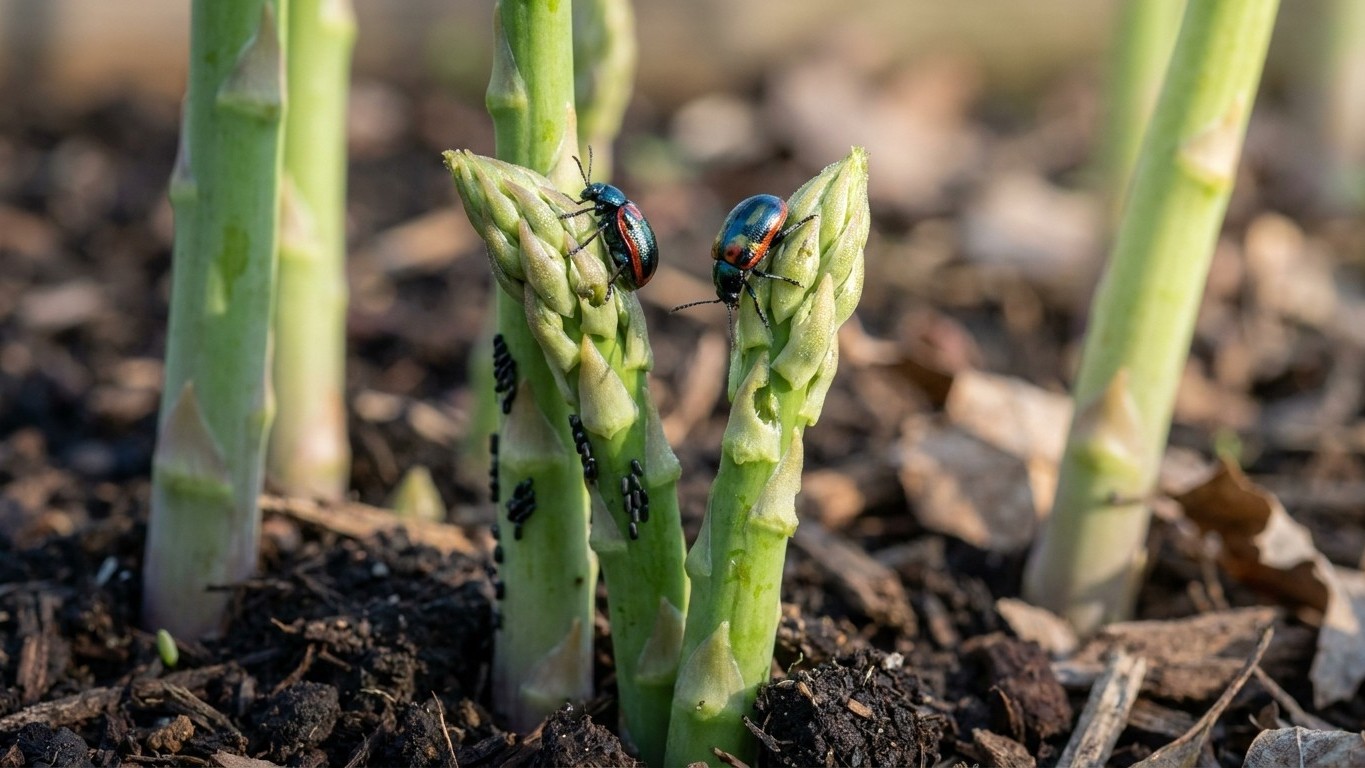

Adult common asparagus beetles wake up in the crowns and debris of last year’s asparagus bed and move onto the first spears within days of them breaking soil. Rutgers NJAES Cooperative Extension doesn’t publish a fixed calendar window for this species specifically, but the pattern that works for New Jersey gardeners is straightforward: cut spears daily during harvest, hand-pick adults and larvae, cover young beds, and clear fern debris every fall.
The weeks to watch

Rutgers NJAES Cooperative Extension’s FS1123 guide covers timing for cucumber beetles, bean leaf beetle, Colorado potato beetle, and spotted lanternfly, but it does not name a specific emergence window for the common asparagus beetle. That gap matters: without a published local date, the safest approach is to rely on the insect’s general biology rather than guess at a calendar day.
First generation, on the spears
Adults overwinter as beetles, tucked into old asparagus stalks, mulch, and garden debris near the bed. They emerge as soon as daytime warmth pushes the first spears above the soil line, feed on the tender tips, and start laying rows of small black eggs directly on the spears. This is the damage a harvesting gardener notices first, often before the second cutting of the season.
Second generation, on the fern
Once harvest ends and the plants are allowed to grow into their tall, feathery summer fern, a second generation hatches and feeds on that foliage instead. Larvae skeletonize the fern’s needle-like leaves, which weakens the plant’s ability to store energy for next year’s crop, even though nobody is cutting spears at that point.
Reading the calendar from your last frost

The common asparagus beetle doesn’t check a calendar. It responds to soil and air warmth, which is why an early or late spring shifts its whole schedule earlier or later along with your asparagus bed itself. The one date most New Jersey gardeners actually plan around is the last spring frost, and NOAA’s 1991-2020 climate normals for the Newark-area reference station put that window between March 29 and April 6. Suburban and rural gardens away from that airport station typically see their own last frost run later, sometimes by one to two weeks, so treat the airport figure as a starting point, not a promise for your particular yard.
- Mark your own local last-frost window using the reference range (March 29 to April 6) as a baseline, then adjust later if your county historically runs cooler.
- Expect asparagus crowns to break dormancy and beetles to become active as soil temperatures climb into the 50s Fahrenheit following that window, which usually means the first spear damage shows up within the opening one to two weeks of harvest.
Because that second step is a range built on a range, don’t treat it as a fixed appointment. Check your bed directly rather than counting days on paper.
What it attacks, and what the damage looks like

A gardener usually sees the symptom well before spotting the insect responsible. Spears show ragged brown scarring, brown scars along the stalk, or a tip that’s bent and discolored where feeding damaged the growing point. On the mature fern later in the season, the giveaway is a lacy, skeletonized look to the fine needle-like foliage, sometimes with entire branches stripped bare. Small black eggs standing upright in tidy rows along a spear are one of the clearest identifying signs, since few other garden pests lay eggs in that exact pattern.
Both the adult beetles and their soft, slug-like larvae do damage, but at different points in the season and on different plant parts:
- Emerging spears, chewed and scarred by feeding adults in spring
- Spear tips, where eggs are laid in visible rows
- Mature fern foliage, skeletonized by larvae in summer
Asparagus is essentially the only host this insect targets in a home garden setting, which makes it easy to rule out once you’ve confirmed the crop. The life stage matters for treatment too: adults on spears respond to hand-picking and covers, while larvae feeding openly on exposed fern foliage are still reachable by direct removal, since neither stage bores inside the stem or hides where it can’t be reached.
How New Jersey sits in this pest’s range

This site currently documents the common asparagus beetle in one territory, New Jersey, so there’s no cross-state comparison to draw from yet on this platform. That single-territory status doesn’t say anything about how severe or common the pest is here relative to anywhere else, it simply reflects what’s been written up so far. The local reference for identification and biology throughout this article is Rutgers NJAES Cooperative Extension, which is the same service that publishes FS1123 for other vegetable pests, even though that particular guide stops short of a dedicated section for this species.
What can be said with confidence is that the insect is established wherever asparagus is grown as a home garden crop, since it has been present in North America since the mid-1800s and follows the plant rather than any particular climate zone. New Jersey’s asparagus-growing counties, concentrated in the southern part of the state, give the beetle exactly the host plant density it needs to persist season after season. Without additional published territory pages to compare against, the honest answer is that New Jersey sits inside this pest’s established range, not at some documented edge of it.
What actually works against it

Cheapest, lowest-effort measures come first, and each one loses effectiveness at a different point in the beetle’s life cycle.
- Cut spears daily during harvest. Removing every emerging spear on a short cycle also removes the eggs laid on them before those eggs hatch, which cuts the next generation off before it starts.
- Hand-pick adults and larvae. Both stages feed in the open on spears or fern, so a quick pass with a bucket of soapy water in the cool morning hours, when beetles move less, physically removes a meaningful share of the population at almost no cost.
- Use row covers over young beds. A floating cover keeps overwintered adults from reaching emerging spears in the first place, but it has to come off once flowering starts if pollinators need access, and it does nothing once beetles are already established underneath it.
- Clear fern debris every fall. Adult beetles overwinter in old stalks and garden litter, so removing that material after frost knocks down the population that would otherwise emerge again the following spring.
- Avoid crowding new beds next to old, heavily infested fern. Asparagus is perennial, so there’s no crop rotation in the usual annual-garden sense, but keeping a new planting some distance from an established, beetle-prone stand limits how easily the population spreads between them.
Some gardeners also dust plants with diatomaceous earth as a physical deterrent; how well that performs specifically against this species hasn’t been settled by controlled trials, so treat it as a supplement to the steps above rather than a replacement for them.
Common questions
Does the common asparagus beetle only affect asparagus?
Yes, in a home garden setting asparagus is essentially its only host plant, which makes identification straightforward once you’ve confirmed the crop and seen the characteristic egg rows or scarred spears.
Can I still eat asparagus spears with beetle damage?
Scarred or slightly discolored spears are generally still edible once trimmed and washed, since the damage is surface feeding rather than any toxin, though heavily chewed or misshapen spears are usually best composted for quality reasons alone.
How do I tell the common asparagus beetle apart from the spotted asparagus beetle?
The common asparagus beetle is bluish-black with cream-colored squares along its wing covers, while the spotted asparagus beetle is a more uniform orange-red with black spots; the spotted species also tends to feed more on berries than on the spears themselves.