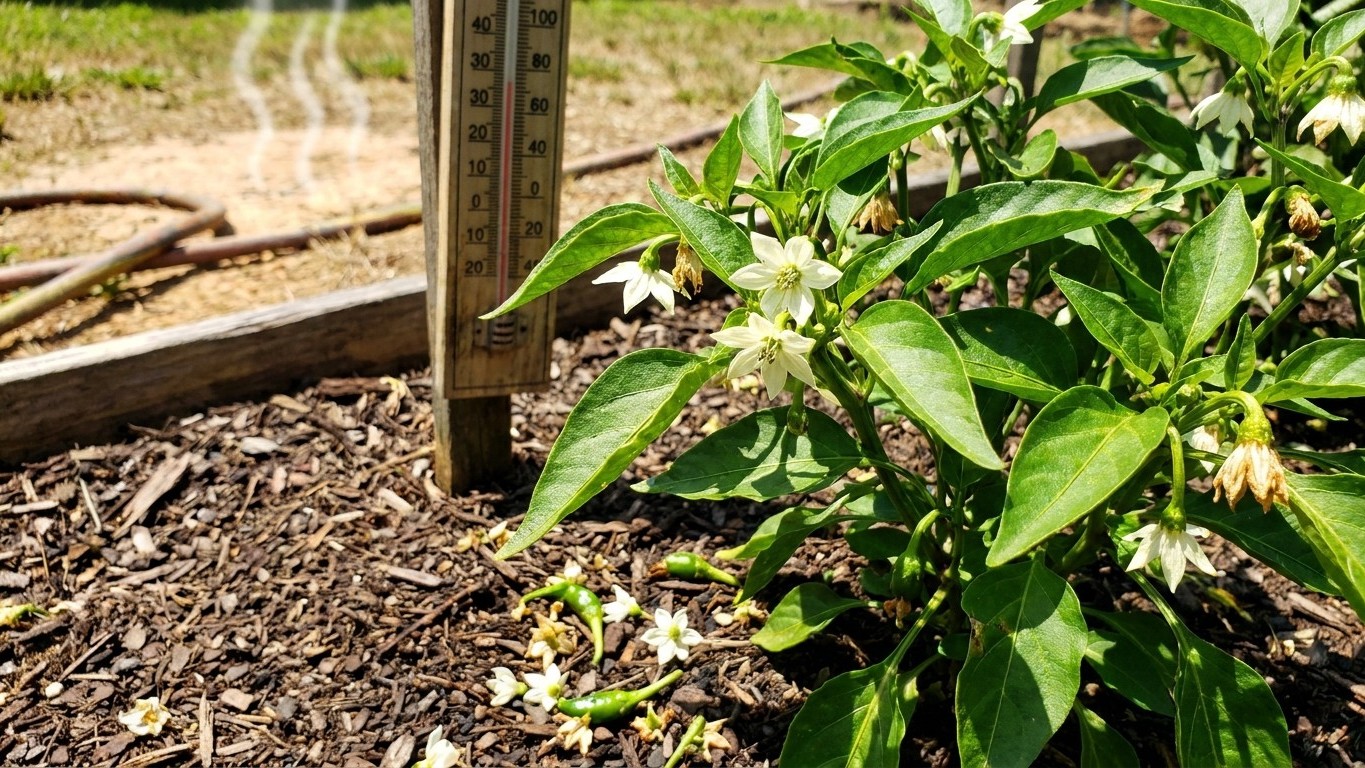

New Mexico’s high desert climate puts pepper plants in a squeeze: too many scorching afternoons on one side, and cool nights that can drop fruit set on the other. Get the timing wrong and you’ll have healthy, green, flowerless plants all summer. The fix starts with knowing your local heat load and working backward from your last frost date.
The short answer
Albuquerque’s reference station averages 42.5 days a year at 90 F or hotter, according to NOAA NCEI Climate Normals covering 1991-2020. That’s not a handful of hot afternoons scattered through July. It’s more than six weeks of cumulative heat stress, often stacked into stretches where daytime highs barely dip below 90 for a week or two straight. For peppers, that matters more than the seasonal average temperature ever will, because fruit set doesn’t respond to averages. It responds to thresholds crossed on individual days.
When daytime highs push past 90 F, pepper flowers frequently abort before they ever open into fruit. The plant, under heat and water stress, essentially triages: it keeps its leaves alive and sacrifices the blossoms. A gardener in Albuquerque, Las Cruces, or anywhere with a similar summer heat profile should expect this to happen in most years, not as a rare fluke. Forty-two and a half days of 90-plus heat gives the plant plenty of opportunity to shed flowers mid-season, right when you’re hoping for a steady harvest.
The other failure point sits at the opposite extreme. Nights that drop below 55 F can stall pollen viability just as effectively as the heat does, and this is where New Mexico gardeners need to do their own homework. This site tracks daytime heat data by location, but it does not carry summer overnight low temperatures for New Mexico or any other state. There’s no shortcut here, and guessing based on elevation or how far north you sit is a bad habit to fall into. A garden in the Rio Grande valley and one at higher elevation forty miles away can see very different overnight lows on the same night, and neither can be reliably guessed from a map.
The practical move is to track your own nighttime lows through the stretch when plants are flowering, whether with a min-max thermometer in the garden or a weather station a few miles out that mirrors your local terrain. If you’re logging nights consistently below 55 F while blossoms are open, that’s your answer for why pods aren’t forming, independent of anything the daytime heat is doing. Both thresholds can be active in the same season, sometimes weeks apart, which is why pepper failure in this state rarely traces back to a single simple cause.
When to start seed here
Timing Pepper Seed in New Mexico means working backward from two fixed points: your last frost date and the moment your soil actually warms up. Here’s how the arithmetic runs, using Albuquerque as the reference point.
- Start with the frost window. NOAA NCEI’s 1991-2020 climate normals put Albuquerque’s last spring frost, based on the 30 to 70 percent probability band for a 32 F freeze, somewhere between March 31 and April 12. That’s the airport station reading. Suburban yards and rural gardens in this state commonly see frost linger later than that, sometimes by one to two weeks, and gardens at higher elevation can run later still. Don’t treat the airport date as your date. Check your own county extension office or your own frost log if you keep one.
- Wait for 60 F soil, not just frost-free air. Utah State University Extension’s guidance on peppers is specific on this: transplant only after the danger of frost has passed and the soil has reached 60 F. Air temperature can feel mild while soil a few inches down is still cold from winter, and pepper roots sulk badly in cold soil even if the leaves look fine above ground. A simple soil thermometer pushed a few inches into the bed tells you more than the calendar does.
- Count back 8 to 10 weeks for indoor starting. Once you have a realistic transplant date for your own garden, whether that’s early April, mid-April, or later at elevation, subtract 8 to 10 weeks. That’s your seed-starting date indoors. If your own frost-safe, 60 F-soil date lands around the third week of April, for instance, you’d be starting seed indoors somewhere in the middle of February.
- Build in a buffer for a slow spring. Because soil warms unevenly and a cold snap can push your safe transplant date later than the calendar suggests, many gardeners in this state hold transplants a few extra days past their planned date rather than rush plants into soil that hasn’t caught up yet. A tray of pepper starts tolerates a short wait indoors far better than young roots tolerate cold ground.
The core logic scales to any county in the state. Find your own last frost window, confirm soil temperature rather than trusting the date alone, then count back 8 to 10 weeks for the indoor start.
What goes wrong here
New Mexico’s swing between fierce daytime sun and the risk of cool nights or sudden heat spikes creates a specific, repeatable set of pepper problems. Each one traces back to the same climate mechanics described above.
- Blossom drop from a hot spell. When daytime highs push into the 90s during flowering, plants shed blossoms rather than set fruit, and Albuquerque’s 42.5 average days at or above 90 F means this isn’t a rare event. Shade cloth over the row during the hottest afternoon stretch and consistent deep watering to reduce heat stress both help the plant hold onto more flowers through a heat spike.
- Blossom drop from a cool night. The flip side hits when overnight temperatures fall below 55 F while flowers are open, and pollen becomes less viable. Because this site doesn’t track summer night lows for New Mexico, the only reliable fix is watching your own thermometer through the flowering window and noting which cool nights line up with a lack of new pods. If a cold snap is forecast during flowering, some gardeners cover plants overnight to hold in a few extra degrees.
- Sunscald on exposed fruit. New Mexico’s high-elevation sun is intense, and pods left uncovered by foliage can develop pale, papery patches on the side facing the sun. This tends to show up on plants that have lost leaves to heat stress or been pruned too aggressively. Keeping the plant’s natural leaf cover intact, and avoiding heavy pruning during the hottest weeks, protects fruit already forming.
- Blossom-end rot. Irregular watering, common when a gardener tries to compensate for a hot afternoon with a heavy soak followed by a dry stretch, disrupts calcium uptake and produces the sunken, dark patch at the fruit’s blossom end. Even, consistent soil moisture, rather than occasional deep watering, keeps calcium moving steadily into developing pods.
Common questions
Why are my pepper plants flowering but not setting fruit in New Mexico?
It usually comes down to one of two temperature extremes. Daytime highs at or above 90 F, which happen an average of 42.5 days a year at the Albuquerque reference station, can cause blossoms to abort. Nights below 55 F during flowering can do the same by reducing pollen viability. Since this site doesn’t track summer night lows for the state, check your own nighttime readings during the flowering window to see which threshold is in play.
When should I transplant peppers outdoors in New Mexico?
Transplant after your local last frost date and once soil temperature reaches 60 F. Albuquerque’s reference station shows a last spring frost window of March 31 to April 12, but suburban and rural gardens in the state often see frost linger one to two weeks later, more at elevation. Confirm your own soil temperature rather than relying on the calendar alone.
How early should I start pepper seed indoors?
Count back 8 to 10 weeks from your own realistic transplant date, the one based on your local frost timing and soil warmth, not the airport station’s average. In a county where safe transplanting lands in mid to late April, that typically puts indoor seed starting in mid-February.
Does New Mexico’s heat cause blossom-end rot?
Not directly. Blossom-end rot comes from inconsistent watering that disrupts calcium uptake, and hot, dry stretches make that inconsistency more likely if a gardener overcorrects with a heavy soak after letting soil dry out. Steady, even watering through hot weeks is the more reliable fix than any single deep watering session.