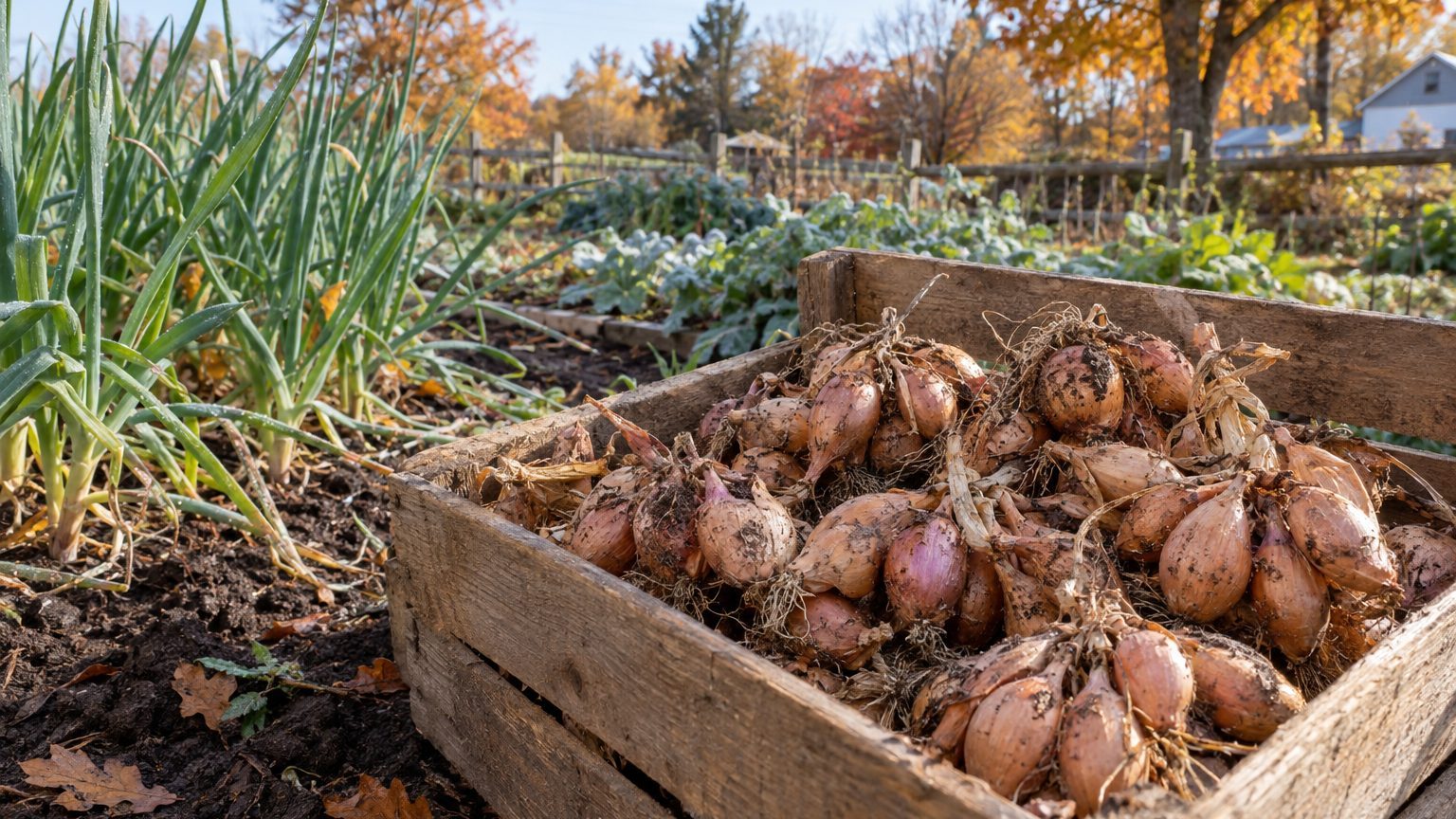

For Nunavut, choose shallots grown from small sets of an early-maturing, multiplying type, and start them in pots indoors. Skip anything sold as slow, large-bulbed or grown from seed. The math is short. At Rankin Inlet, the average last spring frost is June 19 and the average first fall frost is September 13. That leaves about 86 days between them, and those are midpoints, not guarantees.
The short answer for Nunavut
Pick shallots by type, not by catalog name: small to medium sets of an early, multiplying kind, potted up indoors and moved out once the bed has thawed. This page does not have cultivar trial results from Nunavut, so it names no specific cultivar. Anyone who lists one as “the best for the Arctic” is guessing.
The reasoning starts with the calendar. Environment and Climate Change Canada’s 1981-2010 normals for the Rankin Inlet A station put the last spring frost on average at June 19 and the first fall frost on average at September 13. Both are mean dates, so in one year out of two the frost lands later than the average. In spring, that means June 19 is the middle of a window, not a safe date. In fall, it means a killing frost can show up before September 13 about as often as after it.
A shallot is a patient crop in most of North America, so 86 days between average frosts is tight. Heat is not what limits it, since this is a cool-summer territory. Time is the limit. Long June and July daylight helps bulbs form once leaves are big enough, but leaf growth has to happen first, and that is where an indoor head start earns its keep. The Growing Shallots in Nunavut page covers the bed and soil side; this one is about which type to buy.
| Type | Fit for Nunavut | Reason |
|---|---|---|
| Small sets, early-maturing, multiplying | Best bet | Bulbs are already formed, so the plant skips the slowest stage |
| Sets started in pots indoors, then transplanted | Best method | Leaf growth begins before the ground is workable |
| Large-bulb, late-maturing sets | Poor | Needs more days than the frost-free window is likely to give |
| Shallots from true seed, sown outdoors | Poor | Adds an entire seedling season before any bulb exists |
| Fall-planted sets left in the ground | Poor | Winter minimums are far beyond what a bare bulb should face |
What will not work here
Shallots grown from true seed come first on the list. They need to build a plant from nothing, and 86 days between average frosts, with the first weeks too cold for much growth, does not leave room for that. Outdoors in Nunavut, seed-grown shallots are a poor bet. Even indoors, they would occupy window space for months before anything is ready to go outside.
Fall planting fails for a different reason. The mean daily minimum of the coldest month at Rankin Inlet is -34.3 °C (-29.8 °F), according to the 1981-2010 normals. That is an average of the lowest temperature each day, so individual nights are colder. The usual advice in much of the United States is to plant shallots in October and let them root before winter. A bulb in frozen ground at that temperature, with whatever snow cover happens to fall, is not a plan. This page has no soil-temperature data for Nunavut, so it cannot say how deep the cold goes. It can say the margin is too thin to bet a harvest on.
Treating June 19 as a planting date is the quieter mistake. It is an average. Half of all years bring frost later, and a gardener who sets out tender transplants on the mean date is accepting a coin flip. Shallot leaves handle light cold better than many vegetables, but a hard freeze on young transplants is still a setback you cannot afford with so few days to spare. The When to Plant Shallots in Nunavut page works through how to treat that window.
Curing is the last trap, and people forget it. A harvested shallot needs dry, airy weeks for its skins to set and its necks to close. With the average first fall frost on September 13, the curing period will probably fall indoors or under cover, not in open air on a sunny rack. Plan a dry spot with some airflow before you plant, not after the harvest is sitting in a bucket.
What changes across Nunavut
Nunavut is not one garden. It stretches across a vast area, and the figures on this page come from a single station at Rankin Inlet. Environment and Climate Change Canada’s station sits at an airport, and conditions in other communities can run weeks behind or ahead of it.
Natural Resources Canada places the Rankin Inlet reference city in Canadian hardiness zone 0a, using 1991-2020 normals. That is the Canadian system, which draws on seven climate variables, and it does not convert to a USDA zone. Natural Resources Canada says plainly that no simple conversion exists between the two. Treat zone 0a as a label for that one reference city and not as a number for the whole territory.
This page does not have zone figures for other communities, so it will not guess at a spread. What it can say is that the direction of change is predictable. Farther north, the window between frosts shortens, and the advice tightens: pot the sets earlier indoors, use smaller types, and plan on cover for more of the season. Farther south or in sheltered spots, the window may stretch a little, but nothing on this page supports treating any part of the territory as an easy shallot climate.
Altitude and exposure work the same way inside a community. A bed on a hillside facing open water or open tundra may stay cold when a south-facing spot beside a building warms early. For your own location, look up your community on the Canada’s Plant Hardiness Site map from Natural Resources Canada instead of assuming the Rankin Inlet figure applies. Treat the zone as one input, not a verdict. It describes average winter and summer conditions, and it will not tell you whether a given bed thaws on time.
Where to check this for your own county
The page you are reading gives the territorial picture, built from one reference station. A recommendation made for your own community will always beat it, because someone local has watched real beds through real springs. Nunavut has no counties, so think of “county” here as your community or the nearest place with a trial garden.
The place to start is Agriculture and Agri-Food Canada, the federal department. The territorial department’s own site refused automated checks when this page was verified, so the federal site is given instead, because it is better to link something that works than something unproven. Once there, look for two things: a planting calendar for your area, and any list of varieties that have been trialled in your region. If a trial result names a shallot cultivar, that beats any generic type advice here.
When you find local guidance, check which climate period it uses. The Canadian normals cited here cover 1981-2010, while the US figures elsewhere on this site cover 1991-2020, so the two are not directly comparable. If a local grower, community garden or greenhouse project in your town has grown alliums, ask them what they did. Their notes may be the closest thing to a county recommendation that exists for your spot.
Checking this against your own garden
Your own observations outrank every date on this page. Three are worth watching, and none needs a gadget.
How the soil feels. Push your bare hand into the bed. If it is still hard, cold and damp in a way that aches within a minute, it is too early to set out transplants. Note the day it first feels merely cool and crumbly. A spot that gets there well before a neighboring one has a warmer microclimate, and you can lean earlier there next year.
When the first green shoots show. Once sets or transplants are in, record the day the first new leaves appear. A long gap tells you the bed is slow and wet. A quick start suggests good drainage and shelter. Either result tells you whether to move your indoor start date.
What the first frost does to tender leaves. Check a few exposed leaves the morning after a cold night. If tips are browned while a patch near a wall is untouched, you have just found the warmest part of your garden. Plant there next time. Whatever you learn, write it down, because a one-line log kept over a few seasons is worth more than any average from a distant station.
Common questions
What type of shallot is best for Nunavut?
Small sets of an early-maturing, multiplying type, started in pots indoors and transplanted once the bed has thawed. This page has no Nunavut cultivar trial data, so it recommends a type, not a named cultivar.
Can I grow shallots from seed in Nunavut?
Outdoors, it is a poor bet. The 1981-2010 normals for Rankin Inlet put the average last spring frost on June 19 and the average first fall frost on September 13, and a seedling needs time to build a plant before it can form a bulb.
Can I plant shallots in fall and leave them over winter?
It is not advisable. The mean daily minimum of the coldest month at Rankin Inlet is -34.3 °C (-29.8 °F), and this page has no soil-temperature data to show that bulbs would survive.
Is the June 19 frost date safe for planting?
No. It is an average, so in one year out of two the last frost falls later. Treat it as the middle of a window, and watch your own soil and weather before setting anything out.