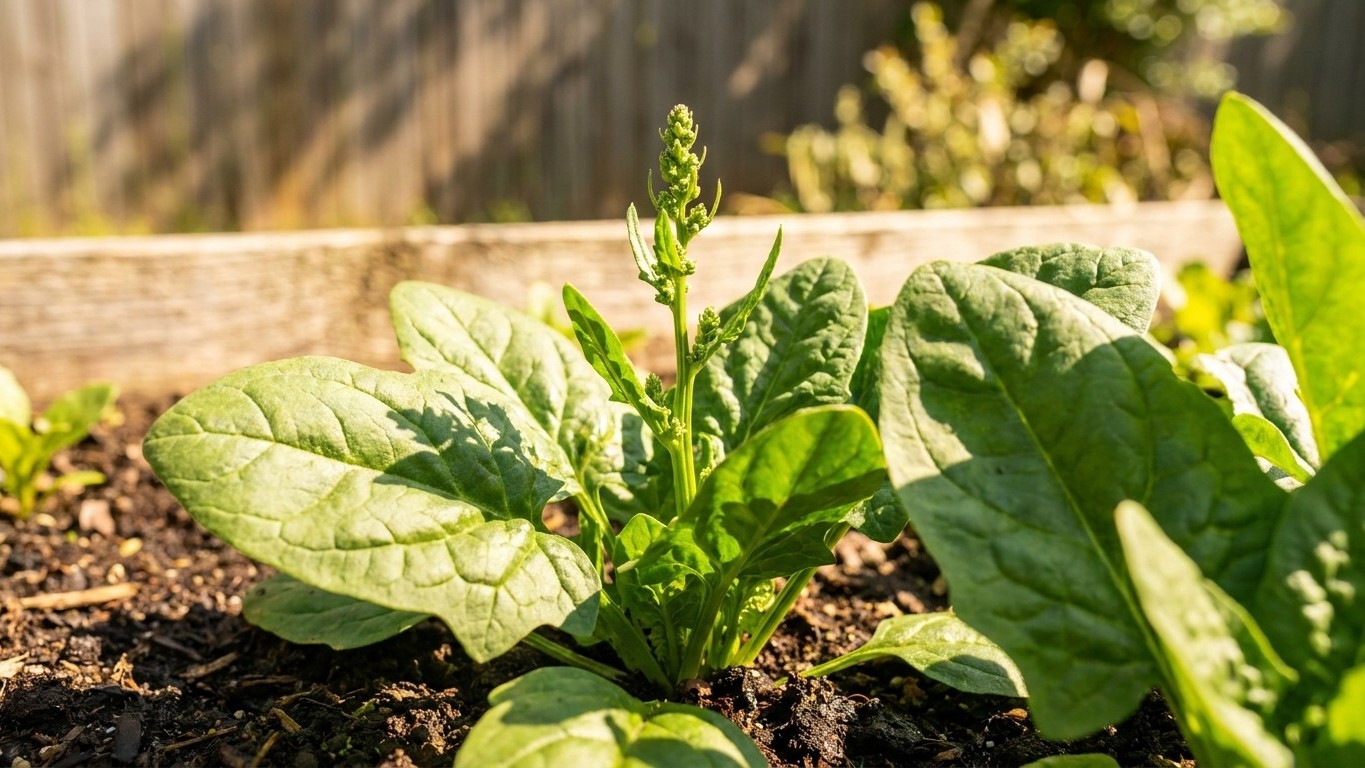

In Albuquerque, the reference city for this page, spinach has two cutting seasons. The spring one is short, running from a mid-to-late March sowing until afternoons pass 75 F. The fall one depends on getting seed to sprout in warm soil. Cut young, in the morning, before the plant flowers. After cutting, spinach is a two-week crop at best, and only at 32°F. In a typical home fridge it fades much faster.
The short answer
The longest day of the year in Albuquerque brings 14 h 22 of daylight. That number matters more than it looks, because long days alone are enough to push spinach toward flowering, with no help from the heat. Spinach does not “use” those hours to grow bigger. It reads them as a signal to stop making leaves and send up a seed stalk. A cool summer therefore doesn’t buy you extra weeks here, the way it might feel like it should.
So is the limit here the day length or the heat? Both, and they stack. Utah State University Extension says spinach bolts during long days and warm temperatures, and grows best where temperatures do not exceed 75 F. The reference station averages 42.5 days a year at 90 F or more, so the heat side of the squeeze is not subtle. The day-length side is built into the calendar and no shade cloth fixes it. If you want the full story on the flowering trigger, Will Spinach Bolt Early in New Mexico? covers it in detail.
For cutting, this means you harvest by the weather, not by a fixed number of days. Take outer leaves while the plants are growing steadily and the afternoons sit below 75 F. When a warm spell arrives and the center of a plant starts to rise into a stalk, cut the whole plant and be done with that row. Leaves harvested early in the morning, while they’re still cool, go into storage in better shape than leaves cut at midday.
Then comes the part people get wrong: how long it keeps. UC Davis Postharvest puts the optimum at 0°C (32°F) with 95 to 98 percent relative humidity. It also warns that spinach is highly perishable and “will not maintain good quality for more than 2 weeks.” Read that as a ceiling, not a plan. Wilting, yellowing and decay increase after 10 to 14 days, and they come faster at 41 to 50°F, which is about what a fridge door actually holds. The coldest spot is the back of the bottom shelf, so that’s where a bag of spinach belongs. Full details are on the UC Davis spinach fact sheet.
How long the spring window really is
Spinach is sown 2 to 3 weeks before the last spring frost, and growth stops being good above 75 F. Between those two markers sits your spring crop. Working it out for the reference city takes four steps.
- Find the frost date. NOAA NCEI’s 1991-2020 normals put the last spring frost at the Albuquerque airport station between March 31 and April 12. That is a reference-city figure, not a guarantee for the whole state. Suburban and rural gardens usually see the last frost one to two weeks later, and more at elevation, so check your own county.
- Subtract two to three weeks. From March 31, three weeks back lands around March 10. From April 12, two weeks back lands around March 29. Seed goes in somewhere across that stretch, roughly the second and third weeks of March at the earliest and the end of March at the latest.
- Watch for 75 F. This is a growth ceiling and also the point where leaves turn bitter, so it is one number with two consequences. It is not a calendar date. No source used for this page publishes the week it arrives in a given place, so keep an outdoor thermometer in the shade and note when afternoons stop dipping below it.
- Count the weeks in between. Whatever stretch you have between sowing and the first run of 75 F afternoons is your harvest window.
Here is the honest arithmetic. Seed goes in around the middle to end of March. The heat load is real, given those 42.5 days a year at 90 F or more, and daylight is already lengthening toward that 14 h 22 peak. Expect the usable spring to be counted in weeks, not months. How many depends on how fast your spring warms, and I can’t give you a single number without inventing one. The same goes for days to maturity: the extension source publishes none for spinach, so there is no count to borrow from another crop.
The same source names four varieties: Bloomsdale, Melody, Teton and Olympia. It gives no data about any of them, so I can’t tell you which one bolts later or tolerates heat better. Choosing among them is a fair experiment for a small row, not a decision with published evidence behind it. If you’re still planning your beds, Growing Spinach in New Mexico covers the broader setup.
The autumn crop, and when the soil lets you sow
The fall crop is the better bet for many New Mexico gardeners, but it has two obstacles, and neither is the one most people expect. One comes at the start of the season and the other at the end.
Warm soil at sowing time
Seed germination is reduced when soil is above 80 F. That is a soil number, not an air number, and in a hot region late summer soil holds heat long after nights start to cool. The autumn window therefore opens when the soil falls, not when the calendar says fall. Plenty of gardeners sow in the first cool week and get thin, patchy stands.
No source here gives the date soil drops below 80 F in a particular New Mexico county, so a cheap soil thermometer is worth having. Push it a couple of inches into the bed in the morning. If it reads above 80 F, wait. Watering the bed before sowing and keeping it shaded from afternoon sun are common ways to help cool a seedbed, but the thermometer is what tells you when to start.
The frost that ends the season
The extension source says to plant fall spinach 50 to 75 days before the date you want to harvest. Take the frost date as your anchor and count back. NOAA NCEI’s 1991-2020 normals give the first fall frost at the Albuquerque airport station as October 29 to November 9. Counting back 50 to 75 days from that range gives you this:
- From October 29: sow between about August 15 and September 9.
- From November 9: sow between about August 26 and September 20.
Those are reference-city dates. Fall frost tends to arrive earlier in suburban and rural gardens, often by one to two weeks and more at elevation, so shift everything in the list one to two weeks earlier if that describes your place. Your county’s own frost range is the better anchor.
Notice the collision. The early end of those windows falls in August, when soil is almost certainly above 80 F. The sowing date you want and the one the soil allows overlap only in a narrow band, probably the later dates in each range. That is why fall spinach rewards patience with the thermometer more than speed with the seed packet. Once seedlings are up, chewed leaves become the next problem, and What Eats Spinach in New Mexico, and When explains what to watch for.
Common questions
How many days until I can cut my spinach?
No source used here publishes days to maturity for spinach, so any figure would be invented. What is published is for fall planting: sow 50 to 75 days before the date you want to harvest. In spring, start cutting outer leaves once the plants have grown enough to be worth eating, and stop when afternoons keep passing 75 F.
How long does cut spinach last in the fridge?
UC Davis says it will not keep good quality for more than 2 weeks, and that is only at 32°F with 95 to 98 percent humidity. Quality drops after 10 to 14 days even in ideal conditions, and faster at 41 to 50°F. Keep it at the back of the bottom shelf, not the door, and plan to eat it well inside that two-week ceiling.
Why does my spinach taste bitter?
The 75 F mark is both the point where growth stops being good and the bitterness threshold. Leaves from plants that have been growing in warmer weather than that tend to taste harsher, and plants that are heading toward flowering are the usual suspects. The fix is cutting earlier in the season, not adding more water.
Can I sow spinach in August?
You can, but germination drops when the soil is above 80 F, and August soil in much of New Mexico is likely to be warmer than that. Check with a soil thermometer rather than the date. If the soil is still above 80 F, wait. The 50-to-75-day count from your first fall frost sets how late you can go, and the soil temperature sets how early.