
Squash bugs start showing up in New Mexico gardens as soon as soil temperatures climb past 65°F, which in the Mesilla Valley and other low desert areas near Las Cruces can mean early April. In higher-elevation spots like Santa Fe or Taos, where spring drags on and nights stay cool, the first adults typically don’t appear until late May or early June. Stopping them comes down to catching adults before they lay eggs, smashing egg clusters on sight, and clearing garden debris every fall so overwintering adults have nowhere to hide.
When Squash Bugs Appear in New Mexico Gardens

Anasa tristis, the common squash bug, spends winter as an adult tucked under leaf litter, mulch, garden stakes, or the siding of a shed. It doesn’t survive as an egg or larva through cold months. That single fact matters more than anything else for New Mexico gardeners, because it means every adult you see crawling across a squash leaf in spring already made it through winter somewhere on or near your property.
Once daytime temperatures hold steady above 70°F for a stretch of days, those overwintered adults become active, mate, and start looking for host plants. Squash, pumpkin, zucchini, and cucumber leaves are the preferred targets, though winter squash varieties like butternut and hubbard tend to draw the heaviest early pressure.
Elevation and Climate Differences Across the State
New Mexico’s growing seasons vary enormously by elevation, and squash bug timing follows that same map. In the low desert around Las Cruces and Deming, sitting around 4,000 feet, gardeners often plant cucurbits in March and see squash bug adults by mid-April. Around Albuquerque, at roughly 5,000 feet, the bugs usually arrive two to three weeks later. Up in Santa Fe or the higher valleys near Taos, above 7,000 feet, the growing season compresses so much that squash bug pressure often doesn’t peak until July, right as monsoon humidity kicks in.
That monsoon shift matters too. Squash bug reproduction slows a bit during the hottest, driest stretches of June, then picks back up once July rains bring more humidity and lush plant growth. A second generation frequently follows in August, which is why many New Mexico gardeners report their worst squash bug damage late in the season rather than right after planting.
How to Spot an Infestation Early
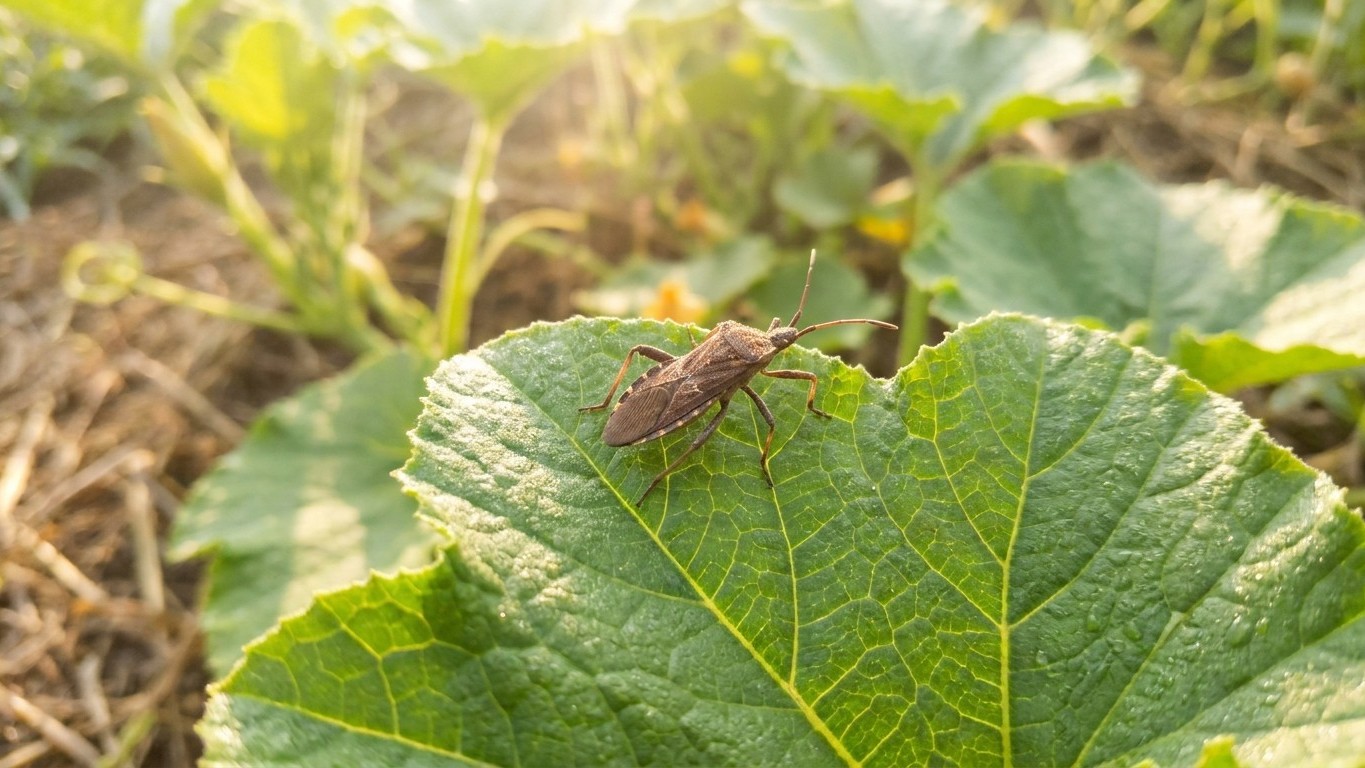
Adult squash bugs are flat-backed, brownish-gray, about five-eighths of an inch long, and they smell faintly unpleasant when crushed, similar to a stink bug. They cluster at the base of plants and under leaves, moving fast when disturbed rather than flying off immediately.
The bigger tell is the eggs. Squash bug eggs are bronze to reddish-brown, laid in tight clusters on the underside of leaves, usually in the V-shaped angle where leaf veins meet. A single cluster can hold 20 to 30 eggs, and one female can lay several hundred over her lifetime. Checking leaf undersides twice a week from the moment plants have true leaves is the single most effective early-detection habit a New Mexico gardener can build.
Nymphs hatch in about a week to ten days and go through five growth stages before becoming adults, a process that takes four to six weeks depending on temperature. Early nymphs are gray with black legs and cluster together, which actually makes them easier to wipe out than scattered adults if you catch them in that stage.
Damage shows up as wilting that starts at the leaf edges and spreads inward, sometimes mistaken for drought stress or bacterial wilt. Squash bugs feed by piercing plant tissue and sucking out fluid while injecting a toxin that disrupts water flow, so heavily infested plants can collapse within days even with adequate irrigation, something that trips up a lot of gardeners watering more water at plants that actually need fewer bugs.
What Actually Stops Squash Bugs in New Mexico Conditions
No single tactic wipes out squash bugs on its own. Extension entomologists across the Southwest consistently point to layered control, meaning several methods used together, as the only approach that keeps populations below damaging levels through a full New Mexico growing season.
Cultural and Physical Controls That Work in Dry Climates
Row covers put on immediately after planting and left in place until flowering starts block adults from ever reaching young plants. Because squash bugs need pollinators to arrive for fruit set, covers have to come off once blossoms open, but that window before flowering is exactly when plants are most vulnerable and easiest to protect.
New Mexico’s dry heat also makes the classic board trap surprisingly effective. Adult squash bugs seek shade and shelter overnight, so laying a flat board or roof shingle near the base of plants gives them somewhere to hide before morning. Flip it early and you’ll often find several adults clustered underneath, ready to be dropped into a bucket of soapy water.
Crushing egg clusters by hand remains one of the most efficient tactics available, especially because arid conditions mean fewer natural egg parasites keep populations in check compared to more humid regions. A few minutes twice a week scanning leaf undersides can prevent an entire generation from hatching.
Crop rotation helps too, though it’s less useful on small urban lots where space is tight. Moving cucurbits to a different bed each year, even 15 or 20 feet away, reduces the odds that overwintered adults find host plants immediately upon emerging.
Mulch is a double-edged tool in New Mexico gardens. It conserves scarce water, which matters enormously in a state where most regions get under 15 inches of rain a year, but thick organic mulch also gives squash bugs a cozy place to overwinter. Pulling mulch back from the base of plants in fall, after harvest, strips away that shelter before adults settle in for winter.
Biological and Least-Toxic Options
Tachinid flies (Trichopoda pennipes) parasitize adult squash bugs by laying a single white egg on the bug’s body, and the larva eventually kills its host. These flies are present in parts of New Mexico, and gardeners can support them by planting flowering herbs like dill, fennel, or yarrow nearby, since adult tachinid flies need nectar sources to survive and reproduce.
Insecticidal soap and neem oil work on young nymphs but do almost nothing against hardened adults, whose shell resists penetration. Timing sprays for the nymph stage, right after eggs hatch, gets far better results than spraying adults later in the season.
Diatomaceous earth applied around the base of plants can dehydrate nymphs that crawl through it, though New Mexico’s frequent wind means reapplication after any disturbance is often necessary for it to stay effective.
Trap cropping is worth mentioning for larger gardens. Blue Hubbard squash reliably draws squash bugs away from other cucurbits because it’s a preferred host. Planting a few Blue Hubbard vines along the garden perimeter, then treating or removing bugs that concentrate there, can protect the main crop with far less effort than treating the entire bed.
Preventing Next Year’s Infestation Starts in Fall
The window between final harvest and first frost is when most New Mexico gardeners lose the fight against next year’s squash bugs without realizing it. Leaving spent squash vines, fallen leaves, and old fruit in the garden through winter gives adults exactly the shelter they need to survive the cold months and re-emerge ready to breed in spring.
Pulling all cucurbit plant debris and either composting it in a hot, actively managed pile or bagging it for disposal cuts overwintering habitat dramatically. Tilling the soil in fall also exposes any adults or eggs hiding near the surface to freezing temperatures and predators, something particularly effective in northern New Mexico where winter lows regularly drop well below freezing for extended stretches.
Rotating next year’s cucurbit bed to a spot at least 20 feet from this year’s planting, combined with row covers going on the day seedlings go in the ground, gives New Mexico gardeners the strongest possible start before the first generation of adults even has a chance to find the crop.
Related guides
- Squash bug in Arizona: When It Shows Up and What Stops It
- Squash bug in Utah: When It Shows Up and What Stops It
- Squash bug in Oklahoma: When It Shows Up and What Stops It
- Squash bug in Ontario: When It Shows Up and What Stops It
- Thrips in New Mexico
- Bagrada bug in New Mexico
- Lygus bugs in New Mexico
- Squash bug in Illinois: When It Shows Up and What Stops It