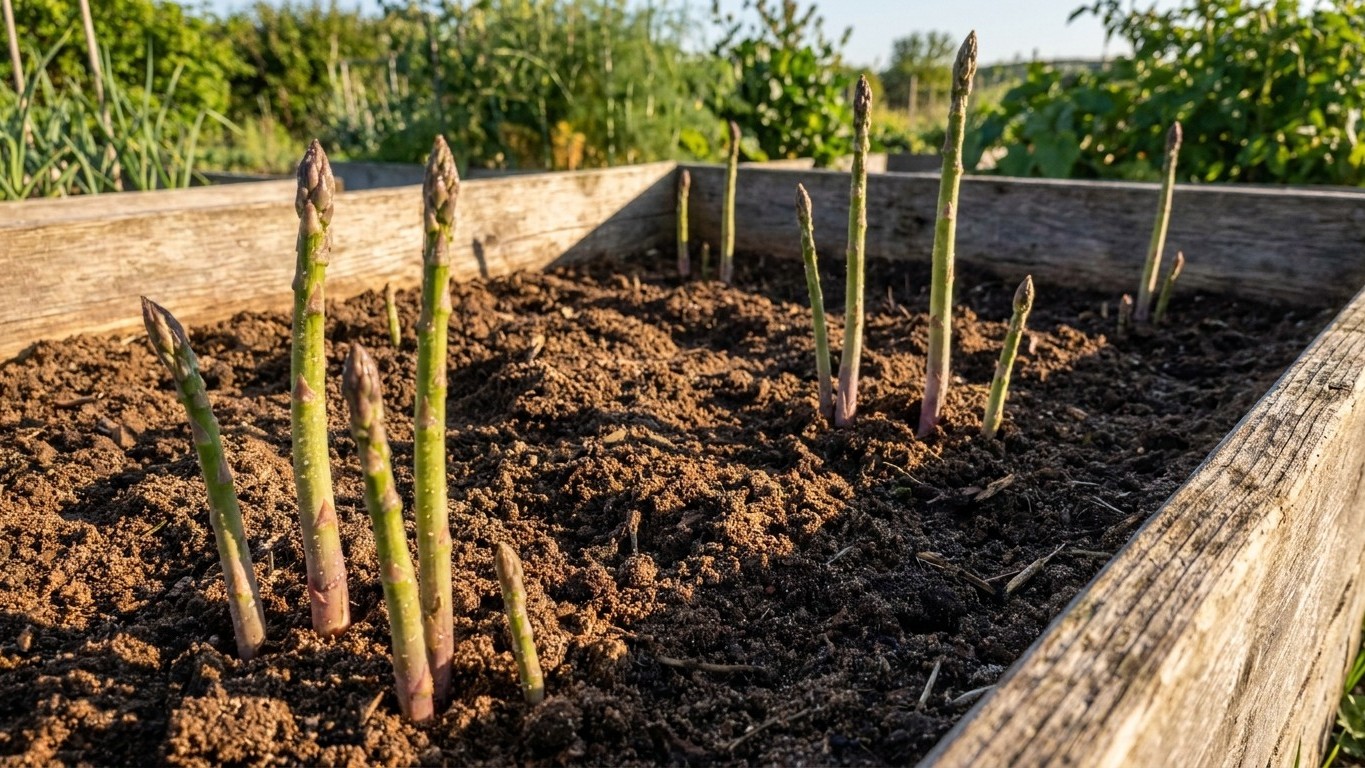

Cut asparagus until most of the new spears come up thinner than a pencil, then stop and let the ferns grow. The bed gets no cutting at all until year 3. Cut spears keep best just above freezing with their cut ends wet, and that takes more care than most refrigerators give by default. Both halves of the job matter, because a spear cut at the right moment still turns tough on a warm counter.
Keeping it, and for how long
What temperature and humidity keep cut asparagus best?
The UC Davis Postharvest Technology Center puts the optimum for green asparagus at 0°C to 2°C (32°F to 35.6°F), with relative humidity of 95 to 100 percent. The air has to be that close to saturated because a spear dries out quickly, and it loses water through the cut end faster than through anywhere else. A bunch left in ordinary dry refrigerator air shrivels from the butt upward, and the tips go limp.
Both edges of that window bite. Above 10°C (50°F), UC Davis reports that spear toughening occurs rapidly. In practice that means within hours, which is how a bunch left on the counter while you decide about dinner turns stringy. At -0.6°C (30.9°F) or lower, freezing injury is likely. The spears take on a water-soaked look and then go extremely soft. The target is cold, wet air that stays above the freezing edge and well under the toughening edge.
How long do cut asparagus spears last in the fridge?
Any number of days quoted for fresh asparagus is a ceiling. It holds only when temperature and humidity both sit in the optimum range from the minute of cutting. Cold slows the clock but never stops it, and a spear in a drying fridge or a warm door shelf runs through its good life much faster than a spear in a jar of water on a cold shelf.
Spears from your own bed have one advantage over store bunches, which have spent unknown hours on trucks and shelves. They go from the plant to the cold within minutes. Use that by cooking them soon, and check before you do. The tips should be tight and closed, and the cut end should look plump and moist. A fresh spear snaps when you bend it, while an old one folds. Slimy tips or a sour smell mean the bunch has gone past saving.
Where in the house that actually is
Which fridge shelf is closest to the optimum for asparagus?
A household refrigerator is set for milk and leftovers, so it usually runs warmer than 0°C to 2°C. The door, opened dozens of times a day, runs warmer still. Door shelves are the worst place for spears. Cold air settles low and toward the back, so the bottom shelf comes closest to the optimum. A crisper drawer works too if its humidity slider can be closed.
Keep the bunch off the back wall if frost builds up there. Freezing injury starts at -0.6°C (30.9°F) or lower, and a spear pressed against an icy panel can reach that while the fridge dial looks fine. A kitchen counter, a sunny windowsill or a porch that swings between cold nights and warm afternoons all cross the 10°C (50°F) line, and the spears toughen each time they do.
How do you get 95 to 100 percent humidity at home?
A kitchen has no humidifier, so water does the work. Stand the butts in water or wrap them in a damp paper towel, then loosely cover the whole bunch with a plastic bag. The easiest setup is an upright jar with a little water under the cut ends, like a bouquet, with the bag slipped over the tips. Refresh the water if it clouds. If you skip this step, the cut ends dry first, and the spears go limp and tough within a short time, even at the right temperature.
How long should you cut asparagus each year in Newfoundland and Labrador?
When do you stop cutting asparagus each season?
Crowns go into 8-inch furrows in early spring, and the bed gets no cutting until year 3. After that it can produce for 10 to 15 years. The first cutting season runs 4 weeks, the next runs 6, and later seasons run 8. Taking “just a few spears” earlier than that costs the crowns the growth they are building for the long haul. The full planting story is in Growing Asparagus in Newfoundland and Labrador.
Those weeks are a cap. The signal to stop is on the plant: when most spears come up thinner than a pencil, quit cutting and let the ferns grow. A calendar date would be wrong in a province this large. At the St. John’s airport station the average last spring frost is May 30, and in one year out of two it falls later. Northern and upland districts run weeks behind that station. Spears that emerge ahead of the last frost can be nipped, so check the forecast on cold nights in late spring. The pencil check works wherever the bed sits.
If something starts chewing the ferns after you stop cutting, What Eats Asparagus in Newfoundland and Labrador, and When covers what to look for.
Does Newfoundland and Labrador soil drain well enough for asparagus?
Most soils suit asparagus if they are well drained. The province’s dominant soil is a Podzol, the leached ground that forms under conifers, covering 59 percent of the mapped surface. Its typical surface is loam to silt (56 percent sand, 9 percent clay, 35 percent silt) with about 3.3 percent organic matter and a median pH of about 4.3, which is strongly acid. It is also imperfectly drained, and that is short of what a 15-year bed needs on its own.
Rain adds to that. The St. John’s airport station averages about 290 mm (11.4 inches) from June through August, with July the driest at 92 mm (3.61 inches), and about 1534 mm (60.4 inches) over a whole year. Those are typical amounts for that one station. A slope, a valley or a coastal garden will differ, and a rain gauge on your own plot settles it. On slow-draining ground that much rain keeps crowns wet through the fern season.
If water stands in your spot after a hard rain, build the bed up in a raised bed or a mound before planting. River bottoms, muskeg and scraped or filled ground behave differently from the province’s typical profile, and the survey covers the agricultural regions only. Take a soil test from the exact spot. Will Newfoundland and Labrador Soil Hold an Asparagus Bed for Fifteen Years? walks through the decision.
Common questions
Can you cut asparagus the year you plant it?
No. Crowns planted in early spring are left uncut until year 3. Spears that appear before then are the crown building itself up for a bed that lasts 10 to 15 years.
How do you know it is time to stop cutting this season?
Look at the spears that are coming up. When most are thinner than a pencil, stop cutting. The weeks (4, then 6, then 8) are the upper limit for each stage, so a thin crop can end the season sooner.
Can cut asparagus sit on the counter or in the fridge door?
Neither is a good idea. Above 10°C (50°F), spears toughen rapidly, and the counter spends most of the day above that. The door is the warmest spot in the fridge. A bottom shelf with the butts in water is the better choice.
Does the variety change when to stop cutting?
Utah State University Extension covers asparagus varieties for the garden. The stopping rule is the same for each, and the end of the season is signaled by pencil-thin spears.