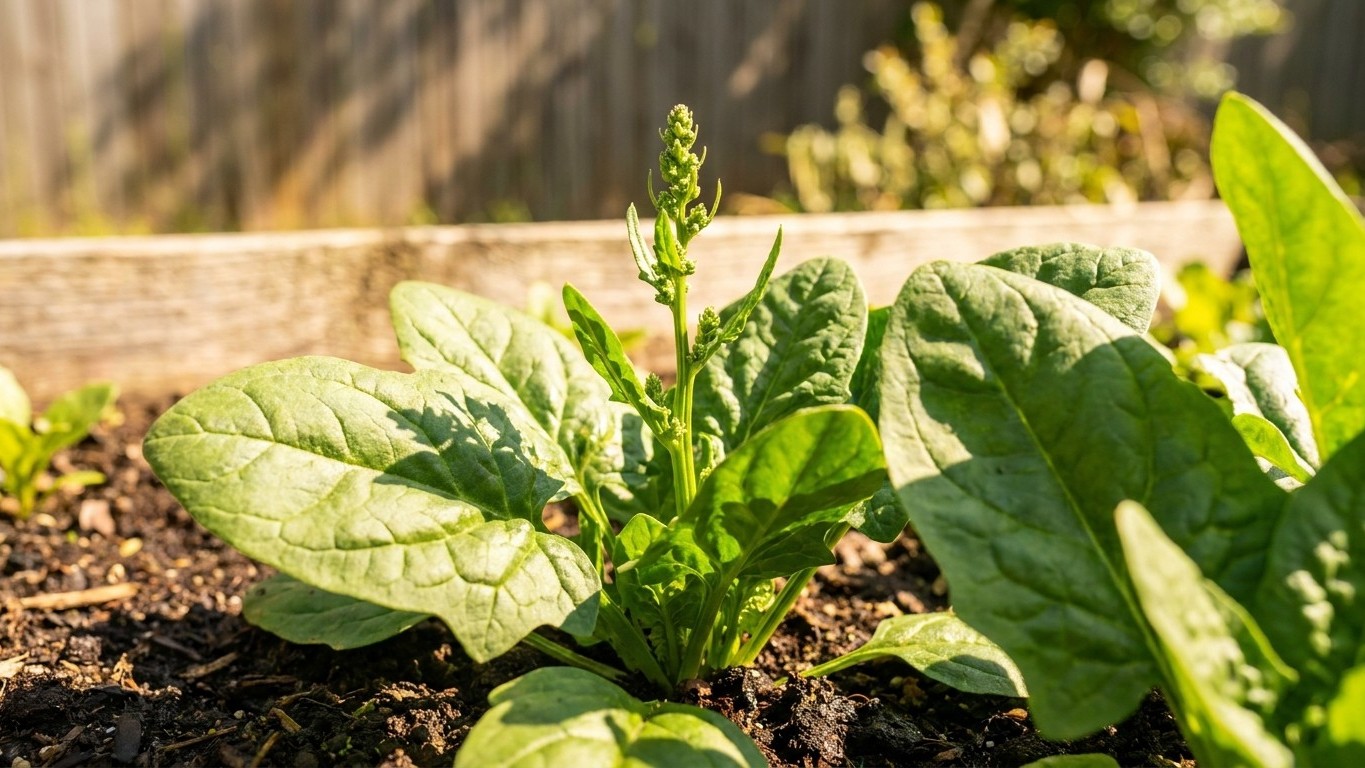

In St. John’s, the longest day of the year brings 15 hours and 47 minutes of daylight. That single number settles the question before frost dates or thermometers even enter the picture: spinach reads day length as a signal to flower, and Newfoundland and Labrador hands it about as much light as almost anywhere spinach is grown. Yes, it will bolt early here, and cool summers won’t stop it.
The short answer
Fifteen hours and forty-seven minutes of daylight on the summer solstice is the number that decides everything else for spinach in this province. Spinach doesn’t wait for heat to flower. It reads the clock, and once days stretch past a certain length, the plant shifts from making leaves to pushing up a seed stalk, a process gardeners call bolting. That shift happens on schedule regardless of whether the afternoon feels like a sweater day or a t-shirt day, which is exactly the trap for anyone moving here from a place with shorter, cooler-feeling summers.
Here’s the twist that surprises a lot of home gardeners: a cool St. John’s summer doesn’t buy extra weeks of spinach the way it would for, say, lettuce trying to dodge a heat wave. Long daylight alone is enough to flip the switch. So even with fog rolling in off the Atlantic and daytime highs that rarely feel tropical, the calendar keeps ticking toward the solstice, and the spinach keeps ticking toward its seed stalk right along with it.
Now, is heat also a factor? Barely. The reference station data for this province shows an average of 0.0 days per year reaching 90 F or higher. That’s not a typo or a rounding error, it’s close to a flat line. Spinach grows best when temperatures stay under 75 F, and in a place that essentially never sees 90-degree days, the plant is rarely getting cooked by heat the way it might in Kansas or Georgia. The bitterness and bolting pressure that heat causes elsewhere just isn’t much of a factor on the Avalon Peninsula or across most of the province.
That leaves day length carrying almost the entire load. This is a place where the limiting factor for spinach is overwhelmingly the clock, not the thermometer. A gardener battling spinach bolt in a hot climate is fighting temperature and light together. A gardener in Newfoundland and Labrador is fighting light largely on its own, which changes the whole strategy: shade cloth and extra water won’t do much here, because the plant isn’t struggling with heat stress, it’s responding to how long the sun stays up.
That distinction matters when you’re choosing when to sow, which variety to try, and whether to bother chasing a summer harvest at all. The rest of this guide walks through what that day-length pressure means for the actual spring and fall windows available in this climate.
How long the spring window really is
Working out the real spring window for spinach here means lining up three things: when the soil is finally workable, when the last frost typically arrives, and how fast the days stretch toward that mid-June daylight peak. None of those three dates is fixed in stone, and the frost figure especially deserves a second look before you plant.
- Start with the frost date, and treat it as a coin flip, not a guarantee. The average last spring frost at the St. John’s A station is May 30, based on the 1981-2010 Canadian Climate Normals from Environment and Climate Change Canada. That’s a mean date, which means in roughly half of all years, frost arrives even later than May 30. Gardeners a few miles inland or at higher elevation should expect to run behind this figure, sometimes by weeks.
- Sowing happens 2 to 3 weeks before that date, not after it. Spinach seed tolerates cold soil and light frost far better than heat, so the recommended timing is to get seed in the ground while frost risk is still present, roughly in the second half of May for most of the island, and later for the Northern Peninsula or interior Labrador where spring lags further behind.
- Then count forward to the daylight ceiling. By the time the solstice arrives in late June, daylight is closing in on that 15-hour-47-minute peak. Spinach sown in mid-to-late May gets roughly four to six weeks of decent leaf growth before the lengthening days push it toward a flowering stalk, regardless of how mild the temperatures stay.
- Heat almost never shortens this window further. With an average of 0.0 days a year above 90 F, the 75 F growth ceiling is rarely breached hard enough to add extra bolting pressure on top of the day-length trigger. The spring crop here fails on schedule, not on a heat wave.
Put together, that’s a spring spinach season measured in weeks, not months; plant in the back half of May, expect to be harvesting and then pulling bolted plants by early-to-mid summer, and don’t count on a mild June to stretch things out.
The autumn crop, and when the soil lets you sow
Autumn is where spinach usually gets its second, better chance, since the days are shortening rather than lengthening as the plant matures. But timing a fall crop here still comes down to counting backward from two hard stops: soil that’s too warm to germinate seed properly, and the frost that eventually ends the season outright.
Soil still too warm to germinate
Spinach seed germination drops off once soil temperatures climb above 80 F, according to Utah State University Extension. In much of the hot interior United States, that means gardeners have to wait out a stretch of scorching late summer before soil cools enough to sow a fall crop. Newfoundland and Labrador’s climate works differently: with essentially no days reaching 90 F air temperature all year, soil temperatures rarely climb anywhere near that 80 F germination ceiling in the first place. This isn’t a region where gardeners need to wait for a heat wave to break before sowing; the obstacle that dominates fall planting in hotter states is a minor concern here at best.
The frost that ends the season
The bigger constraint for a fall crop in this province is simply running out of season before frost shuts things down. The average first fall frost at St. John’s A lands on October 17, again a mean date from Environment and Climate Change Canada’s 1981-2010 normals, meaning frost arrives later than that in about half of all years, and earlier in the other half. Since the source publishes no fixed days-to-maturity figure for spinach, the guidance instead is to sow 50 to 75 days before your target harvest date. Counting back from October 17, that puts a fall sowing window roughly between early August and the very end of August, depending on how much of a cushion you want against an early frost. Given that frost date is only a midpoint and not a guarantee, gardeners who sow toward the earlier end of that window, closer to the start of August, give themselves the best odds of a full harvest before the first hard cold arrives.
Because this fall window sits well clear of the shrinking daylight problem that ends the spring crop, it tends to run longer and produce more reliably here, especially since neither the 80 F soil ceiling nor repeated 90-degree heat is working against it the way it might further south.
Common questions
Does a foggy, cool Newfoundland summer stop spinach from bolting?
No. Bolting in spinach is triggered by long daylight hours as much as by heat, and St. John’s gets nearly 16 hours of daylight at the summer solstice. Cool, foggy conditions don’t cancel out that day-length signal, so plants still bolt on roughly the same schedule they would in a warmer, sunnier location at the same latitude.
Is heat a bigger problem than day length for spinach here?
No, it’s the reverse. The reference station averages 0.0 days a year above 90 F, so the 75 F growth ceiling for spinach is rarely pushed hard by heat. Day length is doing almost all the work in triggering bolting in this climate, not temperature.
What spinach varieties are worth trying in this province?
Bloomsdale, Melody, Teton, and Olympia are commonly named spinach varieties, but no performance data, days-to-maturity figures, or bolt-resistance ratings for them are published in the source used here, so no claims can be made about how they’d compare against day length pressure in this climate.
When exactly should I sow a fall spinach crop in Newfoundland and Labrador?
Counting back 50 to 75 days from the average first fall frost of October 17 points to a sowing window from roughly early August to late August. Since that frost date is a mean and arrives later in about half of all years, sowing toward the earlier part of that window offers more of a safety margin.