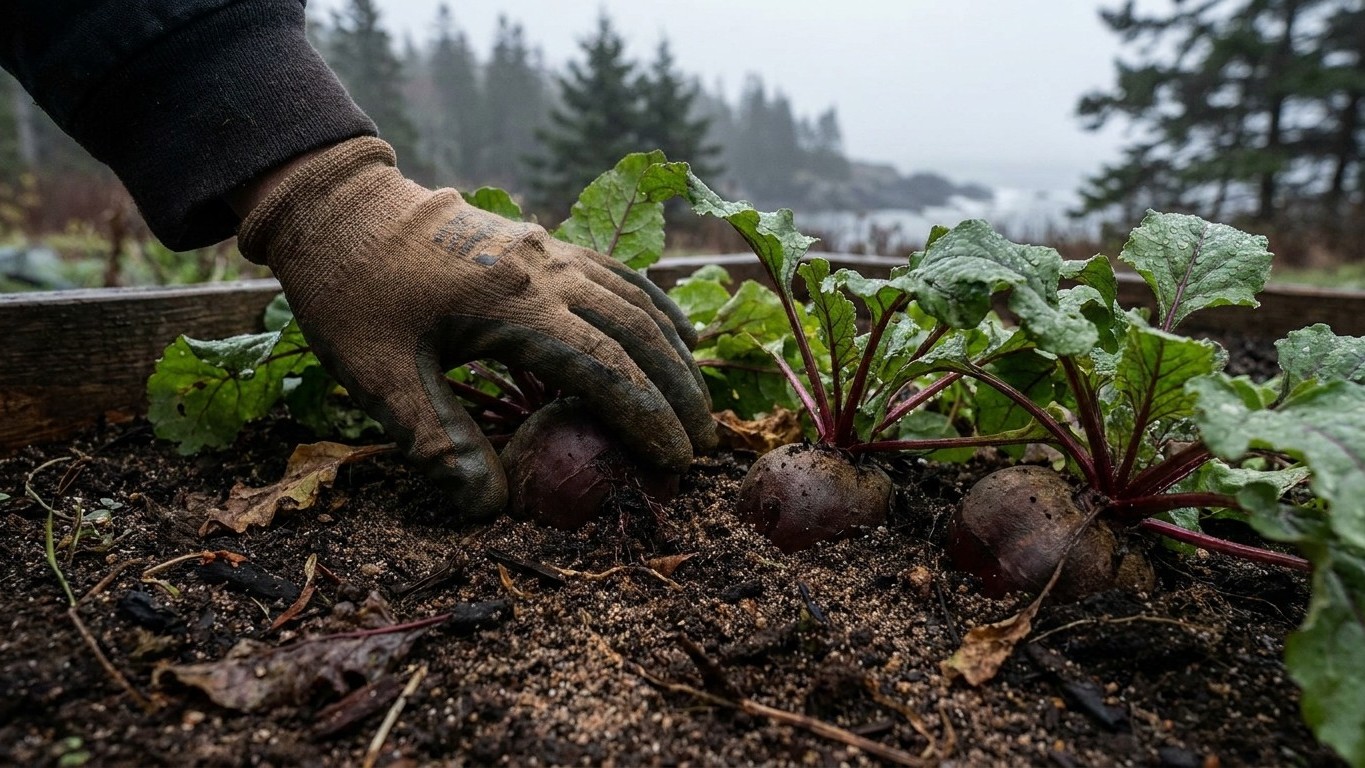

Beets in Newfoundland and Labrador do best when the grower treats the ground as sandy but sour: most agricultural soil across the province runs strongly acid and holds water longer than a beet root wants. Sow two to three weeks before the average last frost, which lands around May 30 at St. John’s, and keep the row consistently moist for the first six weeks. For a full breakdown of timing by region, see When to Sow Beets in Newfoundland and Labrador. That single habit does more to prevent bolting than anything else.
The short answer
Across the mapped agricultural soils of Newfoundland and Labrador, the most common soil order is Podzol, covering 59 percent of the mapped surface, with Organic soils as the next largest group. A Podzol is the classic acid, leached profile that forms under conifer cover, where decades of rain have washed the calcium and other bases out of the topsoil. For a closer look at what this means for growers, see this breakdown of Beet Soil in Newfoundland and Labrador. The median surface pH across those mapped components comes out to about 4.3, which is strongly acid. Texture-wise, the median surface horizon runs 56 percent sand, 9 percent clay and 35 percent silt, a loam-to-silt mix, with organic matter around 3.3 percent and a drainage class described as imperfectly drained.
For a beet, that mix is a split decision. Utah State University Extension describes the ideal bed as deep, sandy and well-drained, rich in organic matter, and amended with no more than 1 inch of composted organic matter per 100 square feet. The province’s sand content lines up reasonably well with that description. The drainage class does not: “imperfectly drained” means water sits longer in the root zone than a beet’s forking taproot prefers, especially in a wet spring or after a heavy rain. The acidity is the other flag. A pH near 4.3 sits well below neutral, and a garden that tests out close to that median benefits from a lime application guided by an actual soil test rather than a guess.
On the heat side, the sourced data for this page does not include a count of days per year that the reference station passes 90°F, so that figure is not published here. What is documented is the mechanism: Utah State University Extension notes that heat above 85°F combined with water stress is what turns a beet root woody, a separate failure from bolting. Readers in a Newfoundland garden should judge that risk locally, since a maritime province rarely strings together many days that hot, but a single dry, sunny stretch late in the season can still do the damage described.
None of this is a diagnosis for one backyard. The province spans hundreds of mapped soil components, and a garden on a river terrace, a filled lot or reclaimed bog ground can differ completely from the province-wide median described above. Treat these numbers as the starting tendency of the region’s ground, then confirm with a soil test.
The six weeks that decide it here
Sowing beets two to three weeks ahead of the last frost puts the entire critical window, the six weeks after seeding when Utah State University Extension says water stress triggers premature flowering, squarely inside this province’s early spring. That timing matters because the average last spring frost at the St. John’s A station is May 30, based on Environment and Climate Change Canada’s Climate Normals covering 1981 to 2010. A grower following the two-to-three-week rule is typically seeding sometime in the second half of May, meaning the six-week clock runs from roughly mid-May into late June or early July depending on the exact sowing date.
That average date deserves a caution of its own. It is a mean, not a safe cutoff: in one year out of two, the last frost actually falls later than May 30. Treat it as the midpoint of a window rather than a green light, and remember that this figure comes from a single coastal station. Northern districts and upland ground inland run weeks behind St. John’s, so a grower away from the Avalon coast should push sowing later rather than earlier when in doubt.
What does that stretch of spring typically bring? Newfoundland’s growing season is shaped by a cool, maritime climate close to open water, which tends to produce a damp, slow-warming spring rather than a dry, sun-baked one. That works in the beet grower’s favor for the bolting risk described by Utah State University Extension, since the trigger is thirst, not cold by itself. A spring that stays naturally moist reduces the odds of the kind of prolonged dry spell that stresses a young beet into flowering early.
The trade-off is drainage. A damp spring layered onto imperfectly drained ground raises the odds of waterlogged seed rows, slow or patchy germination, and rot at the seed stage rather than bolting at the root stage. The six weeks that decide bolting risk in a drier, hotter state are, in Newfoundland, more often the six weeks that decide whether the seed rows drain fast enough to germinate evenly at all.
What goes wrong here
- Bolting from a dry pocket inside an otherwise damp spring. Even in a generally moist climate, a week or two of dry wind and sun during the first six weeks after seeding is enough to trigger the premature flowering that Utah State University Extension links to early water stress. The remedy is simple monitoring: check soil moisture at root depth twice a week during any dry stretch and water before the surface visibly cracks, rather than waiting for the plant to show stress.
- Woodiness from a late hot, dry snap. This is a different failure from bolting, tied to heat above 85°F arriving together with dry soil later in the season. Mulching the row to hold moisture and watering deeply during any hot spell keeps the root tender, since letting the bed dry out during heat is what causes the fibrous texture, not the heat alone.
- Slow or patchy germination in imperfectly drained ground. With a median drainage class of imperfectly drained across the province’s mapped soils, seed rows in low or flat spots can stay too wet right after sowing. Raised rows or a raised bed, plus working in the recommended maximum of 1 inch of composted organic matter per 100 square feet, improves both drainage and the tilth beets need to push a straight taproot down.
- Stunted, pale growth in strongly acid soil. A median surface pH near 4.3 is well outside the comfortable range for most vegetable crops. Rather than guessing, send a soil sample for testing and apply lime according to the lab’s recommendation, since over-liming acidic Podzol soil creates its own set of problems.
- Frost damage from sowing too early off the average date. Because May 30 is a mean and not a guaranteed safe date, and because inland or northern ground runs weeks behind the coast, a sowing timed strictly off that average can still meet a late frost. Row cover held in reserve for the two weeks after the average date is cheap insurance.
Checking this against your own county
Everything above describes the province’s mapped agricultural soils and one coastal climate station, not any single garden. The most useful next step is a soil test through Newfoundland and Labrador’s Department of Fisheries, Forestry and Agriculture, which can be reached at gov.nl.ca/ffa. A test result replaces the province-wide median pH of 4.3 and the province-wide texture figures with numbers specific to the actual bed, and staff there can also speak to how local frost timing in a given district compares with the St. John’s average used on this page. That single step turns a regional starting point into an actual planting plan.
Common questions
How many days after sowing do beets take to mature in Newfoundland and Labrador?
The maturity clock runs from the seeding date, since beets are sown directly in place rather than started as transplants and then moved. The exact days-to-maturity figure depends on the variety chosen, which isn’t specified in the sourced data here, but growers should count from the day the seed goes into the row, not from any later transplant date, when planning a harvest window around the region’s frost dates.
Is the province’s soil naturally too acidic for beets?
The median surface pH across the province’s mapped agricultural soils is about 4.3, strongly acid, which sits below where most root vegetables perform best. That figure describes the regional median, not any one garden, so the only way to know a specific bed’s pH is a soil test, followed by lime if the lab recommends it.
Should I water beets less if Newfoundland springs are already damp?
No. A generally moist spring lowers the odds of the prolonged dry spell that triggers bolting, but it does not eliminate short dry stretches, and Utah State University Extension ties premature flowering specifically to water stress in the first six weeks after seeding. Check the soil at root depth rather than assuming rainfall alone is enough.
Does the average May 30 last-frost date mean it’s safe to sow beets outdoors by early June?
Not automatically. That date is a mean from Environment and Climate Change Canada’s 1981-2010 Climate Normals for the St. John’s A station, meaning frost falls later than May 30 in about half of all years, and inland or northern districts typically lag behind the coast. Treat it as the middle of a risk window and keep row cover on hand for the following two weeks.