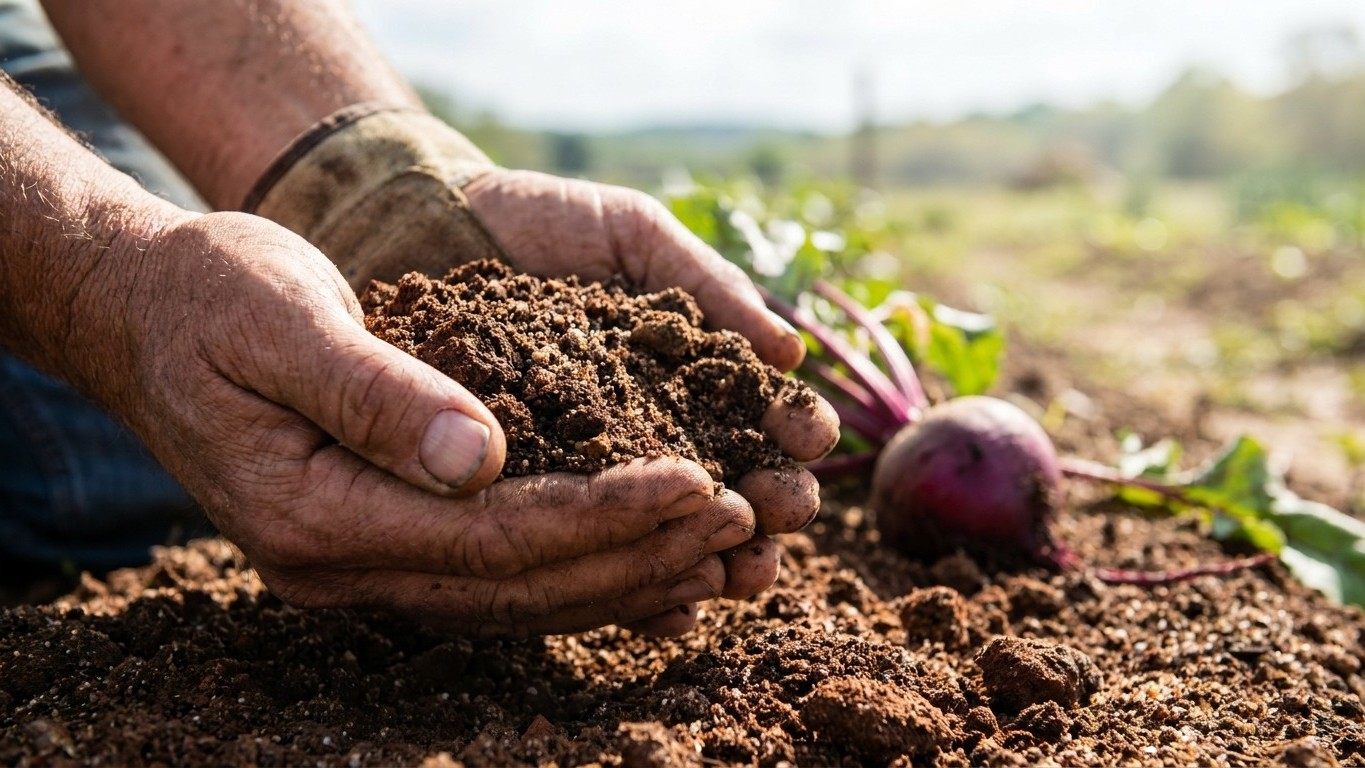

A beet root sown into typical Newfoundland and Labrador ground meets acid, leached soil sitting on an imperfectly drained profile, in a growing season built around a last frost that falls, on average, at the very end of May. That combination sets two separate risks for the gardener: a wet, slow-to-warm start that can trigger early bolting, and a soil chemistry that needs correcting before the root ever gets the chance to size up.
The short answer
Across the agricultural parts of the province, the most commonly mapped soil order is Podzol, the acid soil that forms under conifer forest where centuries of rain have washed the bases out of the topsoil. Podzols cover 59 percent of the mapped surface, with Organic soils as the next most common group. The median surface pH of these mapped soils sits around 4.3, which is strongly acid, well outside the range most root vegetables prefer. Texture runs 56 percent sand, 9 percent clay and 35 percent silt, a loam-to-silt blend, with organic matter around 3.3 percent. Drainage class is imperfect. That figure set comes from Agriculture and Agri-Food Canada’s Canadian Soil Information Service, drawn from the surface horizons of 459 mapped soil components across the province.
For a beet, that profile cuts two ways. The sand fraction and moderate organic matter suggest a root that should push down easily enough once it gets going. But imperfect drainage, likely tied to a compacted or cemented layer beneath the topsoil that’s typical of Podzol formation, means water can sit longer than a beet root wants after a heavy spring rain. And a surface pH near 4.3 is acid enough to stunt growth before drainage even becomes the issue; beets generally do better in soil closer to neutral, so a lime correction based on an actual soil test is the first practical step, not an afterthought.
| Property | Value |
|---|---|
| Dominant soil order | Podzol (59% of mapped surface) |
| Median surface pH | ~4.3 (strongly acid) |
| Texture | 56% sand / 9% clay / 35% silt |
| Organic matter | ~3.3% |
| Drainage class | Imperfect |
The province has no single official soil the way an American state might claim one representative series. This is the dominant profile among hundreds of mapped soils, not a diagnosis of any one garden. River bottoms, muskeg, and any yard that’s been built up or scraped by a contractor will read completely differently, and the survey behind these numbers only covers the province’s agricultural regions, leaving the far north unrepresented. A home soil test remains the only way to know what a specific bed is actually working with.
On heat, there isn’t a published figure here for how many days the reference station spends above 90 F, and that number won’t be invented for the sake of filling a gap. What can be said plainly: Newfoundland’s growing season is maritime and cool by nature, which changes where the beet-growing risk concentrates. Instead of heat being the dominant threat, as it often is inland, the bigger early-season concern here is wet, cold, acid ground slowing everything down before summer even arrives.
The six weeks that decide it here
Beets are direct-sown, not transplanted, and the standard guidance is to put seed in the ground two to three weeks before the last frost. In Newfoundland, that timing lands the first six critical weeks of a beet’s life squarely inside the province’s characteristic spring: cool, often damp, and slow to commit to warmth. The average last spring frost at the ST JOHN’S A station is May 30, according to Environment and Climate Change Canada’s Canadian Climate Normals covering 1981 to 2010. That’s a mean date, not a guarantee. In roughly one year out of every two, frost arrives later than that, so treating May 30 as a safe cutoff misreads what the number actually means. It’s the midpoint of a window, and a station reading from St. John’s doesn’t speak for the whole province either; inland and upland districts commonly run weeks behind the coast.
What does that spring usually bring? A maritime pattern more often lands on the damp side than the dry side, which changes where the classic beet failure sits. The published risk from Utah State University Extension is specific: water stress during the first six weeks after sowing causes beets to bolt, sending energy into a flower stalk instead of a root. In a climate that tends toward damp rather than parched, the odds of that particular drought-driven bolting trigger are lower than in a hot, dry inland state. But damp isn’t the same as well-drained. An imperfectly drained, acid seedbed sitting wet after repeated spring rain creates its own version of stress on young beet roots, just from the opposite direction. The practical takeaway isn’t “water more” or “water less” as a blanket rule; it’s watching the actual bed. A raised, well-drained row with corrected pH removes both risks at once, letting the six weeks after sowing pass in steady, moderate moisture rather than swinging between soggy and parched.
There’s also a second timing detail worth holding onto. Canadian normals here run 1981 to 2010, a different reference window than the 1991-2020 normals used for U.S. climate figures elsewhere. It doesn’t change the date itself, but it’s a reminder that these averages are built from a specific historical stretch, not a live forecast for any single spring.
What goes wrong here
- Seed sitting in cold, acid ground and barely germinating. A Podzol topsoil with a median pH near 4.3 is slow to warm and unfriendly to beet roots at that acidity. Get a soil test before sowing, and apply lime according to the test’s recommendation rather than a guess, so the bed is corrected ahead of the season rather than mid-season.
- Waterlogged seedbeds after spring rain. Imperfect drainage, likely from a compacted layer beneath the topsoil typical of Podzol formation, keeps water sitting around young roots longer than beets tolerate well. Raised beds or raised rows, combined with working in organic matter up to one inch of composted material per 100 square feet, open the profile enough to let excess water move through.
- Bolting from an uneven watering routine in the first six weeks. Even in a generally damp climate, a dry stretch layered on top of already-thirsty soil during that early window can push beets toward premature flowering instead of root growth. Keep moisture steady rather than reactive, watering before the surface visibly dries rather than after.
- Roots turning tough and woody during a rare hot, dry spell later in summer. Utah State University Extension notes that heat above 85 F combined with water stress is what causes this, a separate failure from early bolting. Mulch to hold soil moisture and water deeply rather than lightly whenever a warm stretch arrives.
- Stunted growth that looks like a nutrient problem but is really pH. In acid Podzol soil, beets can look pale and slow even with decent organic matter present, because the acidity itself is limiting uptake. Retesting pH partway through the season, after any lime application, confirms whether the correction actually took.
Common questions
Can I grow beets in Newfoundland’s acid soil without lime?
It’s possible but harder than it needs to be. With a median surface pH around 4.3, most beds in the province’s agricultural areas sit well below what beets prefer, and Utah State University Extension’s guidance centers on well-drained soil rich in organic matter, not specifically on tolerating strong acidity. A soil test followed by lime at the recommended rate removes one of the two biggest local obstacles before sowing even happens.
How do I keep beet seedlings from rotting in a wet Newfoundland spring?
Raised beds or raised rows are the most direct fix for the province’s typically imperfect drainage. Working in organic matter, up to one inch of composted material per 100 square feet as recommended by Utah State University Extension, also helps open a dense, acid topsoil so water moves through rather than pooling around the seed.
Is the average last frost date safe to sow beets by?
Not as a fixed rule. The May 30 average from Environment and Climate Change Canada’s 1981-2010 normals for the ST JOHN’S A station is a midpoint, meaning frost falls later than that in roughly half of all years. Sowing two to three weeks before that date is standard timing, but it’s worth watching local conditions rather than treating the calendar date as a guarantee, especially away from the coast.
Does Newfoundland ever get hot enough to make beets woody?
There’s no published figure here for how often the province crosses the 85 F threshold that Utah State University Extension links to woody roots when paired with water stress. What can be said is that Newfoundland’s maritime climate makes sustained heat far less common than in warmer inland regions, which shifts the greater local risk toward early bolting from cold, wet soil rather than late-season woodiness from heat.