
Newfoundland and Labrador’s growing window is short and cool, bracketed by a mean last frost around May 30 and a mean first fall frost around October 17 in St. John’s. That gap, roughly 140 days at best, means cover crop choices lean toward fast-establishing, cold-tolerant species sown once rather than in overlapping rounds, with timing built around soil warmth rather than the calendar.
When the soil is warm enough in Newfoundland and Labrador
The mean last spring frost at the ST JOHN’S A station sits at May 30, according to Environment and Climate Change Canada’s 1981-2010 Climate Normals. That date is a mean, not a guarantee: in roughly half of all years, frost lands later than May 30, not earlier. Treat it as the middle of a window, not a green light.
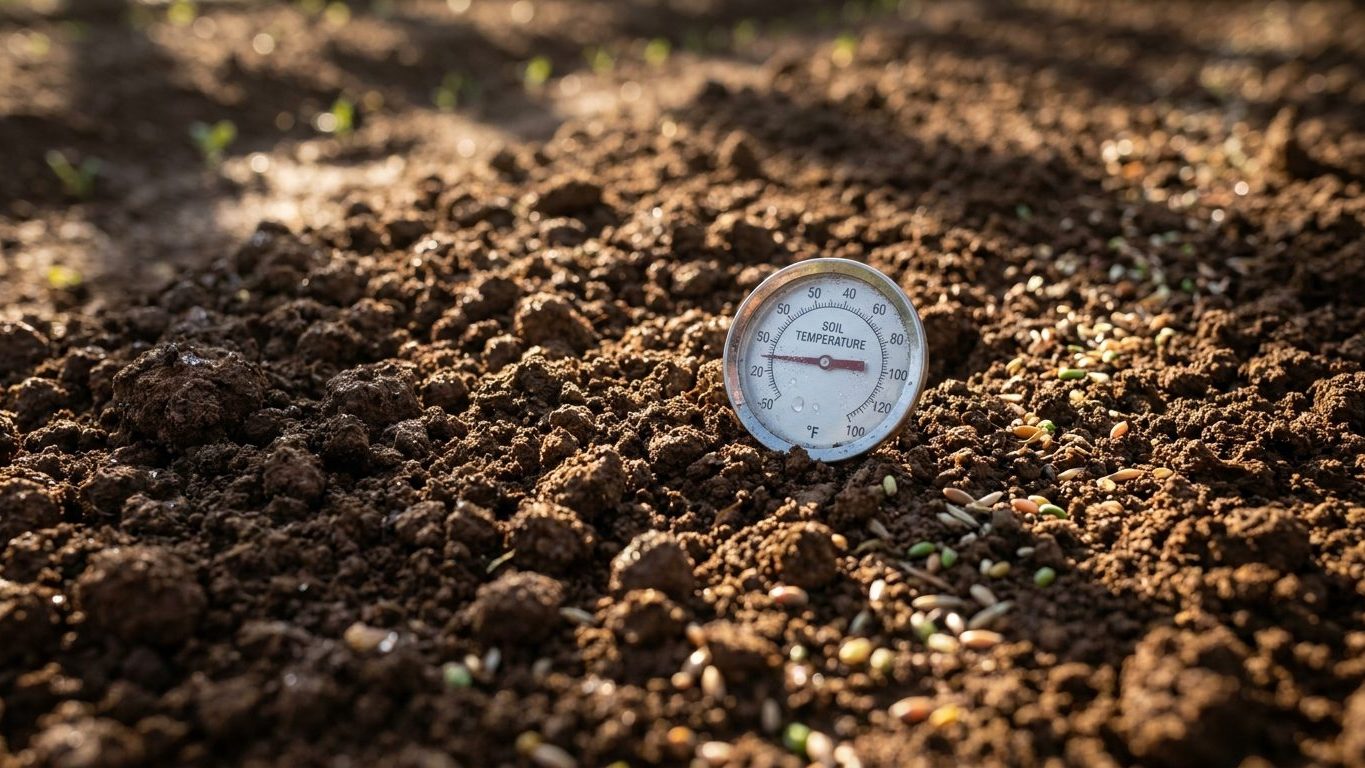
But frost date and planting date for cover crops are two different questions. What matters for germination isn’t whether the air stays above freezing overnight, it’s whether the soil itself has warmed enough for seed to break dormancy and root. Soil lags behind air temperature by days to weeks, especially in Newfoundland and Labrador’s clay-heavy, often waterlogged ground, which holds winter cold longer than sandy soil does. A gardener who sows the moment the frost risk technically clears is often sowing into soil that’s still too cold for anything but the most cold-hardy species to germinate reliably.
That’s where species selection starts to matter more than date-watching. Cool-season grasses and some brassicas will push through in marginal soil temperatures where a warm-season legume just sits and rots. Oats, for instance, germinate at soil temperatures most legumes won’t touch. The practical move is to check soil temperature directly, with a simple soil thermometer pushed a couple of inches down, rather than trusting the frost date alone.
Seeding rate is the next question gardeners ask, and it’s one this page won’t answer with a number. Rate depends on the species chosen, whether you’re broadcasting by hand or drilling, the seed’s own germination percentage, and the purpose, a thick stand for weed suppression needs a different rate than a thin nurse crop for a fall garden bed. Any single figure printed here would be wrong for someone’s situation. The Newfoundland and Labrador Department of Fisheries, Forestry and Agriculture can give rate guidance suited to local seed sources and soil conditions, and that’s the right place to ask.
Termination, when the time comes, follows the same mechanical logic used across this site: mowing, crimping, cutting, or simply letting winter cold do the job. No herbicide recommendation belongs here, and none is given.
How long the season lasts here
Subtracting May 30 from October 17 gives a growing window of roughly 140 days, from the mean last spring frost to the mean first fall frost at the ST JOHN’S A station. That’s the frame every cover crop decision in this province has to fit inside, and it’s tighter than most of the American Midwest or the mid-Atlantic states this site covers elsewhere.
A 140-day window doesn’t leave much slack for a two-round cover crop program. In warmer regions, gardeners often sow a spring cover crop, terminate it, grow a summer vegetable, then sow a second cover crop in fall before frost. Here, that second sowing window is thin at best. By the time a summer crop finishes and the bed clears, there may be only a few weeks left before October’s mean frost arrives, and cover crops sown that late often don’t establish enough biomass to be worth the seed.
That reality pushes most Newfoundland and Labrador gardeners toward a single, well-timed sowing rather than a succession plan. A fall-sown cover crop, put in right after the last vegetable harvest, aiming to establish before growth slows for winter, tends to make more sense than trying to squeeze in a summer cover crop between two vegetable rounds. The exception is a garden bed that sits fallow or gets an early crop pulled in midsummer, leaving genuine time for a short-cycle cover crop before fall frost.
The math also changes how gardeners think about transplants versus direct-seeded vegetables ahead of a cover crop. Transplanting a vegetable rather than direct-seeding it can buy two to three weeks of extra cover crop window at the back end of the season, since the vegetable itself needs less field time to reach harvest. Anyone weighing that trade-off, or trying to figure out whether a second sowing is realistic in their specific bed, should look at this site’s succession sowing guide, which walks through the timing math in more detail than fits here.
Heat and water in Newfoundland and Labrador
For most cover crop guides, summer heat and rainfall decide whether a crop wilts or thrives. Newfoundland and Labrador flips that question almost entirely. Heat isn’t the constraint here, cold is, and the FACTS available for this territory don’t include a days-above-90-F count or a summer rainfall figure, because that framing simply doesn’t fit this climate the way it fits a Zone 7 garden in Virginia or a hot Prairie summer in Saskatchewan.
What does the work instead is the coldest month’s mean daily minimum, which sits at 16.4°F according to the same ECCC Climate Normals dataset. That number is the one that actually decides which cover crop species survive a Newfoundland and Labrador winter and which don’t. It’s not the record low, and it’s not a single cold snap, it’s the average minimum across the coldest month, which means most winters will produce nights colder than 16.4°F, sometimes considerably colder.
That figure, paired with the Canadian hardiness zone of 6a for the reference city (a rating built from seven climate variables under the Canadian system, and not convertible to a USDA zone, according to Natural Resources Canada), tells a clear story: this is a climate where winter-hardy species survive to be terminated by hand in spring, and tender species die back on their own, turning into a mulch layer before the gardener ever needs to touch them.
That’s the real climate question for a cover crop here, not heat tolerance but cold tolerance. In a milder province, a species like oats might survive winter and turn into an unwanted weed the following spring, something to fight rather than something that did its job and quietly died. In Newfoundland and Labrador, that same oat crop reliably winter-kills, making it one of the simplest, lowest-maintenance choices available, since the cold does the termination work for free.
The flip side of a climate this cool is what a damp, short summer brings instead of heat stress: slower ripening, higher humidity lingering in dense plant canopies, and more pressure from fungal issues like mildew on crops that stay wet longer between drying spells. That’s a disease-management question more than a drought-management one, and it shapes which cover crop species make sense here as much as the winter cold does.
Which cover crops suit Newfoundland and Labrador
Three climate facts point toward the same type of cover crop for this province: a short 140-day window favors species that establish and grow fast rather than slow-maturing types; a cold winter (mean minimum of 16.4°F in the coldest month) favors species that either winter-kill cleanly or are genuinely hardy enough to survive without becoming a weed problem; and a cool, damp summer makes disease resistance, especially against mildew and fungal pressure in dense stands, a real selection criterion rather than an afterthought.
Within those constraints, a few broad categories fit the territory:
- Cool-season cereal grains, sown in fall, that reliably winter-kill in this climate and leave a mulch layer requiring no spring termination effort
- Brassica-family cover crops, which germinate in cooler soil than most legumes and can establish quickly within the short window
- Winter-hardy legumes, chosen specifically for genuine survival through a 16.4°F mean winter minimum, not marginal survival that fails most years
- Fast-cycling grasses suited to a single-sowing season rather than a multi-round succession program
What this page won’t do is name a cultivar. That’s not a gap, it’s the honest answer. Variety trials, the kind that test specific cultivars against Newfoundland and Labrador’s actual soil, moisture, and cold patterns, are run at the provincial and county level, not from a general climate page like this one. A cultivar that performs well in a trial plot near St. John’s may behave differently in an inland or upland district running weeks behind the reference station’s frost dates. The Newfoundland and Labrador Department of Fisheries, Forestry and Agriculture holds that local trial data, and it’s the only source that can turn “winter-hardy legume” into an actual named variety worth planting.
The same caution applies to seeding rate and nitrogen contribution. A legume’s nitrogen contribution depends on how much biomass it produces before termination and how that termination is timed, mowed early versus left to flower changes the outcome substantially, and no single pounds-per-acre figure could account for that honestly. Termination itself, as elsewhere on this site, means mowing, crimping, cutting, or simply letting the cold finish the job, never a herbicide application. For rate and variety specifics matched to a particular Newfoundland and Labrador garden, the provincial extension service remains the next real step.