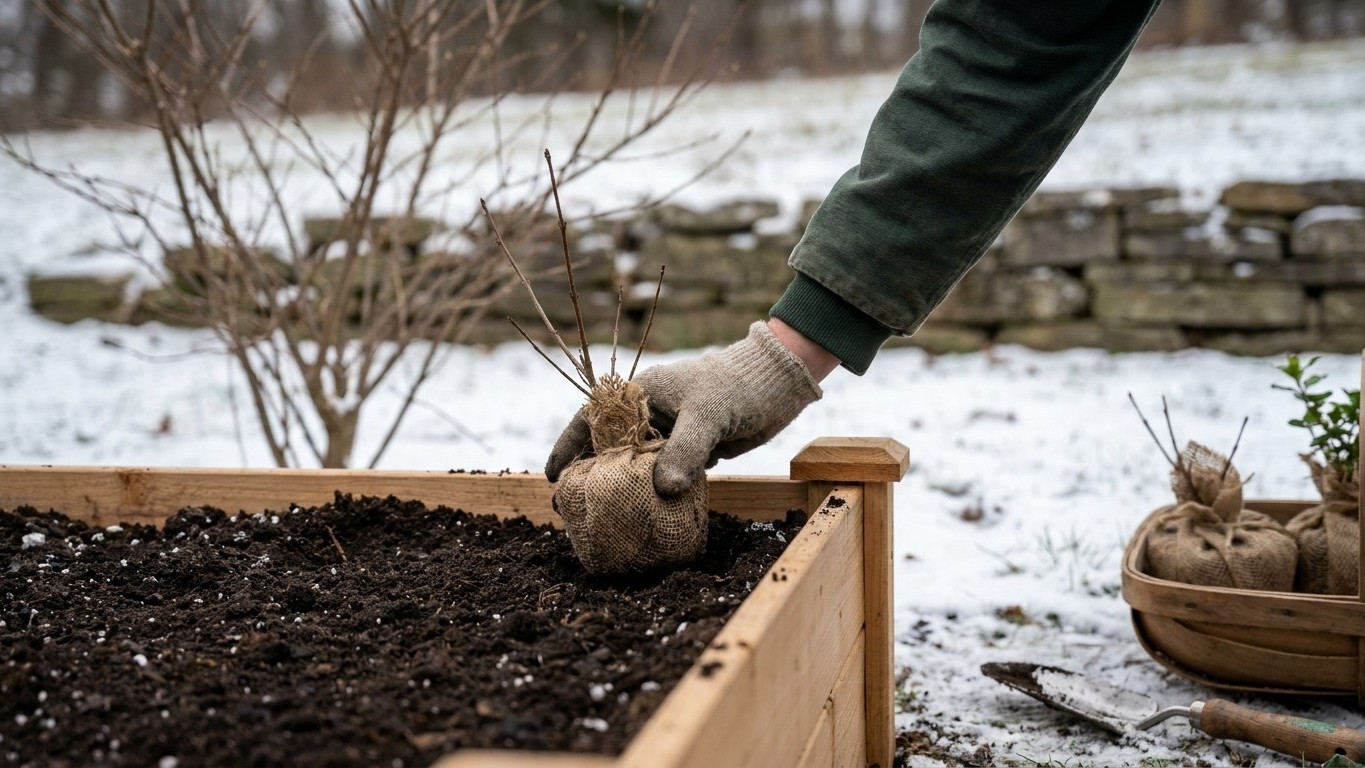

December in Newfoundland and Labrador is not a planting month. The ground is frozen or saturated across most of the province, and the average last spring frost at St. John’s doesn’t arrive until May 30, so anything sown outdoors now has no growing season ahead of it. What’s left is garlic under mulch where the soil is still workable, cold frames, forced bulbs and rhubarb indoors, and a long list of jobs that set up the season to come.
What goes in the ground in December

The decision here isn’t the calendar, it’s soil temperature and whether the ground can be worked at all. Newfoundland and Labrador sits in Canadian hardiness zone 6a at the reference station used for this page, a rating built from seven climate variables rather than the single-factor USDA scale, so it can’t be lined up against American zone numbers elsewhere on this site. What it tells a gardener here is simple: winters are long, springs are late, and December falls deep inside the dormant half of the year.
Say it plainly: nothing goes into open, unprotected ground in this province during December. Soil across most of Newfoundland and Labrador is either frozen solid or too wet to dig, and even where a mild coastal pocket keeps a bed workable, there’s no frost-free window ahead to grow into. The average first fall frost fell back on October 17, and the average last spring frost is still five months out.
What still fits the month:
- Garlic and shallots, but only where the bed hasn’t frozen yet and drainage is good; once the ground locks up, that window closes for the season.
- Cold frames and low tunnels over beds already carrying hardy greens, mainly to hold what’s there rather than to start anything new.
- Bare-root and dormant plantings of fruit trees, shrubs and canes, if the supplier ships and the site isn’t frozen, though most nurseries in this climate hold stock until spring.
- Forcing rhubarb or chicory indoors, lifted from the garden or bought as roots, grown in the dark for tender stalks and shoots.
Everything else waits. Trying to push a direct-sown crop into frozen or waterlogged soil wastes seed and time that’s better spent on the jobs below.
What to start under cover
Counting backward from an average last frost of May 30 is more useful than any fixed date on a seed packet, because it forces the gardener to work from their own site rather than a province-wide average. Long-season crops started from seed indoors, onions and leeks are the classic example, typically need eight to ten weeks under lights before they’re ready to go out, which puts their sowing window in late winter, not December.
December itself is largely too early for that arithmetic to work. Sow onions or leeks now and they’ll be leggy, rootbound and hungry for a bigger pot long before the soil outside has thawed enough to receive them. That’s the first failure mode: starting too soon and fighting weak, stretched seedlings for months.
The second failure mode runs the other way. Wait too long into late winter to start slow crops like celery or artichokes from seed, and there won’t be enough weeks left before the frost window closes to get a usable transplant. Both mistakes come from ignoring the count and trusting the calendar instead.
What does make sense under cover this month is slower, quieter work: starting a batch of microgreens or sprouts on a windowsill for fresh greens in the depth of winter, or potting up bulbs for forcing indoors. Neither depends on the outdoor frost date at all, which is exactly why they belong in December.
What is ready to pick
Outdoors, the honest answer is close to nothing. Any crop still standing in an open Newfoundland and Labrador garden by December has already been hit by frost more than once, and most gardeners cleared their beds well before now.
What still feeds a household this month comes from three places. Overwintered kale, leeks and some hardy cabbage varieties can sit under snow cover and stay usable, often sweeter after cold exposure, as long as the ground beneath them hasn’t heaved. Cold-frame greens, spinach, mâche, hardy lettuce, keep producing light pickings through the darkest weeks if the frame is vented on any mild day to avoid rot. Indoors, sprouts and microgreens started on a rolling schedule can supply fresh salad material every week regardless of what’s happening outside.
The other source is the root cellar or basement store. Squash, potatoes and onions put up in fall need a check now, not later. Squash that’s soft at the stem end or shows a sunken, discolored patch is on its way to rot and should be used first, not left to spread trouble to the rest of the bin. Potatoes that have sprouted or gone green near the surface should be pulled out and either used quickly or discarded, since green skin signals solanine buildup. Onions that have gone soft at the neck are past storing and belong in the kitchen, not the shelf.
The jobs that matter this month
A quiet garden still has deadlines, and December in this province carries more of them than most people expect.
Pruning and structure
Dormant pruning of apple, pear and plum trees, along with raspberry and currant canes, is best done while the plant is fully asleep and the wood is easy to see without leaf cover. Cutting now, rather than waiting for a warm spell, reduces the risk of disease entering fresh wounds and lets the plant heal slowly through the rest of winter. Check stakes, trellises and fruit cages for storm damage while you’re out there, since a broken support is far easier to fix on a calm December day than after the next gale.
Ordering, planning and soil
Seed catalogues move fast in this region, and the varieties bred for a short, cool growing season sell out well before spring planting begins. Ordering now guarantees the specific cultivars suited to a 6a climate rather than whatever’s left on the shelf in April. This is also the month to sketch next season’s crop rotation on paper, pull a soil sample if the ground allows it, and work in lime or organic matter where a fall test showed a need, since amendments need weeks to change soil chemistry before anything gets planted into it.
Maintenance that pays off later
Turning the compost pile keeps decomposition going even in cold weather, and a pile that’s neglected now often arrives at spring as a frozen, unusable brick. Cleaning soil and rust off pruners, spades and hoes, then sharpening blades, saves frustration during the rush of spring planting. Storage checks matter here too: any squash, potato or onion showing early rot should come out of the bin before it takes neighboring produce with it.
What not to do in December
The most common mistake in this climate is trusting a mild spell rather than the calendar or the soil itself. A few unusually warm days in early December can trick a gardener into pulling mulch off garlic beds or venting a cold frame wide open, only for a hard freeze days later to damage plants that had started to lose their cold tolerance. Mulch and covers should stay in place through the whole dormant period, not come off at the first thaw.
Planting anything warm-season into soil this cold is another version of the same error, mistaking air temperature for soil temperature. Peppers, tomatoes and beans have no place going into ground that hasn’t been near frost-free for months and won’t be for months more; starting them far too early indoors just produces weak transplants with nowhere to go.
Fertilizing is the third trap. Feeding nitrogen to dormant trees, canes or garlic beds in December pushes soft new growth right before the coldest stretch of the year, and that growth is exactly what winter injury targets first. Any feeding decision made from a fall soil test should wait for active growth to resume, not be applied to plants that are asleep.
Finally, resist digging or turning waterlogged soil. Working wet clay or silt now compacts it into a dense mass that drains poorly come spring, undoing months of soil-building in a single afternoon.
Checking this against your own county
Everything above is built from data at one station, St. John’s, and Newfoundland and Labrador is not one climate. Coastal areas of the Avalon Peninsula, the interior of the island, and Labrador’s northern communities can run frost windows weeks apart, shaped by elevation, distance from the ocean, and exposure to wind. A garden in a sheltered coastal valley may hold workable soil weeks longer than one on an exposed upland site at the same latitude.
Treat the dates on this page as a starting point, then check them against the Newfoundland and Labrador Department of Fisheries, Forestry and Agriculture for province-specific planting guidance suited to your own district.
Common questions
Can garlic still be planted in December in Newfoundland and Labrador?
Only where the soil hasn’t frozen and drains well. Once the ground locks up for winter, that window is closed until spring, so garlic beds started earlier in fall should already be under mulch by now.
Is it too late to start onions or leeks from seed indoors?
Yes, for December. Counting back eight to ten weeks from an average last frost of May 30 puts the right sowing window in late winter, not the depth of the current season. Starting now produces leggy, rootbound seedlings long before outdoor soil is ready.
What can actually be harvested outdoors this month?
Very little. Overwintered kale and leeks under snow cover, and greens held in a vented cold frame, are about the only outdoor options; everything else comes from stored squash, potatoes and onions, or from sprouts and microgreens grown indoors.
Why does this page’s Canadian hardiness zone not match US zone numbers?
Because the two systems measure different things. The Canadian zone (6a here) is built from seven climate variables, while the USDA system uses only winter minimum temperature, and a single Canadian zone can overlap several USDA zones. The two numbers should never be treated as interchangeable.