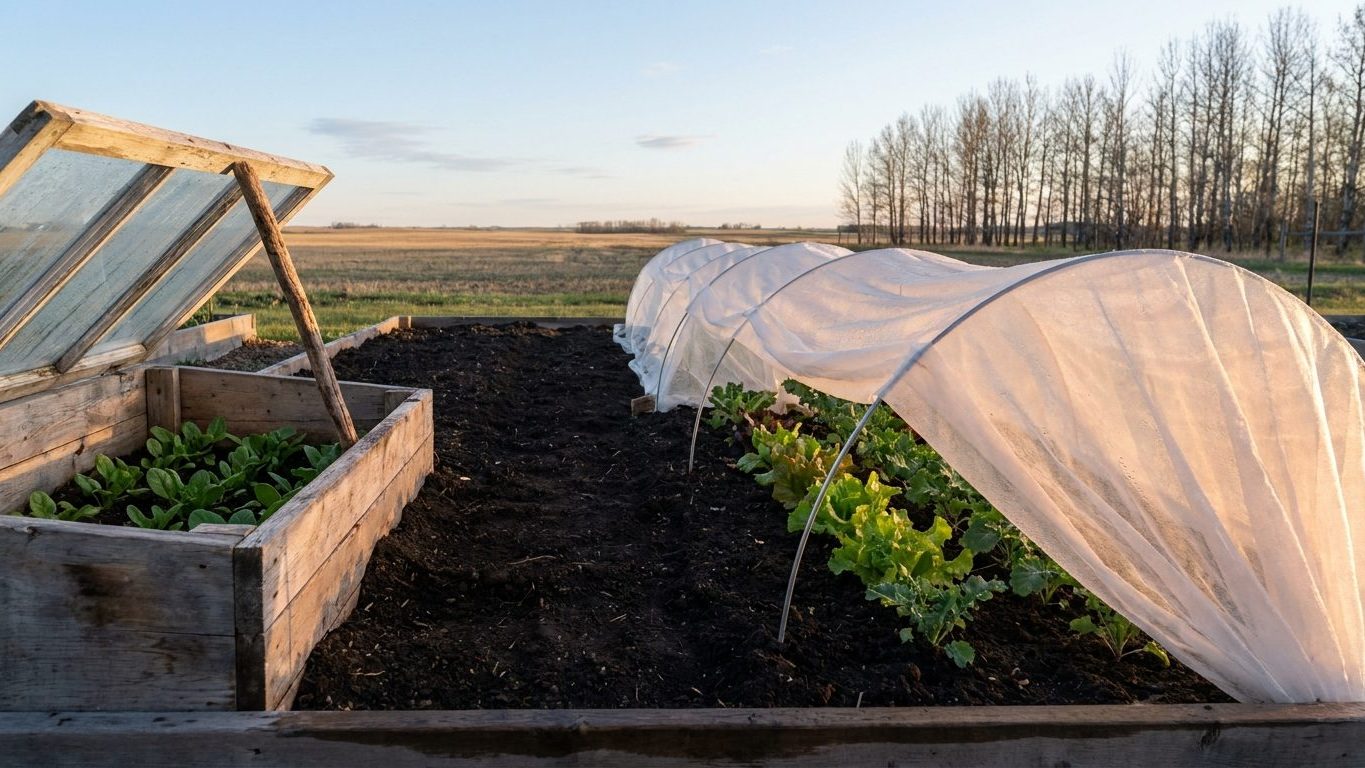

Lightweight floating row cover, low tunnels and cold frames are the extenders that earn their keep in Newfoundland and Labrador. They add a few weeks at each end of a short season, and that is about the most any of them can do here. Tall, heavy structures and anything that needs steady heat do less. The dates below come from St. John’s, so gardeners farther north or inland should shift everything later.
The short answer for Newfoundland and Labrador
Put row cover over hoops for spring and fall frost, and use a cold frame for early greens and for hardening off seedlings. Add clear plastic over a low tunnel when a crop needs warmth as well as frost protection.
The numbers explain why. At the St. John’s airport station, Environment and Climate Change Canada’s 1981-2010 normals put the average last spring frost on May 30 and the average first fall frost on October 17. That leaves about 140 frost-free days between them. Both dates are midpoints. In one year out of two, frost arrives after May 30 in spring, and in one year out of two it arrives before October 17 in fall. May 30 is the middle of a risky window, so it is no safe planting date.
Season extenders work by holding heat that the soil gave up overnight and by cutting the wind that strips it away. That buys protection from light frost and a bit more daytime warmth. It does not buy protection from a hard freeze. The coldest month at the reference station has a mean daily minimum of -8.7 °C (16.4 °F), and no cover turns that stretch into growing time.
A simple way to match the tool to the job:
- Floating row cover on hoops: frost nights in late spring and early fall, and a windbreak for young transplants.
- Low tunnel with clear plastic: extra warmth for transplants and direct-sown crops in cool soil.
- Cold frame: lettuce, spinach and other greens started early, plus hardening off.
- Black plastic on the bed: warms cold soil a week or two before planting.
The broader picture of stretching the calendar is in Extending the Growing Season in Newfoundland and Labrador. For deciding which nights call for a cover, see When to Cover Your Garden in Newfoundland and Labrador.
What will not work here
Crops that need a long, hot summer fall short, and no extender fixes that. About 140 frost-free days sounds like a decent run, but the soil is slow to warm in late May, and the cool summers that follow offer little heat to store. Melons, outdoor peppers and eggplant need warmth through the whole season, and a cover only holds the warmth that exists. Where these crops succeed, they usually grow in a heated or well-vented greenhouse rather than under a hoop.
Treating May 30 as a safe date also fails. Since frost comes later than that date in half the years, a tender transplant set out on June 1 with no cover is a coin flip. Keep covers on hand until well into June, and check the forecast on cool, clear nights.
Wind defeats the flimsy setups. Much of the island’s coast is exposed, and light plastic on thin hoops flaps loose or tears. Row cover left unanchored ends up in the neighbor’s yard. Bury the edges, use sandbags or boards, and choose sturdy hoops pushed deep into the soil. A cold frame with a loose lid will lift off in a gale, so hinge it and fasten it down.
Overheating and damp cause trouble even in a cool climate. A closed cold frame or plastic tunnel can bake seedlings on a sunny afternoon, then drop below freezing that night. Vent it every sunny day. In foggy, wet weather, covers that stay shut hold humidity, which invites mold and slugs. Pull covers back whenever frost is not forecast.
Winter is another limit. With January and February nights averaging well below freezing, an unheated tunnel will not carry tender greens through. A tunnel can extend the fall harvest of hardy crops by a few weeks, but it will not keep lettuce growing in midwinter. Plan on a real off-season, and use the cover to shorten it at both ends.
What changes across Newfoundland and Labrador
The St. John’s reference city sits in Canadian hardiness zone 6a, according to Natural Resources Canada’s 1991-2020 normals. That is the Canadian system, built on seven climate variables, and it does not convert to a USDA zone. It describes one city. The province runs from the mild, maritime Avalon coast to the interior and to Labrador, so there is no single zone and no single answer. The spread is wide, and the map is the only way to see where a given town falls.
Latitude adds to the gap. St. John’s is at 47.62 degrees north, and Labrador lies well beyond it. Anyone near the northern edge of the province should check their own latitude, because day length shapes how fast crops grow and when some of them stop leafing and start setting bulbs or flowers. A garden up there gets long summer days but a much shorter frost-free stretch.
The frost dates travel badly. They come from one airport station, and northern and upland districts run weeks behind them. A garden on a hillside inland may see its last frost in mid-June and its first in September. The practical shifts follow from that. Start later, expect covers to stay on longer, and choose the sturdier tool: a low tunnel instead of loose row cover, a cold frame instead of open beds. Pick early, fast crops such as greens, radishes and peas, and keep the long-season ones for a greenhouse.
Altitude works like added latitude. Cold air also drains into low pockets, so frost can hit a hollow while the slope above it escapes. Natural Resources Canada’s Canada’s Plant Hardiness Site lets you look up your municipality. Use it to find your zone, and do not assume it from the St. John’s number.
Where to check this for your own county
Start with the Newfoundland and Labrador Department of Fisheries, Forestry and Agriculture. Look there for two things: a planting calendar for your own district, and the varieties that have been trialled near you. A calendar built for your region tells you when the soil is workable and when frost risk drops. A variety trial tells you which cultivars matured in conditions like yours, which a seed packet cannot.
Ask the office which covers growers in your area rely on, and how they anchor them against wind. Local growers have usually settled on a few reliable setups, and that saves you a season of trial and error. If your district has a farmers’ market or a community garden group, the people there know which hollows frost early and which slopes stay open late.
A recommendation from your own district beats a provincewide one, and everything above is provincewide. It rests on a single airport station and on normals from 1981-2010, so treat it as a starting point and let local advice overrule it when the two disagree. One more caution: Canadian normals use 1981-2010, while the US figures elsewhere on this site use 1991-2020, so the two sets should not be compared date for date.
Checking this against your own garden
What you see in your own beds outranks every date here. Three things are worth watching, and none needs an instrument.
First, soil warmth by feel. In spring, push your hand a few inches into the bed. If the soil feels cold and clammy, seeds will sit and transplants will stall, even if the air is mild. A bed under black plastic or a low tunnel will feel warmer than the open ground next to it. How big that difference is tells you how much the cover is worth in your spot.
Second, the first male flowers on squash. They open before the female flowers, and when they show up it tells you the plants are getting enough warmth to flower. If yours come noticeably later than a neighbor’s, your garden runs cooler, perhaps from wind exposure or shade.
Third, the first true leaves on direct-sown crops. Seedlings first show two seed leaves. The true leaves that follow mean the plant is actually growing. Compare a row under cover with one in the open. If the covered row is ahead by a week, the extender is paying off. If there is no gap, the cover is not helping in that spot, and you may need to cut the wind or move the bed to a sunnier place.
Common questions
Is May 30 a safe date to plant tender crops in Newfoundland and Labrador?
No. It is the average last spring frost at the St. John’s airport station, so in half the years frost comes later. Northern and upland gardens run weeks behind. Keep covers ready through early June at least.
Is row cover or a cold frame better for early spring?
They do different jobs. Row cover on hoops protects a whole bed from frost and wind. A cold frame suits greens and seedlings that need a sheltered start and hardening off. Many gardeners use both.
Can an unheated tunnel grow vegetables through winter here?
It can stretch the fall harvest of hardy crops by a few weeks. The coldest month averages a daily minimum of -8.7 °C (16.4 °F), which is too cold for tender greens to keep growing without added heat.
How do I keep covers from blowing away?
Bury the edges of row cover or plastic in soil, or weigh them down with boards or sandbags. Push hoops deep into the ground, hinge and latch cold frame lids, and take covers off when frost is not forecast.