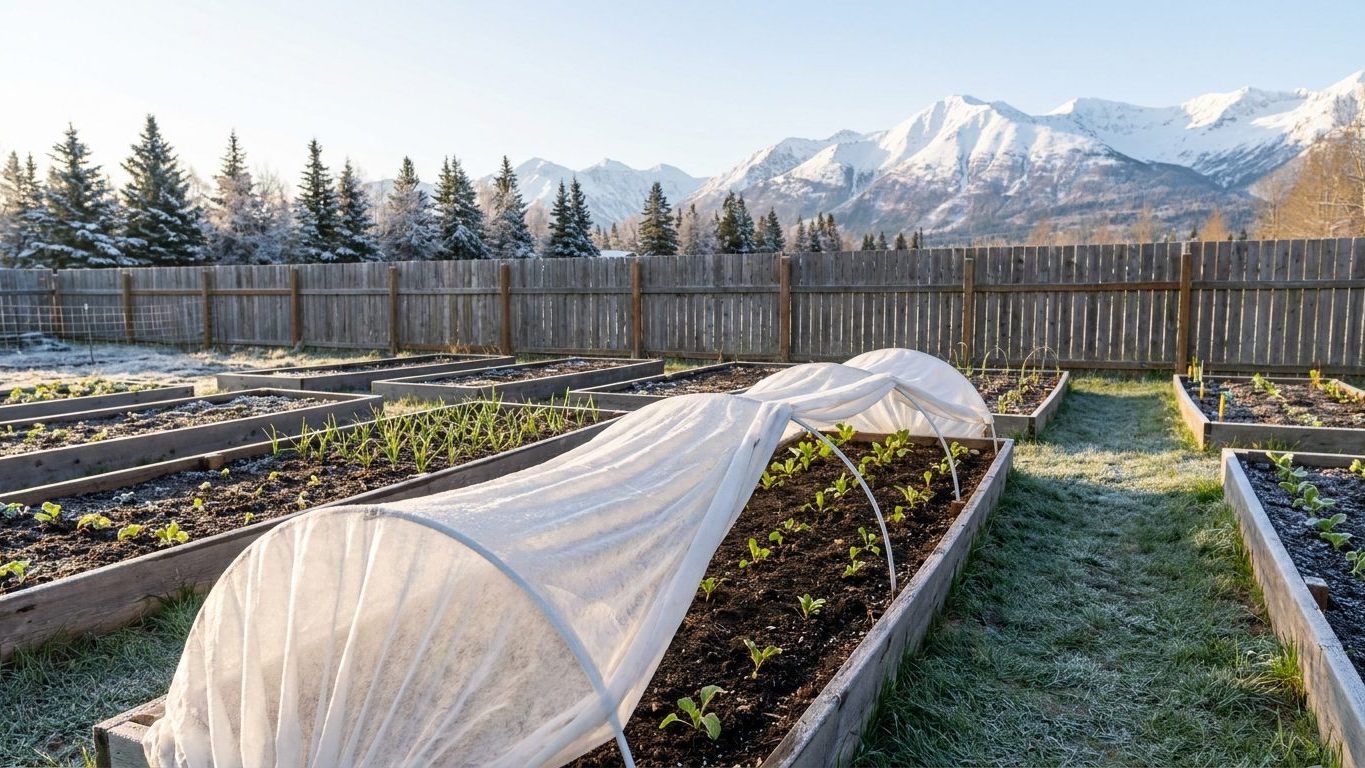

Put covers on before the frost, not after it. In St. John’s the average last spring frost is May 30 and the average first fall frost is October 17, so covers earn their keep at both ends of the season. Use them a couple of weeks before spring planting to warm the soil, and again from late September on any night with frost in the forecast. Those dates are midpoints, so half of all years break them.
The short answer for Newfoundland and Labrador
Put row cover or a low tunnel over spring beds about two weeks before planting, and leave it on until nights stay reliably above freezing. In fall, keep the fabric within reach from mid-September and spread it on any evening when the forecast shows a clear, calm night near 0 °C (32 °F).
The calendar anchors come from the St. John’s airport station, using Environment and Climate Change Canada’s 1981-2010 normals. The reference station has about 140 frost-free days between the mean last spring frost (May 30) and the mean first fall frost (October 17). Both dates are the midpoint of a window. In one spring out of two, the last frost lands after May 30. In one fall out of two, the first frost arrives before October 17. US figures on other pages cover 1991-2020, so the two sets of dates should not be lined up too tightly.
When do you put covers on in spring?
Soil is the slow part. Cold ground holds seedlings back long after the air turns mild, and a cover laid on a bed in mid-May traps enough warmth to start closing that gap. Hardy crops such as lettuce, spinach, peas and brassica transplants can go in under it early. Tender plants (tomatoes, peppers, squash) wait until after May 30 and then still sit under cover on cold nights. Lift or vent the cover on warm, sunny days, because plants cook under sealed plastic faster than most gardeners expect.
When do you cover in fall?
Start watching in late September, well ahead of the October 17 average. Frost forms mostly on clear, still nights, when heat escapes straight up. A cloudy, breezy night at the same temperature often passes without damage. Covering only on the frosty nights, then uncovering the next morning, can carry tender crops through an early light frost and stretch the harvest by weeks. Hardy greens, carrots and kale tolerate more cold and need cover only when a hard freeze is forecast.
What will not work here
Treating May 30 as a safe planting date fails first. A mean date means frost after it is as likely as frost before it. Tender transplants set out on May 31 with no cover on hand are a coin flip.
Heat-loving crops are the second failure. About 140 frost-free days sounds generous, but frost-free is not the same as warm. St. John’s sits on the Atlantic coast at 47.62 degrees north, in a maritime climate with cool summers, fog and wind. A cover adds a few degrees on a sunny afternoon and almost nothing under drizzle. Melons, okra, sweet potatoes and field corn rarely get enough heat, and a cover will not fix that. Short-season varieties of tomatoes and squash do better, with a cover on the cold nights and a sheltered, sunny bed.
Loose plastic is the third. Wind on exposed ground shreds thin film and flips unanchored fabric. Bury the edges in soil, or weigh them down with boards or stones, and push hoops well into the ground. Our guide to which season extenders work in Newfoundland and Labrador goes through the options.
Sealed plastic in damp weather is the fourth. Fog and rain keep a closed tunnel wet inside, and wet leaves in still air invite gray mold and rot. Open the ends on any mild day, even a cloudy one.
Winter is the last. The coldest month at the reference station has a mean daily minimum of -8.7 °C (16.4 °F). A single layer of fabric adds only a few degrees, which will not carry tender plants through nights like that. Covers work for hardy crops (kale, leeks, garlic under a mulch) and for pushing the season at its edges. They do not turn a bed into a greenhouse.
What changes across Newfoundland and Labrador
The hardiness zone for St. John’s is 6a in the Canadian system, from Natural Resources Canada’s 1991-2020 normals. That is the zone of the reference city, not of the province. The Canadian system uses seven climate variables and the USDA system uses one, so the numbers do not convert, and 6a should never be read as a USDA zone.
The province runs from the island’s coasts to interior Labrador, so there is no single answer, and the zone changes with the ground. Sheltered inland spots can run colder than the coast on clear nights, and the sea keeps shoreline gardens milder. Northern and upland districts run weeks behind the St. John’s dates. A gardener in those places should push the spring cover date later and have fabric ready earlier in fall. Covers will do more of the work there, but the margin is thinner.
Latitude matters too. The 47.62 degrees north belongs to St. John’s. Gardeners farther north get longer summer days, and that changes how some crops behave, onions most of all, since day length tells them when to stop making leaves and start making bulbs. Anyone near the edge of the province should check their own latitude.
For a zone reading, use the municipality lookup on Natural Resources Canada’s Plant Hardiness Site. Search for your own community instead of assuming the St. John’s number.
Where to check this for your own county
The provincial agriculture department, Newfoundland and Labrador Fisheries, Forestry and Agriculture, is the place to start. Look for a local planting calendar for your region, a frost date table for the weather station nearest you, and any list of varieties that have been trialled in your area. A variety that did well at one trial site is a better bet than a catalog’s general promise.
A recommendation for your own district beats a provincial one. The dates above come from a single airport station and describe the middle of the range. Your yard may sit a week or two on either side, depending on elevation, distance from the water and how much cold air pools in low ground.
For a wider look at the topic, start with extending the growing season in Newfoundland and Labrador. A local office can then tell you which of those methods suit your area, and when the covers should go on and come off.
Checking this against your own garden
Your own observations outrank every date above. Three things are worth watching, and none needs any equipment.
- Soil warmth by feel. Push your hand two inches into the bed around midday. If it feels cold and your fingers ache within a minute, heat-loving crops will sit idle. Do the same under a cover and in an open bed. The gap between the two is what your cover actually gains in your spot.
- The first male squash flowers. Male blooms open before the female ones on squash and cucumbers. If they open a week earlier under cover than in a bare bed, you can vent more often. If they come late everywhere, your bed is cool or shaded, and it needs a sunnier spot or a faster variety.
- The first true leaves. Seedlings put out rounded seed leaves first, then the true leaves that look like the adult plant. If those appear quickly, the soil is warm enough. If they stall, or the plant turns pale, the root zone is still too cold.
Write the dates down for a few seasons. A notebook with the last spring frost and first fall frost in your own yard will beat the airport average within three or four years.
Common questions
Does row cover protect against a hard freeze?
Lightweight fabric adds only a few degrees, enough for a light frost but not a hard freeze. Double the layers, or harvest tender crops before a hard freeze arrives.
How early can I plant under cover in spring?
Hardy crops such as lettuce, spinach and peas can go in as soon as the soil can be worked, with cover over them. Tender crops wait until after the May 30 average, and even then they need cover on cold nights.
Should covers stay on all day?
Fabric can stay on in cool weather. Plastic should be vented or opened on warm, sunny days, because heat builds fast inside. Flowering crops also need the cover lifted so pollinators can reach them.
When do I take covers off for good in fall?
Harvest tender crops first, then leave covers in place over hardy greens and roots until hard freezes become routine. After that, the cover is mostly protecting the harvest from wind and ice, not the plants from frost.