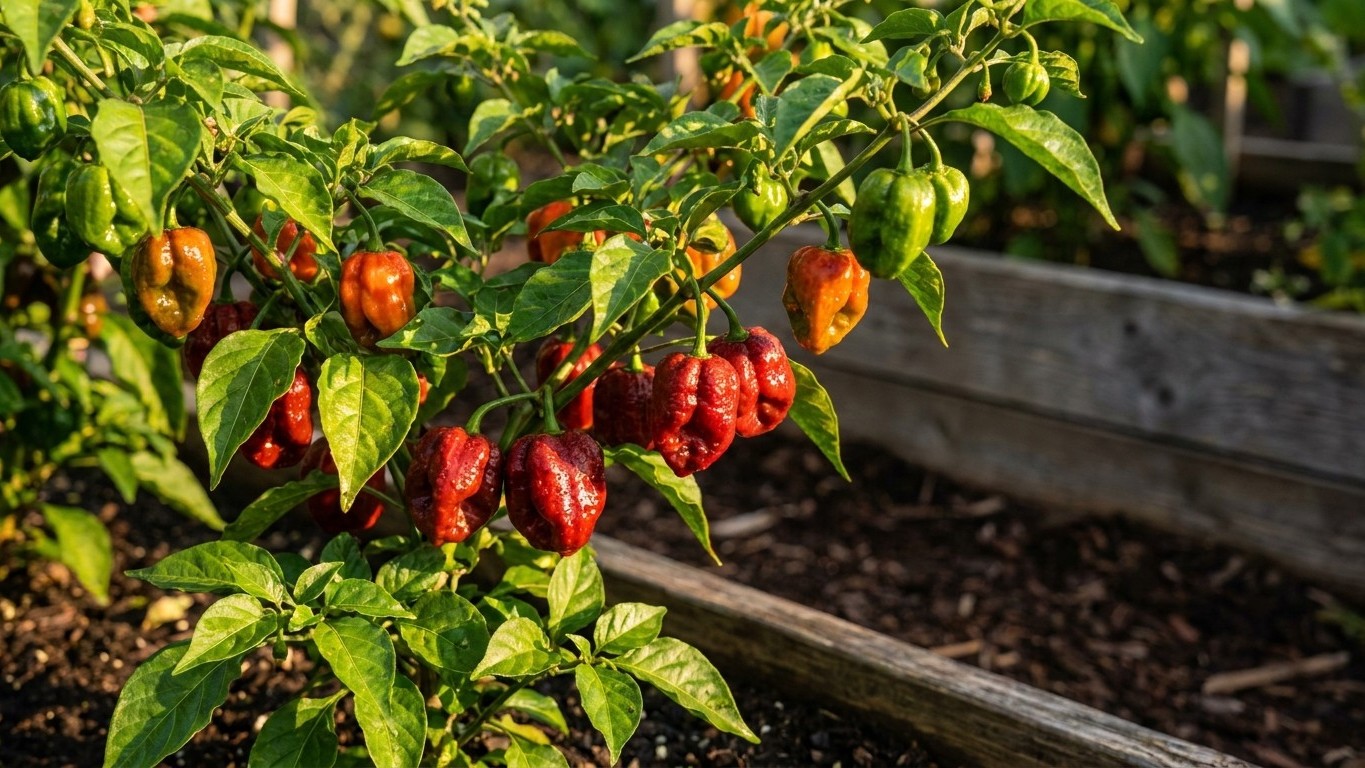

Pick peppers when the fruit reaches full size, feels firm and has glossy skin. That is usually 70 to 85 days after the transplant went into the ground. Once they are off the plant, keep them cool but not refrigerator cold. A domestic fridge runs colder than peppers tolerate, and the damage shows up as pitted, soft spots within days. A cool room at the right temperature holds them far longer, though only for a limited time.
Keeping them, and for how long
Clemson Cooperative Extension gives the target for stored peppers: temperatures of 45 to 50 °F with 80- to 90-percent relative humidity, for two to three weeks. That is the best case. It assumes ripe, undamaged fruit picked at the right stage and held steadily in those conditions. Treat two to three weeks as a ceiling. A pepper with a bruise, a sunscald patch or a nibbled spot will not make it that far.
When are peppers ready to pick?
Clemson puts harvest at about 70 to 85 days after transplanting. The count starts the day the plant goes into the garden, not the day the seed went into a tray. Utah State University Extension says transplants need 8 to 10 weeks indoors and should go out when the soil reaches 60 F, after frost. At the Oklahoma City reference station, the last spring frost falls between March 28 and April 10. Suburban and rural gardens usually see it one to two weeks later, so check your own county before you set anything out. Details on getting the plants started are in Growing Peppers in Oklahoma.
Summer heat shapes the harvest as much as the calendar does. The reference station averages 70.7 days a year at 90 F or higher. Utah State notes that pepper fruit set fails at both ends of the thermometer: days above 90 F and nights below 55 F. Flowers drop in the heat, then the plant sets again when conditions ease. So expect pickings in waves instead of one steady stream. Summer night lows vary a lot from one yard to the next, so watch your own nights. The Why Peppers Fail to Set Fruit in Oklahoma page covers that stall in detail.
What does a pepper ready to pick look like?
Look for fruit that has reached the full size of its type, with firm walls and shiny skin. Dull, wrinkled skin means the pepper is past its best. Cut the fruit off with pruners or scissors, leaving a short piece of stem on it. Pulling by hand often snaps the brittle branches, and a broken branch takes its flowers with it.
Green or colored is your call. Most peppers are edible at full-size green, and leaving them to turn red, yellow or orange adds time and keeps the plant carrying heavy fruit. Many gardeners pick a mix: green ones early to keep the plant producing, colored ones from the fruit that is furthest along. Whatever you choose, pick before the first fall frost. When the forecast shows lows near freezing, take every full-size fruit.
Why does the fridge ruin peppers?
The range Clemson recommends sits above what a domestic refrigerator holds. Below about 45 °F, peppers suffer chilling injury. The skin pits, the flesh softens, and the fruit starts to rot sooner than it would have on the counter. It is the mistake nearly everyone makes, because the crisper drawer seems like the obvious place for vegetables. For peppers it is the wrong call, and the damage often appears after the fruit warms up again on the cutting board.
How long do peppers last once picked?
Under the best conditions, two to three weeks. In a typical house, plan on less and check the pile every couple of days. Pull out any pepper that has gone soft or developed a dark spot, since one bad fruit speeds up the rest. Fruit with chew marks or insect damage should be used first, because broken skin lets decay in quickly. If you are not sure what is chewing on yours, What Eats Pepper in Oklahoma, and When sorts out the usual suspects. Hold off on washing until you are ready to cook, since extra moisture on the skin invites mold.
Where in the house that actually is
Few houses have a spot that sits at 45 to 50 °F all year. The refrigerator is too cold, as covered above. Any heated living space is too warm, and so is a kitchen counter near the stove, a sunny windowsill or the top of the fridge, where the compressor gives off heat. A garage swings with the weather. It can bake on an afternoon above 90 F and cool off sharply overnight, and peppers do poorly with that kind of swing.
The closest match is usually an interior room that stays cool without being cold. A pantry on an inside wall works, and so does a closet on the shady side of the house, an unheated interior room or a basement if your house has one. Interior spots avoid the heat that exterior walls pick up on summer afternoons. Cellars and storm shelters can also run cool, though they can be damp, so check them for mold before you use them.
Temperature is the part you can measure. Put a thermometer in the spot for a full day and night before you trust it, preferably a min-max model that records the high and low. A room that reads 48 F at breakfast may reach 60 F by late afternoon. Skipping the test is how a good harvest ends up either pitted from cold or limp from warmth. If the spot runs a little warm, the peppers will still keep, just for fewer days. If it dips below 45 F, move them.
Humidity is harder to read but easy to manage. Peppers lose water quickly in dry air and shrivel. A perforated plastic bag, or a container with the lid left slightly open, holds moisture around the fruit while letting some air move. Shriveling means the air is too dry. Beads of water inside the bag mean it is too wet, so open it up a bit. A cheap hygrometer can confirm you are near the 80 to 90 percent range Clemson describes.
When no spot in the house works, the refrigerator is still better than leaving peppers on a hot counter. Keep them cool but not in the coldest part of the fridge, and plan to eat them within a few days. For a big harvest, the better move is to freeze, dry or pickle some of it rather than stretch the fresh storage window.
Common questions
Can I store peppers in the refrigerator if I have no cool room?
You can for a short time, but expect some quality loss. The fridge is colder than the 45 to 50 °F range that suits peppers, so chilling injury (pitting and softening) can set in. Use the warmest shelf, keep the peppers dry and eat them quickly. Cut pieces are different: once a pepper is sliced, it belongs in a closed container in the refrigerator and should be used soon.
Should I pick peppers green or wait for them to change color?
Either works. Green peppers are mature enough to eat once they reach full size and feel firm. Waiting for color gives a sweeter, riper pepper but keeps fruit on the plant longer, which can slow new flowers. A practical approach is to pick some green throughout the season and leave the best-developed fruit to color. Pick everything of size ahead of a freeze.
Do peppers keep ripening after I pick them?
A pepper that has already started to blush often finishes coloring at room temperature. A small, fully green fruit will not turn into a ripe, sweet one just by sitting on the counter. If you want color, let the pepper begin changing on the plant before you cut it.
What can I do with more peppers than I can use in two to three weeks?
Preserve them. Slice and freeze them on a tray, then bag them for soups, stir-fries and sauces. They go soft once thawed, so they suit cooked dishes better than raw ones. Peppers can also be dried or pickled. Because the fresh storage window is a maximum, start preserving the extras as soon as the pile grows larger than you can eat in a week or so.