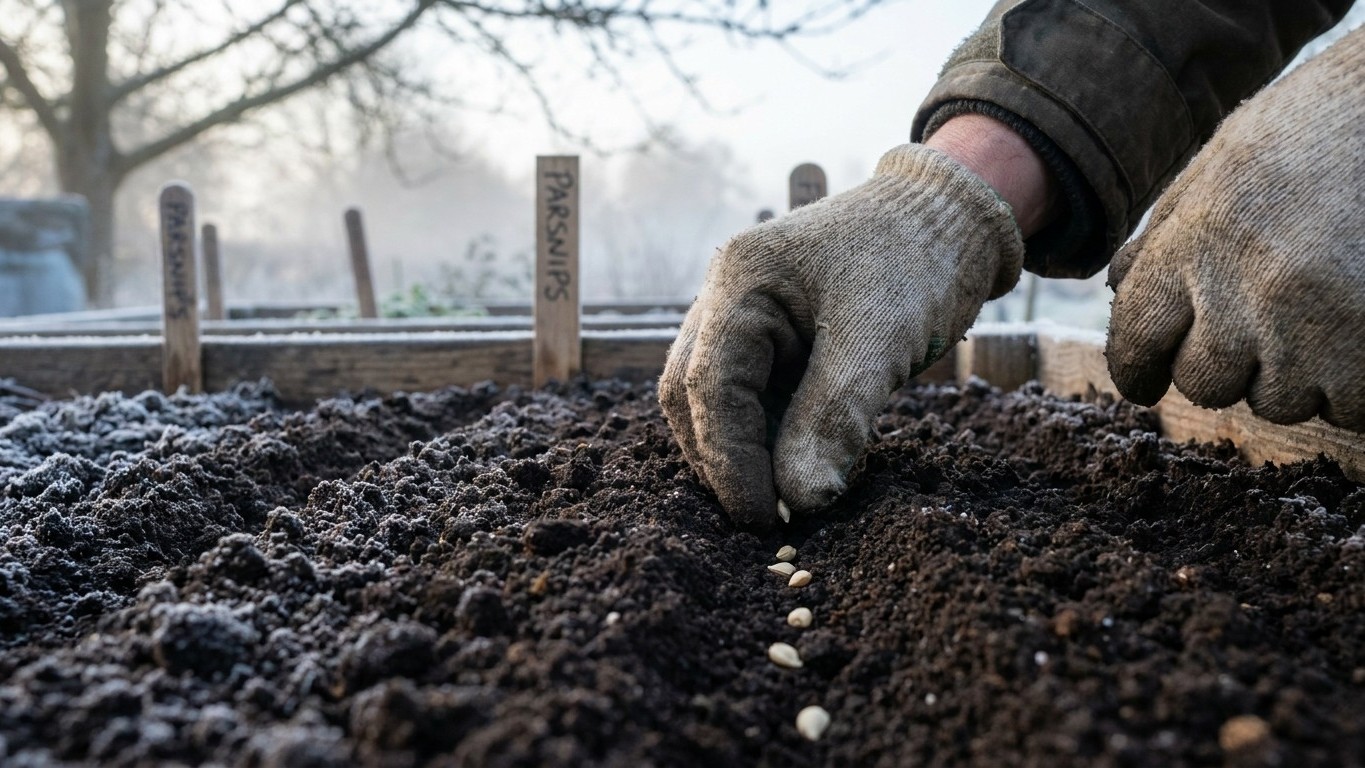

Parsnips can be sown in the Northwest Territories, and the territory’s brutal winters practically guarantee the frost exposure this root crop needs to turn sweet. The catch is timing: sow too late and the 100 to 120 day root never finishes before the ground locks up for the season.
The short answer
Everything about growing parsnips well comes down to one question: does this place deliver several weeks of frosty weather, cold enough to convert the root’s stored starch into sugar, but not so brutal that the ground freezes solid before you can dig? In the Northwest Territories, the answer leans hard toward yes on the cold. The mean daily minimum of the coldest month, drawn from the Yellowknife reference station in Environment and Climate Change Canada’s 1981-2010 climate normals, sits at -21.1 degrees Fahrenheit. That is not a record low. That is the average low, night after night, through the depths of winter.
A figure like that tells you almost nothing about whether a plant survives here (it would not, if left exposed), but it tells you a great deal about frost exposure once the growing season winds down. Parsnips do not need deep winter cold to sweeten. They need repeated light-to-moderate frosts while the roots are still in the ground and still accessible with a fork or spade. Given how sharply temperatures drop here once autumn turns, a parsnip crop that reaches maturity before the season truly closes will get more frost exposure than it knows what to do with.
That is worth separating clearly from hardiness zone talk, because the two get confused constantly. A hardiness zone describes whether a perennial plant’s roots survive winter in the ground. Frost exposure describes something else entirely: whether a biennial root vegetable like parsnip, grown as an annual and harvested the same year it is sown, spends enough time near freezing to trigger that starch-to-sugar conversion. A mild-winter zone can leave a parsnip perfectly healthy and completely bland. A cold territory like this one, if the timing works, does the opposite: it produces a parsnip that has actually earned its sweetness.
So the plain answer here is that a parsnip grown in the Northwest Territories, sown at the right time and dug at the right time, will sweeten rather than merely grow. The harder part, and the part that actually determines success, is whether the growing season leaves enough room for the root to mature before that same cold turns the ground into something closer to concrete.
Does the season fit?
Parsnips are sown directly in place, never transplanted, and the 100 to 120 day clock starts at seeding, not at germination and not at some later thinning date. Here is how that clock lines up against this territory’s frost window, worked through step by step.
- Start with the average last spring frost for the Yellowknife A station: May 25. This is a mean date from Environment and Climate Change Canada’s 1981-2010 normals, not a guarantee. In roughly one year out of two, frost arrives later than that, so treat it as the middle of a range rather than a safe line to plant against.
- Parsnip seed goes in the ground 2 to 3 weeks before that average last frost, which puts a realistic sowing window at roughly May 4 to May 11 across most of the territory, and later still in northern or upland districts that lag well behind the Yellowknife reference station.
- Germination is slow and needs patience: parsnip seed takes 14 to 21 days to come up. A gardener who sees bare soil after a week and re-sows, assuming a failed batch, is very often just early. Wait out the full three weeks before drawing any conclusion.
- From that same seeding date, the root itself needs 100 to 120 days to reach full size. Counting forward from early May, maturity lands somewhere between mid-August and early September.
- Compare that maturity window against the average first fall frost, September 18. The root finishes growing roughly two to five weeks before that first frost arrives, on average.
- That gap, however short, is exactly what makes sweetening possible: the root sits in the ground already at size, ready to catch the frosty weeks right as the season turns, rather than racing the cold while still trying to bulk up.
Put together, the season here fits, but tightly. There is little slack for a late spring, a cool summer, or a sowing pushed back by wet ground. Hitting the early edge of that 2 to 3 week pre-frost window matters more in the Northwest Territories than almost anywhere further south, because the buffer between root maturity and hard freeze is thin to begin with.
Why the tight fit still works
A narrow window is not the same as no window. Gardeners who sow at the earliest safe date, rather than waiting until the calendar feels comfortable, give the root the full 100 to 120 days it needs and still leave several weeks of exposure to the frosts that arrive right on schedule in mid-September. It is a season with almost no room for error, but it is a season that closes the loop.
What goes wrong here
- Forked roots from heavy or stony native ground. Parsnips want deep, loose, sandy soil to send a straight taproot down without hitting resistance. Northern soils that run heavy, compacted, or full of stones split the root into forks the moment it meets an obstacle. The remedy, according to Utah State University Extension, is to double dig the bed to a depth well beyond the expected root length, or build a raised bed filled with a sandy loam mix specifically for this crop.
- Forked roots from overwatering. This is a separate cause from heavy ground, and the two get lumped together far too often. Soil kept consistently soaked, rather than evenly moist, encourages the root to branch instead of driving straight down. The fix is steady, moderate watering, not the heaviest possible watering schedule, especially once the taproot has established itself.
- A season that runs out before the root finishes. Given how tight the window already is here, sowing even a week later than the 2 to 3 week pre-frost mark can push maturity dangerously close to, or past, the average first fall frost. The remedy is to treat the early edge of the sowing window as the target date, not the late edge, and to use a cloche or row cover in early spring to warm the soil and buy a few extra growing days.
- Ground that freezes too hard, too fast, to dig after the sweetening frosts hit. Unlike milder provinces, a winter too gentle to sweeten the roots is simply not the risk in the Northwest Territories. The opposite risk is real here: once temperatures drop toward that -21.1 degree mean minimum, the soil can lock up before harvest happens. A heavy mulch layer, applied once the first frosts arrive, keeps the ground workable for extra weeks and lets the sweetening finish before the fork can no longer get through the dirt.
Common questions
Can parsnips actually sweeten in a place this cold?
Yes, and the deep cold here helps rather than hurts, provided the root reaches maturity before the ground freezes solid. Sweetening comes from frost exposure while the root is still accessible, not from the severity of winter itself.
What soil should I prepare before sowing?
Utah State University Extension recommends deep, sandy soil for straight roots; where the native ground is heavy, double digging the bed is the starting point, not a guaranteed fix on its own, since drainage and stone content both play a role too.
Why hasn’t my parsnip seed come up after a week?
Nothing is wrong yet. Germination normally takes 14 to 21 days, and re-sowing before that window closes usually just wastes a second batch of seed.
Is May 25 a safe date to count on for the last frost?
No. It is the average last frost date at the Yellowknife A station over the 1981-2010 period, which means frost arrives later than that in roughly half of all years, and northern or upland areas typically run behind this figure as well.