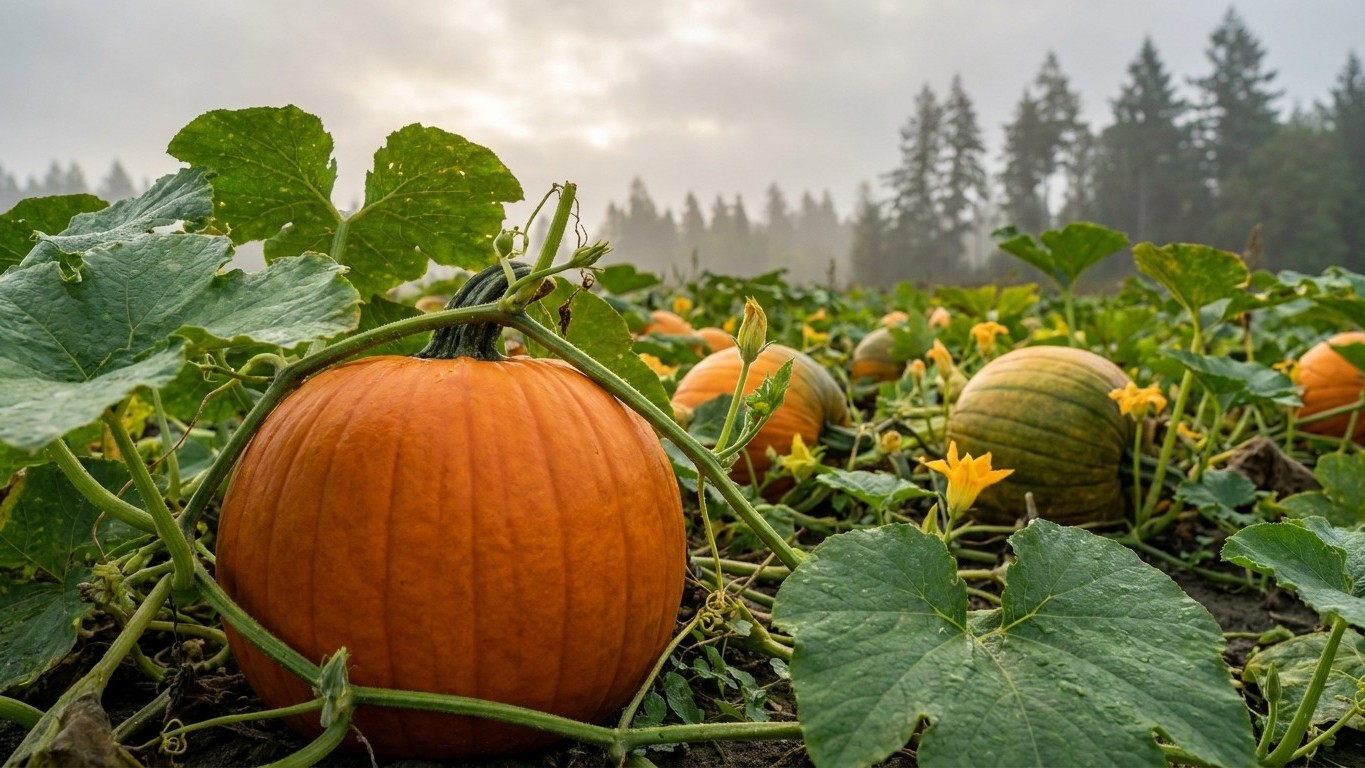

In coastal British Columbia, pumpkins ripen only when their flowers open by mid-to-late September, working back from the region’s average frost date. Vancouver’s growing season looks long enough on paper, but the region’s slow-warming spring soil eats into that margin every year. Get the flowering window right and a jack-o’-lantern-ready pumpkin is realistic. Miss it by two weeks and you’re left carving a green one.
The short answer
Start at the other end of the calendar. Environment and Climate Change Canada’s 1981-2010 climate normals put the average first fall frost at Vancouver Int’l A on November 10. That’s a mean date, not a guarantee: in one year out of two, frost actually lands later than November 10, and in the other half it arrives sooner. Treat it as the midpoint of a window, not a line you can plant against.
Utah State University Extension’s pumpkin guidance supplies the other half of the equation: pumpkins need 45 to 55 days after their flowers open to finish ripening. Not from the day seed goes into the ground. From the day the first female flower opens and sets fruit. That distinction changes the whole calculation, because a vine can sit in the ground for weeks putting out leaves and male blooms before a single fruit-bearing flower ever opens.
Run the subtraction against November 10. Fifty-five days back lands on September 16. Forty-five days back lands on September 26. That gives a flowering window of roughly September 16 to September 26. Open a flower inside that stretch and, in an average year, the fruit has enough time on the vine to finish coloring and harden its skin before frost cuts the vine down. Open a flower after September 26 and even the fastest-finishing pumpkin on the vine is racing a clock it’s likely to lose.
Two things narrow that window further. First, “average” cuts both ways: because the November 10 date is a mean, a grower planning to flower right up against September 26 is betting on a later-than-average frost to bail them out. A grower who wants real margin should aim for flowers open by mid-September, not the end of it. Second, this whole calculation is anchored to one climate station, Vancouver International Airport. Move up the Fraser Valley, into the Interior, or up in elevation into the Kootenays or the Cariboo, and frost can arrive weeks earlier than this station’s normal. The Lower Mainland’s mild, ocean-buffered climate is not what a grower in Prince George or Williams Lake is working with.
So the short answer to Will Pumpkins Ripen Before Frost in British Columbia?: yes, pumpkins can ripen in this part of British Columbia, provided flowers open by roughly the third week of September. The harder part, and the part most growers get wrong, is knowing When to Sow Pumpkins in British Columbia so that a vine sown in this region’s cool spring soil actually reaches flowering that early.
When to sow here
Sowing date in this region hinges on soil temperature, not the frost calendar, and the two rarely line up the way growers expect.
- Know the last frost is only a starting marker. Environment and Climate Change Canada’s normals put the average last spring frost at Vancouver Int’l A on March 18, again a mean, not a promise, so frost shows up after that date about half the time.
- Wait for the soil, not the calendar. Utah State University Extension is specific that pumpkin seed goes into the ground once soil temperature reaches 65 F, not once the air stops frosting. Soil holds winter’s cold long after the air has moved on, so a mid-March frost date says almost nothing about when the ground itself is warm enough for pumpkin seed to germinate reliably.
- Expect a real gap between the two dates. In this region’s cool, damp spring soil, 65 F typically isn’t reached until well into spring, often weeks after the average last frost has already passed. Growers who sow the week after their last frost, treating that date alone as a green light, are usually sowing into soil still too cold for a seed to do anything but sit and rot.
- Check the ground with a thermometer, not a guess. A simple soil thermometer pushed a couple of inches into the bed, checked in the morning over a few consecutive days, tells you far more than counting weeks off the frost date ever will.
- If you’re impatient, buy time with row cover. Laying row cover over the bed warms the soil underneath faster than bare ground would warm on its own, commonly reckoned to buy about two weeks against the open-ground timeline. That’s two weeks earlier than the soil would otherwise reach 65 F on its own, not two weeks earlier than the last frost date itself.
- Count forward from sowing to the flowering deadline. Once seed goes in, the plant needs enough weeks to grow, vine out, and set its first female flower before September 16 to 26. Sowing late in the soil-warming window and still expecting an on-time flower is where most Lower Mainland pumpkin patches lose their margin before the vine has even set fruit.
What goes wrong here
Given this region’s season length, the failures tend to fall into three predictable patterns.
- A late flower that never colors. When the first female flower doesn’t open until early October, the fruit behind it is counting down 45 to 55 days while the season’s remaining daylight and warmth are shrinking fast. The pumpkin can grow to full size but stay green or blotchy, since color development is one of the last things to happen before a fruit is fully ripe. The fix starts weeks earlier: get seed into 65 F soil as soon as that threshold arrives, and use row cover to push the soil there faster, so the plant has the head start it needs to flower inside the September window instead of after it.
- A fruit caught by frost before it finishes. Utah State University Extension’s guidance is to harvest with the stem attached and move pumpkins somewhere they will not freeze before frost sets in. The source gives no temperature or storage timeline beyond that, only the instruction itself. A grower watching a fruit that’s close but not quite there, with frost in the forecast, is better off cutting it early and bringing it indoors than leaving it on the vine to gamble against a frost date that, remember, arrives later than November 10 in only half of all years, meaning it also arrives earlier than that in the other half.
- A vine that dies back before the skin hardens. Powdery mildew and feeding damage from pests can take a vine down well before its fruit has hardened its rind, cutting the ripening clock short regardless of what the calendar says. Scout the vine regularly through late summer rather than waiting for symptoms to become obvious. Growers dealing with insect damage can find pest-specific detail on this site’s squash bug and cucumber beetle pages.
Checking this against your own county
Every figure in this article comes from one climate station: Vancouver International Airport. That’s a reasonable stand-in for the Lower Mainland and much of the South Coast, but British Columbia is not one climate. A grower in the Okanagan, the Peace River region, or up in the Cariboo is working with a different frost calendar entirely, often weeks earlier in fall and later in spring than what’s written here. Elevation alone can shift a local frost date by weeks compared with a valley floor a few miles away.
Before betting a season’s pumpkin patch on the numbers above, check them against local records. British Columbia’s Ministry of Agriculture and Food publishes regional growing information and can point toward local frost data and contacts for specific districts across the province. Look up guidance for your growing area at gov.bc.ca’s agriculture and seafood section before locking in a sowing date.
Common questions
Can I still plant pumpkins in July in British Columbia?
There’s no published days-to-flower figure for pumpkins here, only the 45 to 55 day count that starts after flowering. A July sowing using an already-growing transplant may still reach flower by mid-September. A July sowing straight from seed leaves much less runway and is a riskier bet.
What happens if my soil doesn’t reach 65 F until June?
The flowering deadline of September 16 to 26 doesn’t move, so a June sowing leaves noticeably less time for the vine to grow before it needs to flower. Row cover and starting from a transplant rather than direct seed both help close that gap.
Is November 10 a safe date to count on for harvest?
No. It’s a mean date, so frost arrives later than that in about half of all years and earlier in the other half. Treat it as a planning midpoint, not a guarantee, and watch actual forecasts as fall approaches.
Can I ripen a green pumpkin indoors after cutting it early?
Utah State University Extension’s guidance only covers storing harvested pumpkins somewhere they will not freeze, with the stem left attached. It gives no ripening timeline or temperature for finishing color on a fruit cut green, so treat an early cut as a fallback for a frost emergency, not a guaranteed way to finish ripening.