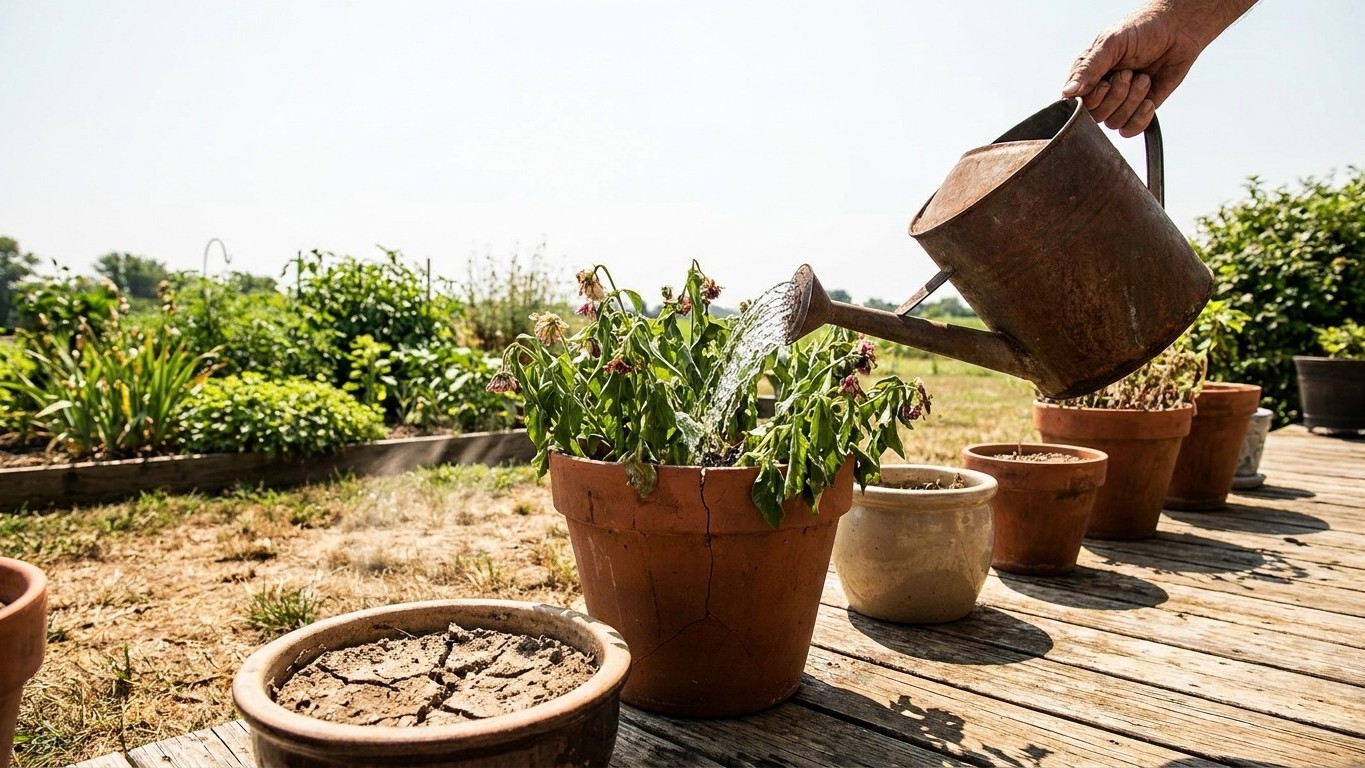

Tennessee gardens and container plantings need supplemental watering most in July and August, when the state’s driest month brings under 4 inches of rain while temperatures push into the 90s roughly 40 days a year. Pots dry out faster than garden beds because they hold far less soil to buffer that heat.
What changes here

Tennessee’s driest summer month, August, averages 3.79 inches of rain, and the state logs 40.0 days a year at or above 90°F. Put those two numbers together and the takeaway is simple: August is the month gardens are most likely to run short on water at the exact moment heat is pulling moisture out of the soil fastest.
A typical garden bed wants roughly an inch of water a week. Spread August’s 3.79 inches across that month’s four-plus weeks and the sky delivers something close to 0.88 inch a week on its own, a shortfall of a little over a tenth of an inch that a gardener would normally need to carry by hand. But that arithmetic understates the real gap. Forty days a year of 90°F-plus heat drive evaporation well past what a simple weekly total suggests, and a single summer thunderstorm often runs off a hard, sun-baked surface rather than soaking in, so the deficit in practice runs higher than the math implies.
| Month | Average rainfall |
|---|---|
| June | 4.36 in |
| July | 4.16 in |
| August | 3.79 in |
Soil texture changes how far that inch actually goes. On sandy ground, common in parts of the state’s river bottoms, an inch of rain moves through within a day and leaves little reserve. On heavy clay, more typical across Middle Tennessee, the same inch can sit in the root zone for the better part of a week. Containers sidestep that comparison entirely: a pot holds a fraction of the soil mass of a garden bed, so under a 90°F afternoon it can lose its moisture reserve in hours regardless of what potting mix it’s filled with.
How to water when it matters
Deep, infrequent watering at the base of the plant, done in the morning, beats a daily overhead sprinkle for three separate reasons. Deep watering pushes moisture down where roots can follow it, rather than leaving a shallow, easily baked layer near the surface. Watering at the base keeps leaves dry, which matters because wet foliage sitting overnight is an open invitation to fungal disease. Morning watering gives the plant hours to draw on that moisture before the day’s heat peaks, instead of sitting damp and unused through a humid summer night.
Checking the soil at root depth, not just the surface, is what actually tells a gardener when to water. A finger pushed two inches down, or a trowel pulled up for a quick look, will show dry soil even when the top looks fine after a light shower.
- Push a finger or trowel two inches into the soil; if it’s dry at that depth, water regardless of how the surface looks.
- Water slowly at the base of the plant until moisture reaches root depth, avoiding the leaves.
- Water in the morning, before the day’s heat sets in.
- Aim for roughly 1 inch a week in one or two deep soakings on garden beds, adding a session during any stretch of the state’s 40 annual days at 90°F or above.
- Check container soil daily in hot weather, since a pot’s limited volume can dry out within hours.
Sandy ground holds little of that inch, so it asks for shorter, more frequent soakings, closer to twice a week with less water each time. Heavy clay holds a week’s worth but drowns roots if it’s watered again before the surface has actually dried, so the finger test matters more than any fixed schedule. Treat one inch a week as a starting point to check against your own ground, not a rule that applies the same way in a sandy backyard and a clay-heavy one three miles away.
What goes wrong
Watering a little every day
A light daily sprinkle wets only the top inch or two of soil, training roots to stay near the surface where Tennessee’s 90°F afternoons bake them. Deep, less frequent watering pushes roots downward into cooler, more stable soil instead.
Watering the leaves in the evening
Wetting foliage as the sun goes down leaves it damp for hours in a state where summer humidity already runs high, and that combination is exactly what fungal disease needs to take hold overnight.
Trusting a rain shower without checking
A fast summer thunderstorm can look generous while mostly running off a hard, dry surface rather than soaking in. A finger two inches down after the storm settles the question a lot more reliably than the sky did.
Skipping mulch
Bare soil under 40 days a year of 90°F heat gives back moisture almost as fast as it’s applied. A few inches of mulch slows that loss and keeps the inch of weekly water actually available to roots instead of evaporating back into the air. On heavy clay the opposite mistake shows up too: watering again before the soil has had a chance to dry can drown roots that were never short on moisture to begin with.
Local help
The University of Tennessee Institute of Agriculture runs the state’s Extension service, with county offices that offer soil testing and local planting guidance. Watering restrictions vary by water utility and change with drought conditions, so check current rules directly with your local water provider before setting a summer watering schedule.
Common questions
How often should I water a Tennessee garden bed in summer?
Aim for about 1 inch a week split into one or two deep soakings, checking soil moisture two inches down before adding more, and increasing frequency during stretches of 90°F-plus heat.
Do potted plants need more water here than in-ground plants?
Yes. Containers hold far less soil than garden beds, so they lose their moisture reserve much faster, often within a day or less during the state’s hottest stretches.
What’s the best time of day to water in Tennessee’s heat?
Morning. It gives plants hours to use the water before peak heat and keeps leaves from staying wet overnight, which lowers disease risk.
Are there water use restrictions in Tennessee?
They exist in some areas and change with local conditions, set by individual water utilities rather than statewide. Check with your own water provider for current rules before planning a watering routine.