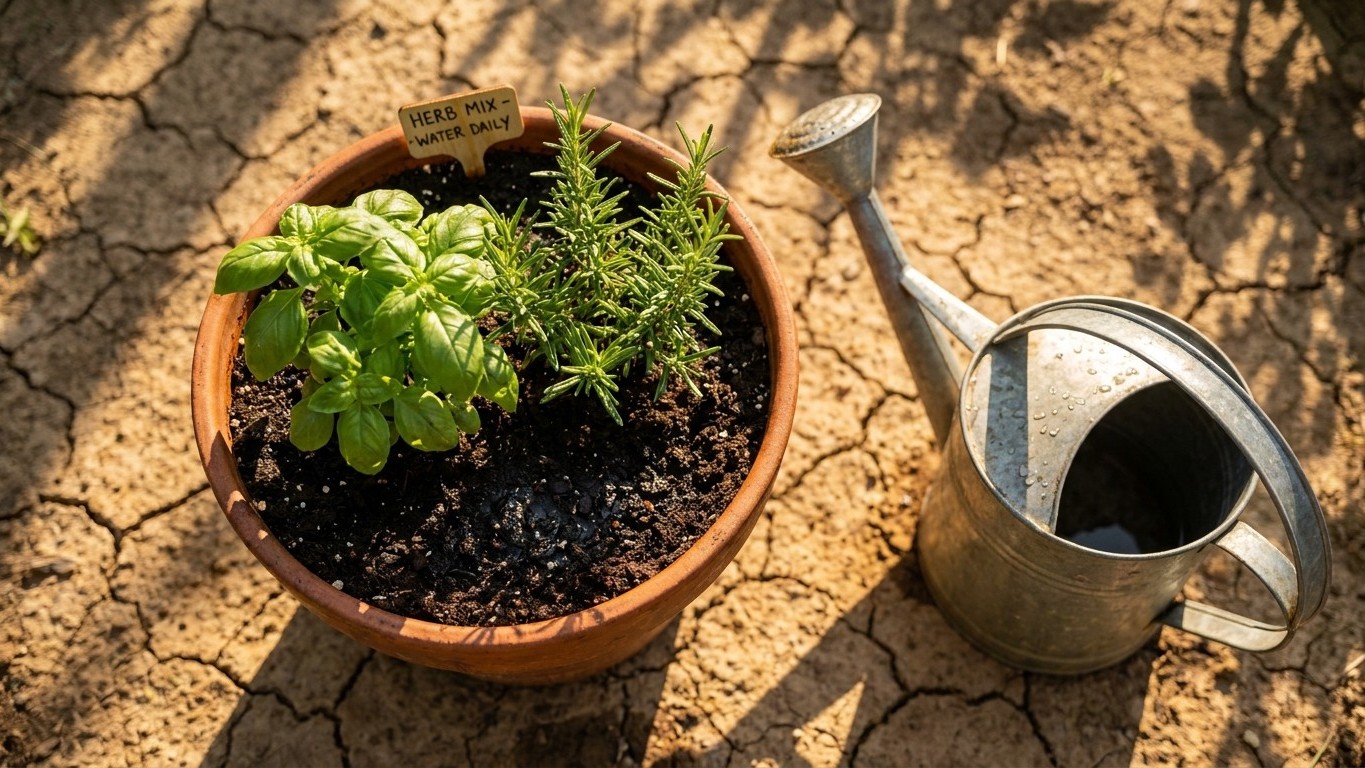

In Virginia, garden beds and potted containers both want roughly an inch of water a week, but they rarely get it the same way. Beds draw on rain and stored soil moisture together; containers hold only a few gallons of soil and dry out on their own schedule, sometimes daily in July heat. The right answer depends on the month, the heat, and what the soil under those roots is actually doing.
What changes here

Two numbers set the terms for Virginia gardeners. The driest summer month, June, averages 4.15 inches of rain. And the state’s reference station logs 26.0 days a year at or above 90F. Put together, that means the month when rain is thinnest is also right at the front edge of the hottest stretch of summer, so a garden can’t lean on June showers to carry it through July’s heat load.
The arithmetic matters more than the headline figure. June runs about thirty days, or roughly four and a third weeks, so that 4.15 inches works out to about 0.97 inch a week on average, just under the inch a bed typically wants. On paper that looks close to enough. In practice it almost never is, because June rain in Virginia tends to arrive as a handful of thunderstorms rather than a steady drizzle. A storm that drops half an inch in twenty minutes mostly runs off a slope or a compacted lawn instead of soaking down to root depth, and the rest evaporates fast once the sky clears and the mercury climbs toward 90F again.
Soil texture decides how far that rain, or a hose, actually gets. On sandy ground, an inch of water drains past the root zone within a day, so the plant is back to relying on whatever comes next. On heavy clay, that same inch can sit near the surface for the better part of a week, which sounds like an advantage until the roots start to suffocate in waterlogged ground. Neither failure shows up the same way, but both trace back to the same average rainfall figure behaving differently depending on what’s underfoot. A container splits the difference in the worst way: it holds no reserve at all once its potting mix dries, so June’s near-adequate average rainfall does almost nothing for a pot sitting on a deck or a patio.
How to water when it matters
The method that works in Virginia is the same one that works almost everywhere, but the rhythm has to answer to local heat and rain patterns rather than a generic calendar. Deep, infrequent watering trains roots to grow downward, chasing moisture instead of clustering near a surface that bakes off in an afternoon above 90F. Watering at the base, not overhead, gets water to those roots directly instead of losing a share to leaf surfaces and wind. Morning watering gives the plant a full day to take up what it needs before the heat peaks, and lets any leaves that did get splashed dry out before nightfall.
Checking the soil beats guessing every time. A finger pushed two inches into bed soil, or a trowel pulled up for a quick look, tells you far more than a glance at the surface, which can look bone-dry an hour after rain or deceptively damp right after a light sprinkle that never reached the roots. For containers, the same check works with a finger to the second knuckle in the pot; if it’s dry there, water, and if it’s still cool and damp, wait.
Soil texture changes the schedule directly. Sandy ground holds little water at a time, so it asks for shorter, more frequent soakings rather than one big weekly dose. Heavy clay can carry a week’s worth of water, but watering it again before it’s had time to drain and dry invites root rot, so the wait between soakings needs to be longer even if the total volume looks similar.
- Start from about 1 inch of water a week for garden beds, delivered in one or two sessions rather than a daily trickle, and treat that as a baseline to adjust once you’ve checked your own soil.
- Water in the early morning, before the day’s heat sets in, so moisture reaches the roots and any wet foliage has time to dry.
- Apply water slowly at the base of the plant, letting it soak in rather than pool and run off, especially on sloped or compacted ground.
- Check soil moisture two inches down with a finger or trowel before every watering session, rather than watering on a fixed calendar.
- For containers, water whenever the top two inches of potting mix feel dry, which in Virginia’s summer heat can mean daily during the hottest stretches around those 26 days above 90F.
What goes wrong
Watering a little every day
Light daily watering wets only the top inch or two of soil, so roots stay shallow to chase that moisture instead of growing down where the ground holds water longer. Those shallow roots are the first to suffer once a hot stretch hits, which in Virginia means any of the 26 days a year that reach 90F or beyond.
Trusting a passing thunderstorm
A summer downpour can look like it solved the watering problem for the week, but June’s rain often falls fast and runs off before it soaks past the surface. The only way to know if a storm actually helped is the same finger check used before any watering session, not a glance out the window.
Wetting the leaves in the evening
Overhead watering after dinner leaves foliage damp all night, and that extended wet window is exactly what fungal diseases need to take hold. Watering at the base in the morning avoids the problem entirely.
Skipping mulch, or overwatering clay after rain
Bare soil around a bed loses moisture fast once summer heat sets in, undoing whatever the last watering or rain accomplished. On the flip side, adding a full watering to clay soil that’s still damp from a recent storm pushes it past what roots can tolerate, drowning them in ground that simply hasn’t finished draining yet. Given Virginia’s mix of solid summer rainfall and real heat load, both mistakes show up in the same season, sometimes in the same bed.
Local help
Virginia Cooperative Extension publishes region-specific guidance on soil, irrigation timing, and plant selection through Virginia Tech’s Extension service. Watering restrictions during dry stretches vary by locality and utility, so check current rules with your own water provider before setting an irrigation schedule, rather than assuming a statewide standard applies everywhere.
Common questions
How often should I water a Virginia garden in summer?
Aim for about an inch of water a week, split into one or two deep sessions rather than daily watering, then adjust based on how the soil two inches down actually feels.
Do containers need more water than garden beds in Virginia?
Yes. Potting mix holds far less reserve moisture than ground soil, so containers often need checking daily during the stretch of days each summer that hit 90F or higher.
Is June rainfall enough to skip watering?
Not reliably. June averages 4.15 inches, close to an inch a week on paper, but that rain often arrives in fast storms that run off rather than soak in, so a finger check still matters.
Does clay soil mean I can water less often?
It means longer intervals between waterings, not less total water. Clay holds moisture for close to a week, but watering it again before it’s dried can drown roots.