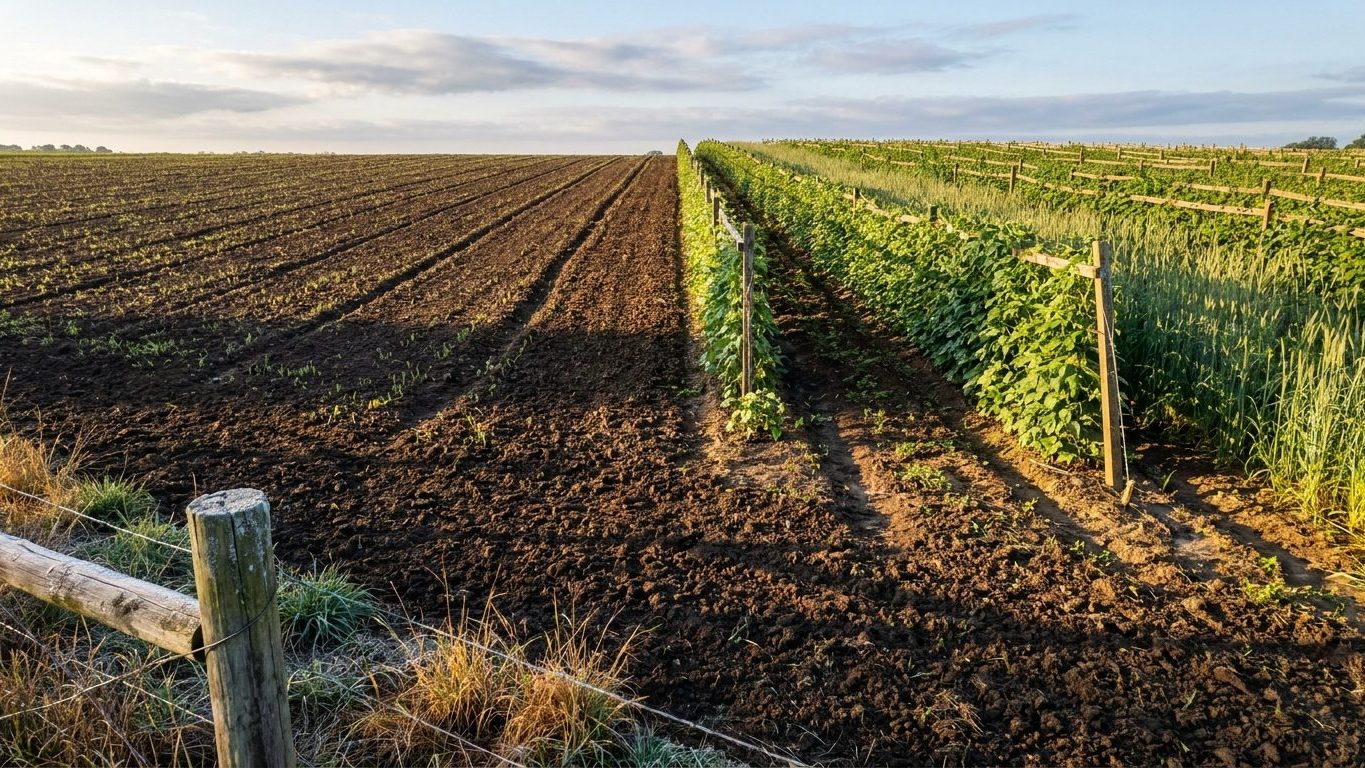

Cover crops in North Dakota go in the ground on two different clocks, not one. Spring-sown species need the soil workable after the last frost window (May 4 to May 15), while the more common late-summer seeding after small-grain harvest has to finish establishing before the first fall frost (September 25 to October 5). Which clock applies depends on what you’re growing and why.
The short answer for North Dakota
Spring-sown cover crops, oats, field peas, or a brassica mix planted as a nurse crop or forage, go in once soil is workable after the last spring frost window of May 4 to May 15. That date range comes from NOAA’s 1991-2020 Climate Normals for the Fargo airport station, and it marks the 30-70% probability band for a 32°F freeze: on May 4, there’s still roughly a 70% chance of hitting freezing, and by May 15 that risk has dropped to around 30%. It is not a guarantee. It is a window where the odds shift in your favor.
The more widely used North Dakota approach is fall seeding, dropping cereal rye, radish, or a clover mix right after wheat, barley, or canola comes off the field, typically late July into August. That timing matters because the first fall frost band, September 25 to October 5, sets the outer limit for how much growth the crop gets before winter shuts things down. A cover seeded in early August in the Red River Valley might get six to eight weeks of growth before that frost band arrives. One seeded after Labor Day gets three weeks, maybe less.
Why winter survival is a separate question
Getting a cover crop up and growing is only half the job if you want it to overwinter. The mean daily minimum temperature in North Dakota’s coldest month sits at 0.2°F, measured at the Fargo reference station under the 1991-2020 Climate Normals. That number, not the record low, is what decides whether a species survives the winter here at all. Cereal rye is the one cover crop that reliably takes that kind of cold and comes back green in April. Most other “winter hardy” options sold in seed catalogs were bred and tested somewhere milder, and they don’t get the memo about a North Dakota January.
So the practical calendar looks like this: spring window May 4-15 for annual, winterkilled species meant to be terminated before a cash crop; late-July-to-August window for anything meant to overwinter, built around cereal rye as the backbone. Anything outside those two windows is working against the calendar, not with it.
What will not work here
The growing season implied by these frost dates, roughly May 10 to late September, runs about 140 days at the reference station, and likely fewer in outlying counties. That’s short. Species that need a long stretch of warm nights to build real biomass, sunn hemp, cowpea, sorghum-sudangrass, are marketed heavily in cover crop mixes aimed at the Corn Belt and the South. Seeded in North Dakota after a small-grain harvest in mid-August, they get maybe five to six weeks before frost. That’s rarely enough time to do what they’re supposed to do: suppress weeds, build root mass, feed soil biology. They germinate, they grow a little, and then the frost band arrives and kills them before they’ve paid for their seed cost.
Buckwheat gets recommended constantly as a fast, cheap summer cover, and it is fast almost everywhere else. But planted too early against a cold spring, it sulks in soil that hasn’t warmed enough, and planted too late against that September 25-October 5 fall frost band, it never gets to flower and set the biomass gardeners expect. There’s a narrow slot in between, and missing it by two weeks in either direction wastes the seed.
The winterkill trap
The 0.2°F coldest-month minimum also rules out treating hairy vetch or crimson clover as reliable stand-alone overwintering covers here, the way growers further south or in milder zones do. Both are sold as winter-hardy, and both are, in places where the coldest month doesn’t dip anywhere near 0.2°F on average. In North Dakota, without heavy and consistent snow cover acting as insulation, a pure stand of either species can winterkill outright. Growers who want a legume in the mix generally pair it with cereal rye rather than relying on it alone, precisely because rye is the one species with a track record of surviving that cold minimum.
Dry seeding into August stubble without checking soil moisture is another common miss. North Dakota falls can turn dry fast, and broadcasting seed onto dusty ground with no rain in the forecast produces a spotty stand at best, a failed one at worst.
What changes across North Dakota
North Dakota spans USDA Hardiness Zone 3a to 4b, according to the 2023 USDA Plant Hardiness Zone Map built on 1991-2020 normals. That’s a real spread, not a rounding error. Zone 3a, generally the colder north and northwest of the state, and Zone 4b, generally the milder southeast including areas near the Red River Valley, don’t run on the same calendar. The USDA zone system is built on one variable, the average annual extreme minimum temperature, so it speaks to winter survival more than it speaks to spring planting dates, but the two track together closely enough to matter here.
A grower in the colder end of that range should expect the safe spring seeding window to open later than the Fargo-based May 4-15 band suggests, and the safe fall seeding cutoff to arrive earlier. That squeezes the growing window on both ends. A grower in the milder southeast, closer to the reference station itself, is working with something closer to the numbers already given, though even there, a rural field away from the airport’s heat-retaining pavement and buildings typically sees frost earlier in fall and later in spring than the official dates suggest.
There is no single sowing date that covers Zone 3a and Zone 4b equally well, and this page won’t invent one. The honest move is to treat the frost bands above as a starting reference, then adjust toward more caution the farther north and west you are, and check where your own county actually falls on the current USDA map rather than guessing from a mailing address.
Where to check this for your own county
This page gives the state-level picture. Your county’s Extension office gives the version built for your actual conditions, and that version wins every time the two disagree. North Dakota State University runs the state’s Extension service, and its agriculture Extension portal is the right first stop.
Once there, look for two things specifically. First, a county-level or regional planting calendar for cover crops, which will reflect actual local frost data rather than the single reference-station figures used here. Second, variety trial results for your area: NDSU and its county agents run field trials on cover crop species and mixes across different parts of the state, and those trials tell you which species have actually performed in soil and weather like yours, not just which ones are marketed as cold-hardy nationally.
A state-level page like this one is useful for understanding the mechanism, why the frost bands matter, why winter survival depends on that coldest-month minimum, why the hardiness zone spread means no single date works everywhere. But mechanism isn’t the same as a local recommendation. If your county Extension office publishes a specific sowing calendar or a list of cover crop varieties trialed near you, that information is built on your actual soil, your actual microclimate, and your actual frost record, and it should be the number you plant by.
Checking this against your own garden
Every date on this page is a probability built from decades of averages at one weather station. Your own field or garden bed is a sample size of one, and it will tell you things the averages can’t. Three signs are worth watching, and none require anything more than your hands and your eyes.
Feel the soil at planting depth, two to three inches down, with a bare hand. If it feels cold and clammy rather than merely cool, most cover crop seed will sit there stalled rather than germinate, regardless of what the calendar says about the date. Second, watch for volunteer weeds. When foxtail, lambsquarters, or other common weeds start germinating on their own in bare soil nearby, that’s a decent sign the ground has warmed enough for oats or field peas to get going too. Third, before a late-summer seeding, grab a handful of soil from the field and squeeze it. If it crumbles apart and won’t hold a shape, the topsoil is too dry for reliable germination, and seed broadcast into it will likely wait on the next rain rather than come up on schedule, no matter how well it lines up with the fall frost window.
None of these replace the frost data above. But they catch the gap between a regional average and what’s actually happening in your own dirt this particular year, which is often the difference between a stand that establishes and one that doesn’t.