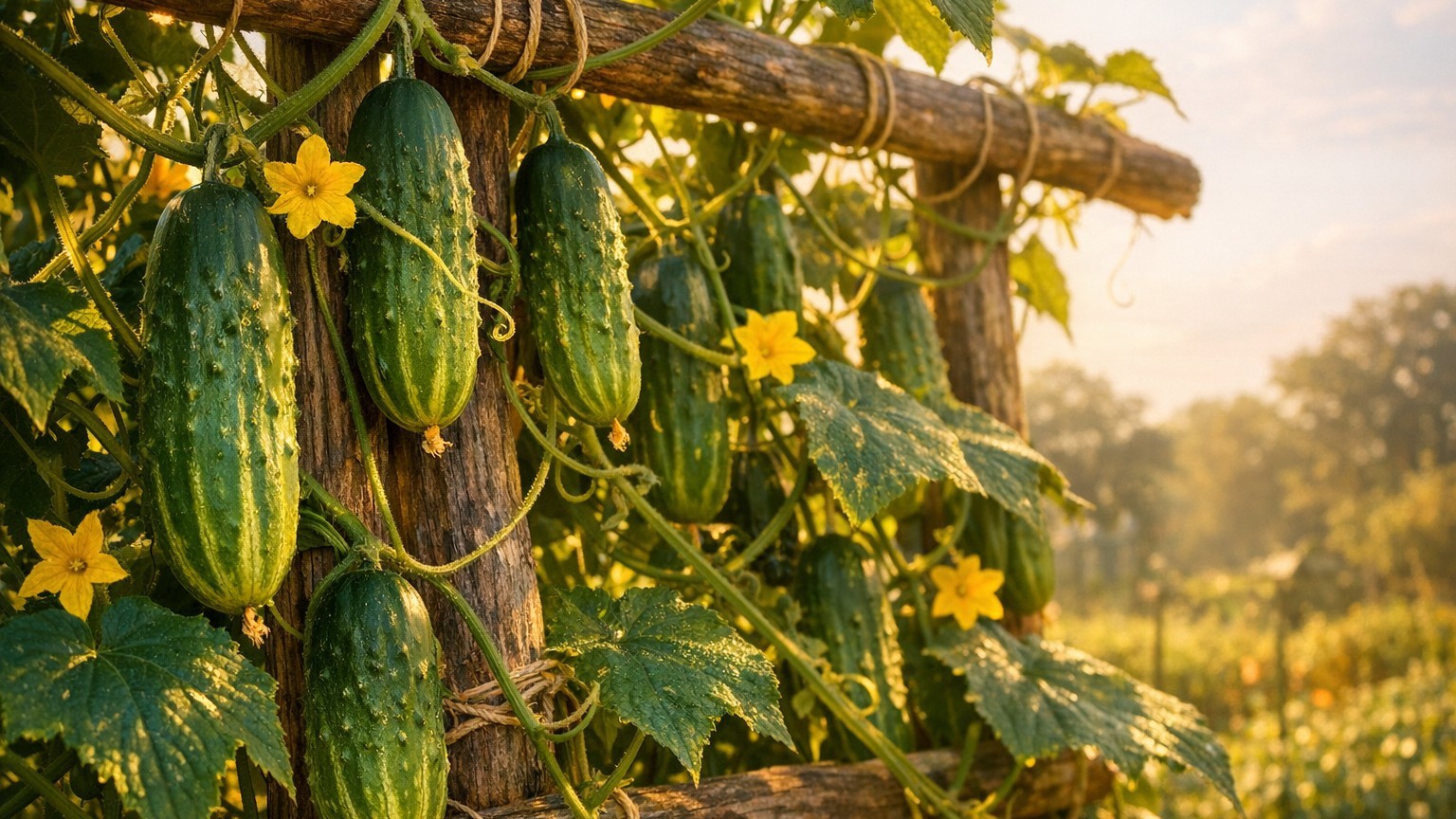

Short-season types win in North Dakota, period. Pickling cucumbers and compact bush slicers built to mature in the 50-to-70-day range fit the state’s frost window far better than long-vine burpless or specialty slicers that need 75-plus days of reliable heat to finish.
The short answer for North Dakota
The frost-free window at the reference station (Fargo, USW00014914) runs from a last spring frost of May 4 to May 15, to a first fall frost of September 25 to October 5. That’s a station-level window of roughly 133 to 154 days between the two 30-70% probability bands. But that number comes from an airport weather station, and suburban and rural gardens typically see the last spring frost later and the first fall frost earlier, sometimes by one to two weeks, more if the garden sits at higher elevation. Trim both ends and a realistic working season for many North Dakota yards lands closer to 105 to 130 days, not the full station figure.
Cucumbers need warm soil to germinate at all, then a solid run of warm days to size up fruit. With a season that can shrink to about 105 days once you account for a colder yard, the decision comes down to type more than anything else.
| Type | Fit for North Dakota | Why |
|---|---|---|
| Pickling, bush habit | Best fit | Compact plant, fastest to first harvest, tolerates a shorter effective season |
| Pickling, vining | Good fit | Slightly later than bush types but still within a trimmed 105-130 day window |
| Slicing, short-season selections | Workable | Needs an early start (transplants or black plastic) to finish before fall frost risk climbs |
| Burpless or long slicing types | Risky | Bred for longer, steadier heat than the shortened station window reliably offers |
| Parthenocarpic (seedless, no pollination needed) | Case by case | Some strains are early enough for this season, others are not; check maturity range before committing |
None of this is a pitch for one named variety over another. A cultivar that performs well in a trial plot two states away may not be the one your local extension office has actually tested. The North Dakota State University Extension Service tracks which pickling, bush, and short-season slicing varieties have done well in state trials, and that’s the list worth pulling before you buy seed.
What will not work here

Long-maturing slicing cucumbers and most burpless types are the first casualty of a North Dakota garden. A variety bred to need close to 80 days of steady warmth is gambling against a frost window that, once you account for a colder home garden versus the airport station, can run closer to 105 days total, not 105 days of usable heat. Cool nights in early June and again in early September eat into that number further, since cucumbers stall rather than grow when nights turn chilly.
Direct-seeding too early is the second failure point. Cucumber seed wants warm soil to germinate, and gardeners chasing the May 4 end of the frost window by planting immediately after it often find the seed sits and rots rather than sprouts, because soil temperature lags air temperature by weeks. That wasted week or two, subtracted from an already short season, is often the difference between a decent pickling harvest and a disappointing one.
Water math that doesn’t add up
Summer rainfall at the reference station averages about 10.0 inches across June, July, and August, but it’s front-loaded: June averages 4.29 inches, July 3.07, and August, the driest month, only 2.6. A cucumber patch relying on rainfall alone to get through August, right when fruit is sizing and the plant is under real demand, will come up short in a typical year. Add in an average of 11.7 days a year hitting 90°F or higher, mostly clustered in mid-to-late summer, and the moisture deficit compounds: heat drives evaporation faster than a light rain can replace it. A cucumber that dries out and rewets on a weekly cycle tends to produce bitter, misshapen fruit, so a watering plan built around “it usually rains enough” is one of the more common failures in the state.
Fall-extension attempts without protection are the third trap. Given a hardiness zone range of 3a to 4b, extreme winter minimums aside, the growing-season cushion on the back end is thin. Trying to squeeze a second late planting of cucumbers in July, expecting six more weeks before frost, runs into the same reference-station caution: fall frost can arrive well before October 5 once you’re outside town.
What changes across North Dakota
North Dakota is not one climate wearing a single label. The USDA Plant Hardiness Zone Map places the state across a 3a to 4b range, a spread built on one measurement, the average annual extreme minimum temperature. That two-notch difference matters less for a summer annual like cucumber directly, but it’s a decent proxy for how much colder and shorter the season runs in the coldest pockets of the state compared to the milder ones.
A garden sitting toward the colder end of that range, whether from latitude, elevation, or local cold-air drainage, should assume the frost-free window is shorter than even the trimmed 105-to-130-day estimate given above for the reference station. That points toward the earliest bush pickling types available, plus season-extension tools: black plastic mulch to warm soil ahead of planting, floating row cover to buy a week or two on both ends, and transplants started indoors rather than direct-seeded, so the plant is already established when the ground finally warms.
A garden closer to the milder end of that 3a-4b range has more room to work with. Short-season slicing types become more realistic without extra protection, and a second, staggered planting of pickling cucumbers has a better shot at finishing before fall frost risk climbs.
This page can’t tell an individual reader which side of that range their own yard falls on. Zone boundaries shift with elevation, slope, and distance from rivers or lakes in ways a state-level page can’t resolve. The USDA hardiness zone map, searchable by ZIP code, is the tool for pinning down a specific location. What can be said with confidence: a state spanning 3a to 4b has no single answer, and treating the whole state as one growing season is the fastest way to end up with a mismatched variety.
Where to check this for your own county
North Dakota State University Extension is the source for anything county-specific. The state-level picture includes frost dates from the reference station, the summer rainfall pattern, and the general logic of matching cucumber type to season length, but a county recommendation will always beat a state one, because it accounts for local frost records and local trial results.
Two things are worth pulling from the extension site before planting. First, the local planting calendar for the specific county, which will reflect actual frost data for that area rather than the airport-station figures used here, figures that this page has already flagged as running later in spring and earlier in fall once you leave town. Second, the list of cucumber varieties that have actually been trialled in North Dakota conditions, sorted by pickling, slicing, or bush type, with real maturity ranges attached. That list is the closest thing to a guarantee a home gardener can get, because it reflects what has actually grown to harvest in the state’s soil and heat, not a seed catalog’s national-average estimate.
County extension offices, reachable through the same NDSU Extension directory, often add a layer beyond the state page too: local pest pressure, local soil tendencies, and sometimes a shorter list narrowed to what’s done well in that specific county’s trial gardens. If county-level detail isn’t posted online, a phone call to the local office is usually answered by someone who has fielded the exact same cucumber question before.
Checking this against your own garden
Every date on this page is a normal, an average built from thirty years of station data, not a promise about this particular spring in this particular yard. The garden itself gives better information, if you know what to watch for.
Soil warmth by feel is the first check. Cucumber seed wants soil that feels consistently warm to the hand, not just air that feels warm during the day. Cold, damp soil that still feels cool an hour after the sun hits it is soil that will sit on cucumber seed rather than sprout it, regardless of what the calendar says about the frost date having passed.
The first flush of male flowers is the second signal. Cucumbers typically produce a wave of male flowers before the female flowers, the ones with a tiny swollen fruit behind the bloom, show up in real numbers. Seeing plenty of male flowers but no females yet isn’t a problem, it’s the normal sequence, and it tells you the plant is healthy and simply hasn’t reached fruiting maturity.
The appearance and vigor of the first true leaves, the leaves that show up after the initial rounded seed leaves, is the third. Slow, pale, or stunted true leaves relative to what you’d expect for the week of planting usually points to either soil that’s colder than it feels, or a stretch of the kind of dry, hot spell this state sees an average of nearly 12 days a year. Either way, that’s the garden telling you something the frost-date averages on this page never could.