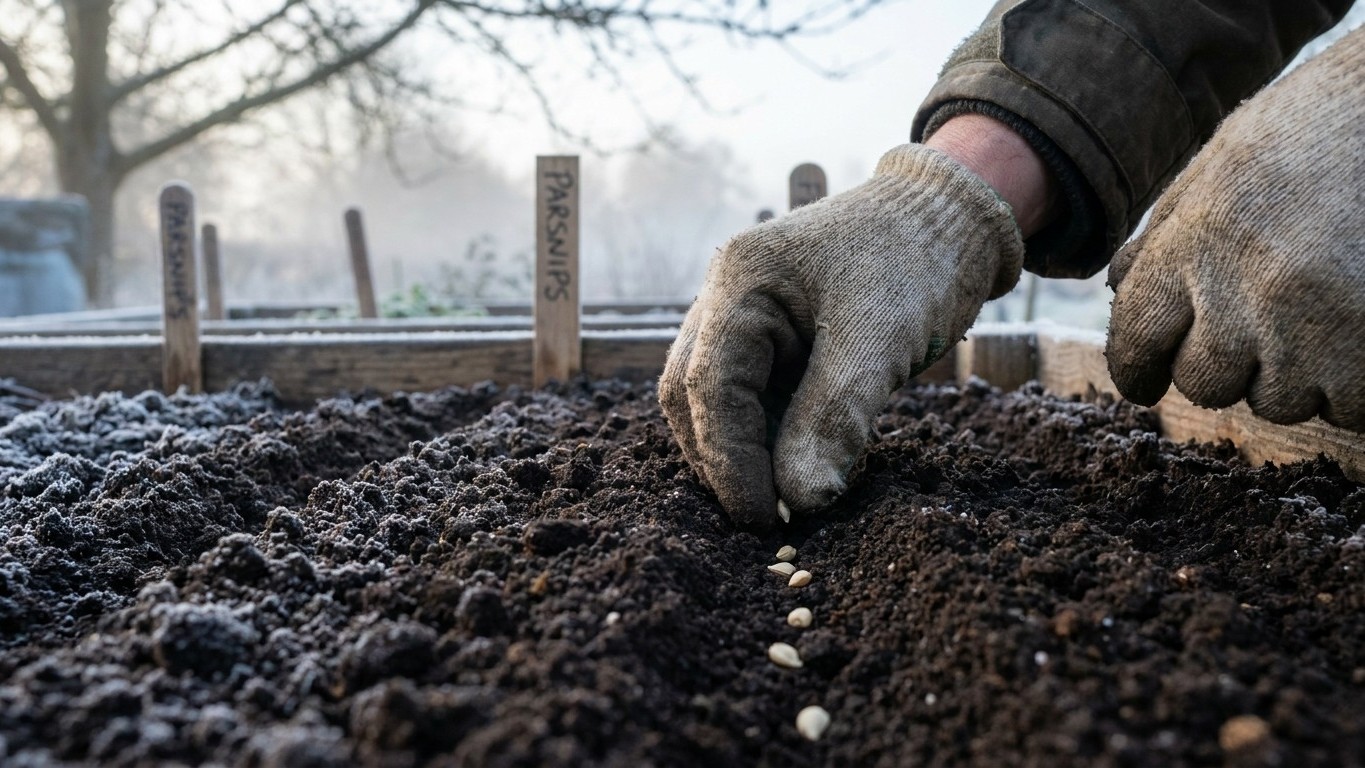

Sow parsnip seed directly in the garden bed from mid to late April in most of North Dakota, roughly two to three weeks before the last spring frost lands between May 4 and May 15 near Fargo. The state’s cold winters, with a coldest-month average minimum of just 0.2°F, guarantee plenty of frost exposure once the roots mature, so a parsnip crop here has every chance to turn genuinely sweet, not just grow to size.
The short answer
The question that actually decides whether North Dakota parsnips are worth growing isn’t how cold it gets in a single January cold snap. It’s whether the region delivers several sustained weeks of frosty weather once the roots are mature, because that prolonged chill is what converts stored starch into sugar inside the root. A single overnight dip does almost nothing. Weeks of it change the flavor entirely.
North Dakota answers that question decisively. The mean daily minimum temperature during the coldest month, based on NOAA NCEI Climate Normals from the Fargo reference station, sits at 0.2°F. That’s not a record low or a rare dip. It’s the average low across the entire coldest month, which means the region spends weeks, not days, well below freezing. For a crop that needs sustained frost exposure to sweeten, that’s about as reliable an answer as a gardener could ask for.
This is a different measurement than a hardiness zone, and the two shouldn’t be swapped for each other. A hardiness zone tells you whether a perennial plant can survive winter where it’s planted. Parsnips grown as an annual root crop don’t care about that number at all. What matters is whether the ground and the air around the maturing root get cold enough, for long enough, before harvest. A region can sit in a comfortable hardiness zone and still have a mild enough autumn that parsnips never really sweeten. North Dakota has the opposite problem, if it’s a problem at all: winters that start early and bite hard, delivering the frost exposure the crop needs almost as soon as the roots finish sizing up.
So the short answer is that a parsnip grown in North Dakota soil, left in place through the first weeks of fall frost, will do more than just grow. It will sweeten, provided the roots are dug before the ground locks up solid rather than left to freeze in place. The climate here isn’t the limiting factor for flavor. If anything, the challenge runs the other direction, toward timing the harvest before the frost that sweetens the crop turns into the freeze that traps it underground.
Does the season fit?
Parsnips need 100 to 120 days from the day the seed goes into the ground, according to Utah State University Extension, and they’re sown in place rather than transplanted, so that clock starts at seeding, not at germination. Working out whether North Dakota’s frost window gives that much room takes a bit of arithmetic, but it’s arithmetic any gardener can do on the back of a seed packet.
- Set the sowing date. Sowing happens two to three weeks before the last spring frost. With the last frost falling between May 4 and May 15 near Fargo, that puts seeding in the ground somewhere around late April to the very first days of May, depending on how quickly the soil thaws and dries enough to work.
- Account for germination. Parsnip seed is notoriously slow, taking 14 to 21 days to germinate. That lag doesn’t add to the 100-120 day maturity clock since that count already runs from seeding, but it does mean a gardener staring at bare soil for three weeks shouldn’t panic and re-sow. Patience here saves seed.
- Run the maturity math. Sowing around April 25 and adding 100 days lands near early August. Adding the full 120 days pushes maturity into mid-August. Either way, the roots are sized up well before the first fall frost.
- Check against the fall frost date. The first fall frost near Fargo arrives between September 25 and October 5. That leaves roughly six to eight weeks between when the roots reach maturity in early to mid-August and when the first frost hits, plenty of time for the roots to sit in the ground and start converting starch to sugar.
- Total up the frost-free window. Counting from the latest likely last frost (May 15) to the earliest likely first frost (September 25) gives about 133 frost-free days. Counting from the earliest last frost (May 4) to the latest first frost (October 5) stretches that to roughly 154 days. Either figure comfortably covers the 100-to-120-day maturity requirement with weeks to spare for the frost-sweetening period afterward.
The season fits comfortably, not tightly. The bigger planning task isn’t squeezing the crop in before frost, it’s deciding how many weeks of frost exposure to let the roots have before digging them, since North Dakota’s cold arrives with enough force that the ground itself becomes the limiting factor once it freezes solid.
What goes wrong here
- Forked roots in heavy or stony ground. Parsnips send a single taproot straight down, and any compacted clay, rocky subsoil, or hardpan common across parts of North Dakota will split that root into several forked legs the moment it hits resistance. Utah State University Extension recommends deep, sandy soil for straight roots, and where the native ground is heavy, double digging the bed to loosen and aerate 12 to 18 inches down before sowing is the fix, not amending after the fact.
- Forked roots from overwatering. This is a separate cause from heavy soil, and it’s easy to confuse the two. Inconsistent or excessive watering encourages the taproot to branch as it searches for a stable moisture level, even in soil that’s otherwise loose and workable. The remedy is steady, moderate watering rather than heavy soaking followed by dry stretches, with mulch used to even out soil moisture instead of relying on the hose to fix a dry spell.
- A season that runs out because of a late sowing. Waiting until the soil feels comfortably warm and dry before sowing, rather than sowing at the two-to-three-week-before-last-frost mark parsnips actually call for, can push maturity dangerously close to the first fall frost, especially in a year running on the late side of the May 4 to May 15 window. The fix is straightforward: get seed in the ground as soon as it can be worked in April, since parsnip seedlings tolerate cool soil and light frost far better than the wait-and-see approach assumes.
- Roots trapped once the ground freezes hard. North Dakota’s climate doesn’t produce the opposite problem some milder regions face, a winter too gentle to sweeten the crop. Here the risk runs the other way. With a coldest-month average minimum of 0.2°F, the ground can lock up solid not long after the first fall frost passes. Leaving roots in too long past that point means digging through frozen soil or losing the harvest altogether. A heavy layer of mulch, applied once the first light frosts start, insulates the bed and buys extra weeks for both sweetening and digging before the ground closes up for good.
Common questions
Can I sow parsnips before the last frost in North Dakota?
Yes, and it’s actually the recommended approach. Sowing happens two to three weeks before the last spring frost, which near Fargo falls between May 4 and May 15, so seed typically goes into the ground in the second half of April. Parsnip seedlings handle cool soil and light frost far better than warm-season crops.
How long do parsnip seeds take to germinate?
Fourteen to twenty-one days, per Utah State University Extension. That’s a long wait for what looks like empty soil, and it’s the point where many gardeners give up too soon and re-sow the row unnecessarily. Marking the row and keeping the soil consistently moist during that stretch is worth more than a second round of seed.
Should I harvest parsnips before winter or leave them in the ground?
Leaving them in the ground through several weeks of frosty weather is what develops the sweetness parsnips are known for, since that cold exposure converts stored starch into sugar. In North Dakota, that window opens once the first fall frost passes in late September to early October, but the roots need to come out before the ground freezes solid enough to trap them.
Does North Dakota soil need amending for parsnips?
It depends on what’s already there. Parsnips want deep, loose, sandy soil, and heavy or rocky ground common in parts of the state should be double dug 12 to 18 inches deep before sowing to prevent the taproot from forking. Treat the native soil as a starting point to check, not a guarantee that it’s ready as-is.