
In the Fargo area, spring spinach goes in the ground roughly two to three weeks before the last frost, which lands between May 4 and May 15. The fall crop is trickier: soil has to cool below 80°F first, which usually doesn’t happen until early August, and from there you’re counting back 50 to 75 days from whatever date you want to harvest before the first frost arrives, typically September 25 to October 5.
The short answer
On the longest day of the year, the Fargo area gets 15 hours and 41 minutes of daylight. That number matters more than most gardeners realize, because spinach bolts under long days and warm temperatures together. It doesn’t wait for one or the other. A stretch of 15-plus-hour days pushes the plant toward flowering whether the thermometer cooperates or not, and North Dakota’s early summer delivers exactly that kind of daylight. A gardener who assumes a cooler northern summer will stretch the spinach season is working from the wrong logic. Day length alone can end the crop even before heat becomes a factor.
Heat piles on top of that. The reference station averages 11.7 days a year at 90°F or hotter, and those days cluster in July and into August, right when the days are already at their longest. Spinach grows best where temperatures stay under 75°F, and that same 75°F line is also where the leaves start turning bitter. So the ceiling isn’t a single afternoon of discomfort for the plant, it’s a threshold with two separate penalties: growth slows, and flavor drops at the same time.
So which is it, the day length or the heat? Here, it’s both, and they arrive together. The long-day stretch of late May through July overlaps with the warmest weeks of the year, which means spinach sown too late in spring runs into a double wall: daylight long enough to trigger bolting, and temperatures high enough to make it worse. This is why spinach in North Dakota is really a two-season crop, planted early enough in spring to finish before the daylight and heat converge, and again in late summer once both start easing off.
None of this means North Dakota is a poor spinach state. It means timing carries more weight here than soil quality or watering habits. Miss the window by two weeks in either direction and the plant either bolts before you get a real harvest, or the seed sits in soil too warm to sprout. The rest of this guide breaks down exactly how much usable time that leaves in spring, and how to work backward to a fall sowing date that actually works.
How long the spring window really is
- Start with the last frost date. At the reference station, that’s May 4 to May 15. Sowing two to three weeks ahead of that puts seed in the ground somewhere around mid-to-late April, sometimes earlier if a particular spring runs mild. Spinach seed tolerates cold soil far better than most garden vegetables, which is what makes this early start possible at all.
- Mark the point where daylight and heat start working against you. Day length climbs fast after the spring equinox, and by early-to-mid June the region is closing in on that 15-hour-41-minute peak. Around the same weeks, temperatures start pushing past the 75°F growth ceiling on a regular basis, and the occasional 90°F day starts showing up.
- Subtract one from the other. An April planting date against an early-to-mid June cutoff leaves somewhere close to six to eight weeks of usable spring growing time. That’s enough for a full harvest of baby leaves, and often enough for mature leaves too, if the seed went in on the early side of that window.
- Treat the reference dates as a starting point, not a guarantee. Suburban and rural gardens away from the airport station where these normals were recorded often see a later last frost and an earlier first fall frost, sometimes by one to two weeks, more at higher elevation. A gardener outside the immediate Fargo area should check local frost history before locking in a date.
That six-to-eight-week stretch is the entire spring opportunity. Push sowing later than early May and the harvest window shrinks fast, because the plant is racing daylight and heat at the same time, not just one or the other.
The autumn crop, and when the soil lets you sow
Fall spinach faces a different problem than spring spinach. Cold isn’t the obstacle at sowing time, warmth is. And once the crop is established, the season ends the same way every North Dakota crop ends: a hard frost.
Soil that’s still too warm to germinate
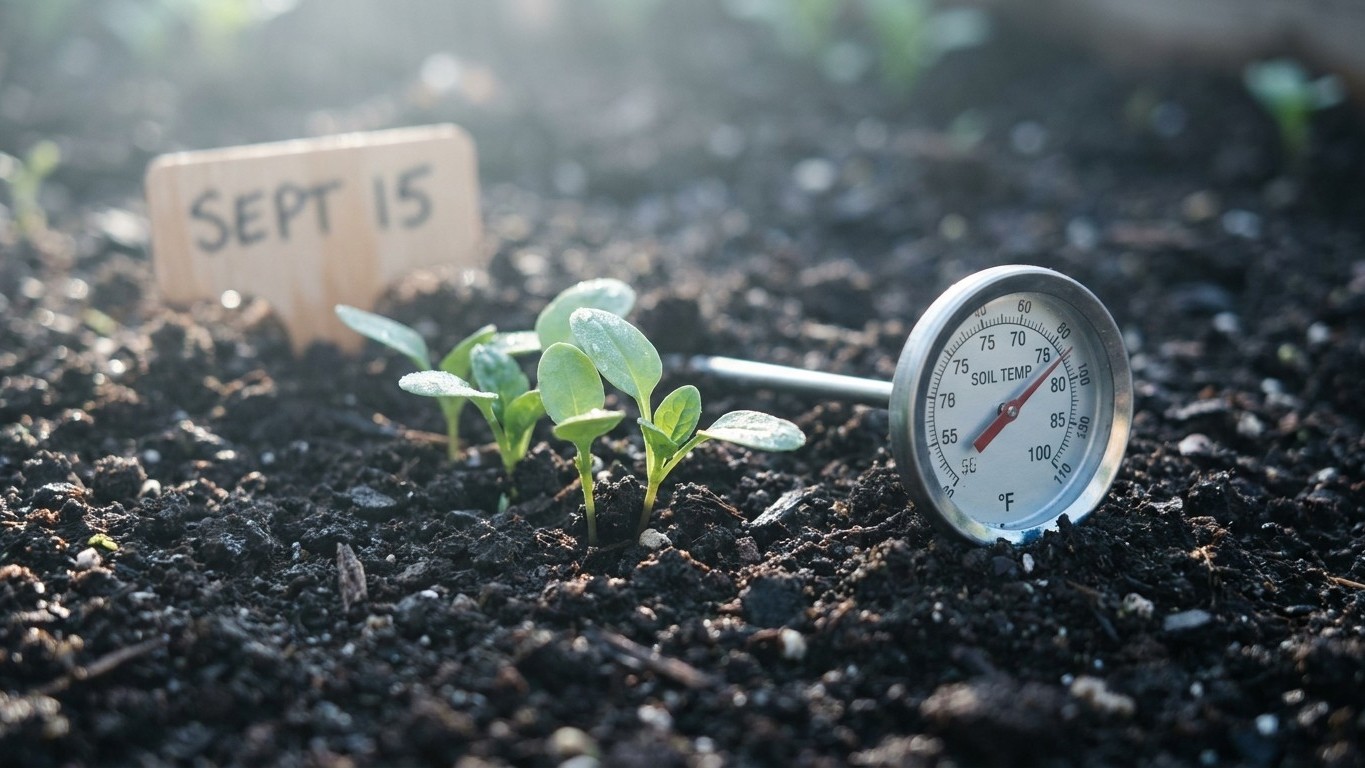
Spinach seed germinates poorly once soil temperature climbs above 80°F, according to Utah State University Extension. With 11.7 days a year averaging 90°F or hotter concentrated in July, soil at a few inches’ depth often sits well above that 80°F mark through most of that month and into early August. Sowing directly into that soil means a weak stand at best, no germination at all at worst. The practical fix is patience: wait until soil has cooled, and check it with an actual thermometer pushed two to three inches down rather than guessing from the calendar. In most years around Fargo, that cooling happens sometime in early-to-mid August.
The frost that ends the season
First fall frost at the reference station falls between September 25 and October 5. Working backward from a harvest target in that window, using the 50-to-75-day range the source gives for fall sowing, points to a sowing date somewhere between mid-July and early August. That’s the tension every North Dakota gardener runs into with fall spinach: the count-back math wants seed in the ground by early August at the latest, but the soil may not have cooled below 80°F until right around that same time.
The workable compromise is to sow as early in August as the soil allows, checking temperature rather than waiting on a fixed date, and accepting that the harvest may land closer to the 50-day mark than the 75-day mark. Four varieties commonly grown for fall harvest are Bloomsdale, Melody, Teton, and Olympia, though the source used for this guide publishes no days-to-maturity or performance data for any of them, so treat variety choice as a separate decision from the timing math above. And as with spring, remember that a garden away from the reference station may see that first fall frost arrive earlier, which tightens this window further rather than loosening it.
Common questions
Can spinach survive a light frost in North Dakota?
The source used for this guide doesn’t publish a separate frost-tolerance threshold for spinach, so no specific number can be given here. What’s documented is the 32°F freeze date range itself (September 25 to October 5 in fall), which marks the end of the growing season referenced in this guide.
Why does a cool North Dakota summer not extend the spinach season?
Because bolting is triggered by long days as much as by heat. Once daylight stretches past a certain length, roughly the 15-hour-41-minute peak reached at the reference station, the plant moves toward flowering regardless of how mild the temperature happens to be that week.
Is it better to sow fall spinach early or wait for cooler soil?
Wait for the soil, not the calendar. Germination drops sharply above 80°F soil temperature, so seed sown into still-warm ground in mid-July often fails to come up at all, even though the 50-to-75-day count-back math might suggest an earlier date.
Do the frost dates in this guide apply to every county in North Dakota?
No. These figures come from one airport weather station used as the regional reference point. Rural and suburban gardens typically see the last spring frost later and the first fall frost earlier than the station reports, sometimes by one to two weeks, so local frost records are worth checking before finalizing a sowing date.