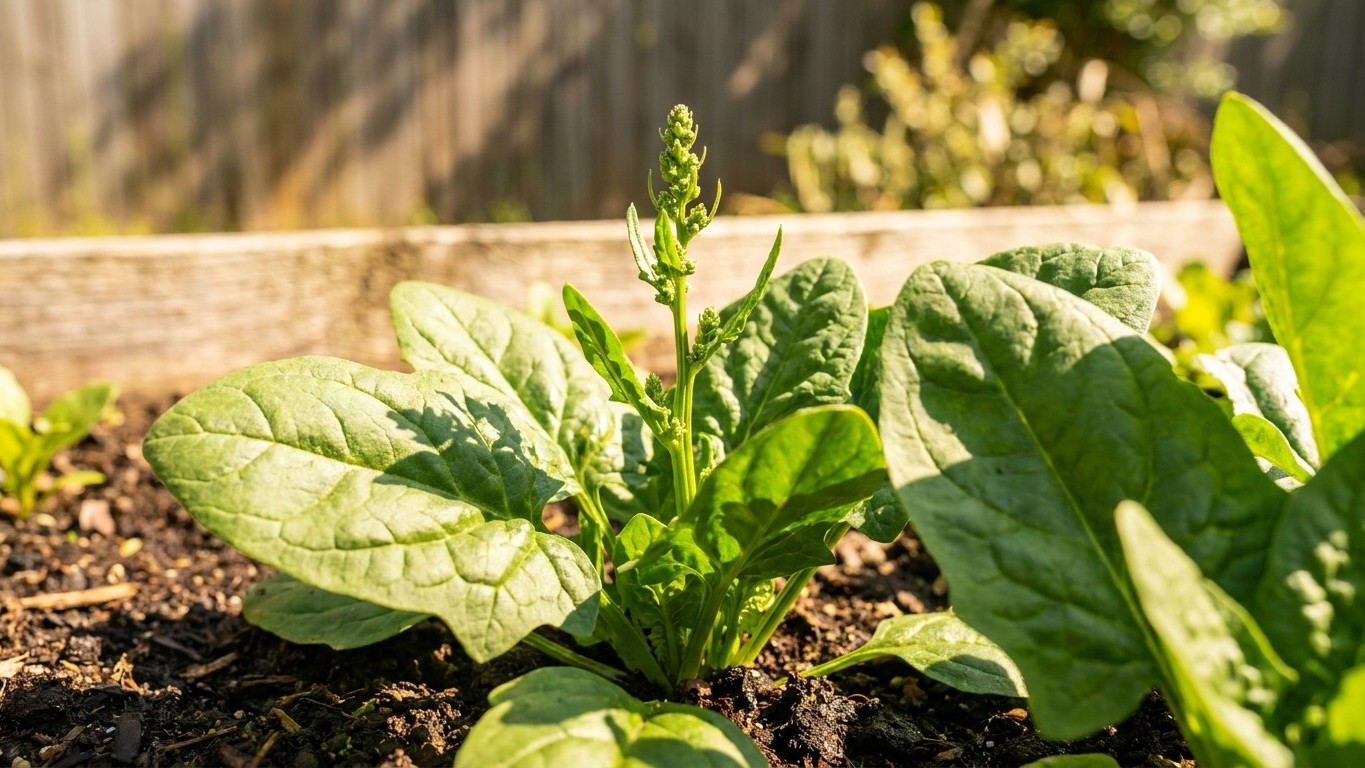

Cut spinach in North Dakota from late spring into early summer, as soon as the leaves are big enough to eat and before a flower stalk starts to rise. A second sowing in late summer gives a fall cutting. Once harvested, spinach is a short-lived crop. Kept at 32°F it holds for two weeks at the very best, and in a typical refrigerator it starts to yellow within days.
The short answer
On the longest day of the year, the reference city here gets 15 h 41 of daylight. That number matters more than any thermometer reading, because long days alone push spinach toward flowering. Heat adds to the push, but it isn’t required. Utah State University Extension puts it plainly: spinach bolts in long days and warm temperatures, and grows best where temperatures stay at or below 75 F.
A cool summer therefore doesn’t buy you extra weeks in North Dakota. A gardener in a cooler, shadier spot can keep the heat off the bed and still watch the plants shoot up a stalk as the days stretch toward that 15 h 41 peak. The limit here is both day length and heat, working together. Day length sets the outer boundary of the season. Heat decides how bitter and short the harvest feels inside it.
The heat side is real but not extreme. The reference station at Fargo averages 11.7 days a year at 90 F or higher. That is a modest number compared with the Plains farther south, and it means most summers are not brutally hot. But spinach doesn’t need 90 F to turn on you. The 75 F mark is both the point where growth stops being good and the point where the leaves turn bitter, so a string of ordinary warm afternoons ends the good eating well before a true heat wave arrives. For the plant’s side of the story, see Will Spinach Bolt Early in North Dakota?
So “when to cut” really means two things. First, cut when the leaves have reached a size you would happily eat, working from the outside of the plant in if you want a longer harvest. Second, cut the whole plant without waiting once the center begins to lengthen or the afternoons keep climbing past 75 F. A bolting plant doesn’t hold in the garden the way lettuce sometimes does. Leaving it just trades tender leaves for bitter ones.
The frost dates below come from the airport weather station at the reference city, not from a state-wide rule. Suburban and rural gardens usually see the last spring frost one to two weeks later and the first fall frost one to two weeks earlier, and more so at higher elevation. Treat the numbers as a starting point and check your own county’s records. If you’re new to the crop, the full Growing Spinach in North Dakota guide covers the rest of the season.
How long the spring window really is
Spring spinach is a race between a late frost and an early warm spell, and North Dakota squeezes both ends. Here is how the weeks add up at the reference city:
- Find the frost date. The last spring frost falls between May 4 and May 15 (NOAA NCEI, 1991-2020 normals). If you garden outside town, push that a week or two later.
- Count back for sowing. Spinach goes in 2 to 3 weeks before the last frost. Three weeks before May 4 is about April 13, and two weeks before May 15 is about May 1. The sowing window is therefore roughly two and a half weeks wide, and a rural plot shifts the whole thing later.
- Remember the ceiling. Growth stops being good above 75 F. That is a temperature, not a calendar date, and none of the sourced figures pin down when North Dakota afternoons cross it. Watch your own forecast rather than trusting a date someone else made up.
- Know what isn’t published. The source gives no days-to-maturity for spinach, so no honest count can say how many days after sowing the first cutting arrives. Start tasting leaves when they look usable and let the plant tell you.
- Add the day-length clock. By the June solstice the days reach 15 h 41, and the bolting trigger is already there before any hot spell. The usable spring window is a matter of a few weeks of cutting, not a season.
The practical lesson is to sow early and in stages. A single big planting ripens all at once and bolts all at once. Two or three small sowings spread across that two-and-a-half-week window give you overlapping cuttings, so a warm snap doesn’t take the whole bed in a single weekend.
Variety choice is the other lever, and here the data run thin. The source names four varieties (Bloomsdale, Melody, Teton and Olympia) and publishes nothing about how any of them performs, so claims about which one resists bolting longest have no sourced backing on this page. Pick one, sow it, and note what happens in your own bed. Pests also thin a spring bed early; What Eats Spinach in North Dakota, and When lays out who shows up and what to watch for.
The autumn crop, and when the soil lets you sow
Fall spinach is the easier cut for most North Dakota gardeners, because the days are shortening instead of lengthening and the season ends with cool weather rather than heat. The catch is the start. You have to sow into the tail end of summer, and the trouble there is the soil.
The soil is still too warm to germinate
Germination drops once the soil is above 80 F, according to Utah State University Extension. So the fall problem is warmth, not cold, and it can be counterintuitive: a seed packet sown in mid-summer can sit in a bed that is simply too hot for it to come up well. In a place where the last 90 F days are rare, the early part of the sowing window is where the risk sits. The window opens when the soil falls below 80 F, and a cheap soil thermometer settles the question better than the calendar. Shading the bed and watering it just before sowing can help bring the surface temperature down.
The frost that ends the season
The source’s rule for fall spinach is to plant 50 to 75 days before the date you want to harvest. For a realistic end date, use the first fall frost at the reference city, September 25 to October 5. Counting back 75 days from September 25 lands on about July 12. Counting back 50 days from October 5 lands on about August 16. That gives a sowing range from mid-July to mid-August, and the dates sit earlier for rural and higher-elevation gardens, where the first frost often comes a week or two sooner. Work it from your own county’s frost date instead of mine.
The fall cutting then runs until the season closes, and the harvest is usually gentler on your timing than spring. Cool nights slow the plants without flipping them toward bolting, and shortening days work in spinach’s favor. Treat the frost date as a conservative deadline for the harvest, and cut what is ready ahead of it.
Storing what you cut
UC Davis Postharvest gives the best conditions for spinach as 32°F with 95 to 98 percent relative humidity. It warns that spinach is highly perishable and will not keep good quality for more than two weeks. Wilting, yellowing and decay climb after 10 to 14 days, and faster at 41 to 50°F, which is about what a home refrigerator holds in its warmer spots.
Two weeks is a ceiling, not a plan. In a home fridge, the coldest spot is the back of the bottom shelf, not the door, and that is where spinach belongs, loosely packed in a bag or container that holds moisture without sealing in water. Cut in the cool of the morning, get the leaves chilled quickly, and plan to eat them well inside that two-week limit.
Common questions
When is the best time to cut spinach in North Dakota?
For spring crops, once the leaves are large enough to eat and before a stalk rises from the center. For fall crops, from cool autumn weather until frost ends the season. Sowing for spring runs 2 to 3 weeks before the last frost, which at the reference city falls between May 4 and May 15.
Can a cool summer keep spinach from bolting?
Not reliably. Long days alone trigger flowering, and North Dakota reaches 15 h 41 of daylight on the longest day. Cool weather helps with bitterness and growth, but it doesn’t cancel the effect of day length.
How long does spinach keep after cutting?
At 32°F and 95 to 98 percent humidity, UC Davis says it will not hold good quality beyond two weeks. At 41 to 50°F, typical of a fridge door, it yellows faster. Keep it at the back of the bottom shelf and eat it early.
When should I sow spinach for a fall harvest?
Plant 50 to 75 days before the date you want to harvest. Against a first fall frost of September 25 to October 5 at the reference city, that works out to roughly mid-July to mid-August. Hold off if the soil is above 80 F, since germination drops, and adjust for a frost date that comes earlier in your county.