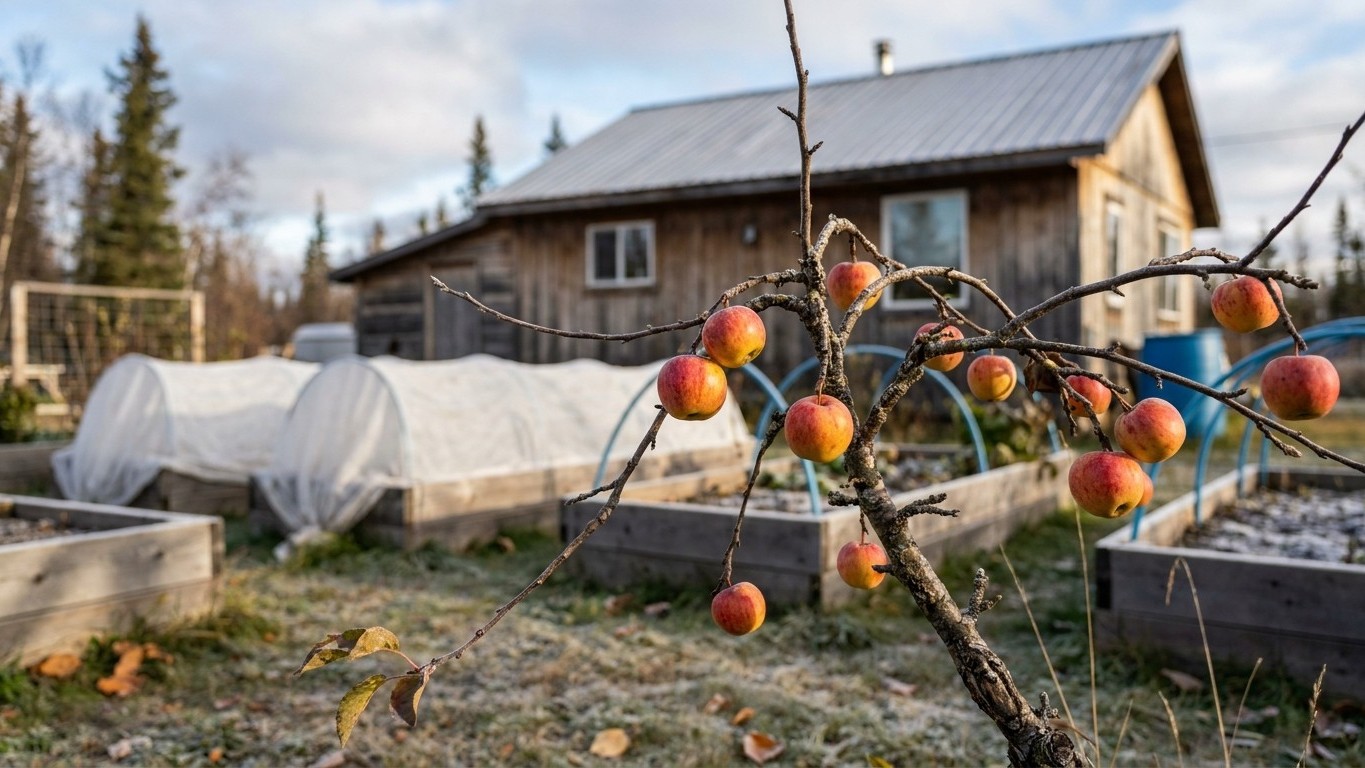

Apples can be grown in the Northwest Territories, but only the hardiest prairie-bred cultivars survive its winters, and mostly in sheltered pockets like the Yellowknife area. Environment and Climate Change Canada’s 1981-2010 climate normals put Yellowknife’s coldest month at an average daily minimum of -29.5 °C, a threshold that kills most orchard apple wood outright. Before you order a tree, match that figure against the cultivar’s own published hardiness rating rather than trusting a generic “cold hardy” label on the nursery tag.
Which varieties suit this climate

The first filter is simple survival. ECCC’s 1981-2010 climate normals for Yellowknife put the coldest month’s average daily minimum at -29.5 °C, and that number rules out almost every apple sold at a general garden center. ‘Honeycrisp’, ‘Gala’ and ‘Fuji’ are bred for winters far milder than this and will die back hard, or die outright, at that kind of cold.
Hardiness comes first
What survives is a short list of cultivars bred specifically by Canadian prairie research programs for winters this severe: ‘Norland’, ‘Goodland’, ‘Parkland’, ‘September Ruby’ and the crabapple ‘Rescue’. These came out of Manitoba and Saskatchewan breeding stations working with conditions that regularly match or beat Yellowknife’s coldest-month average, and they are the starting point for any planting list here, not a guarantee at every site in the territory. No Government of the Northwest Territories source we could find publishes a variety list specific to NWT growers, so treat these five as candidates proven hardy in prairie trials elsewhere, consult this Northwest Territories apple Best varieties guide, track their development through the season with The Northwest Territories Apple Calendar, Stage by Stage, and confirm current availability and performance with the extension service before ordering (see Local help below).
| Variety | Fruit type | Typical ripening | Best known for |
|---|---|---|---|
| ‘Norland’ | full-size apple | late summer | earliest ripening of the group, tart-sweet flavor |
| ‘Goodland’ | full-size apple | early fall | good keeper, well documented in prairie trials |
| ‘Parkland’ | full-size apple | early fall | compact tree, bred at Morden, Manitoba |
| ‘September Ruby’ | full-size apple | early fall | red skin, dessert use |
| ‘Rescue’ | crabapple | late summer | extremely cold-hardy, useful as a pollen source |
Winter chill: not a constraint here
Hardiness tells you whether the tree survives winter. Winter chill is a separate measure, the number of cold hours a tree needs to break dormancy and flower properly the following spring. A mismatch shows up as a thin, ragged bloom when a variety bred for short, mild winters gets planted somewhere too cold and dark for too long, but that’s the opposite problem from the one you have here. In the Northwest Territories the winter runs so long that chill accumulates far beyond what any apple variety needs, so this second filter, unlike hardiness, is not what limits you. Growers in places like Nova Scotia, where winters are milder and shorter, have to think harder about matching a variety’s chill requirement to the local climate. In NWT the whole decision comes down to cold survival, full stop.
Planting a pair that works here
Almost none of the varieties above will set fruit alone. Apple trees are mostly self-sterile, meaning a single tree flowers reliably and still produces little or no fruit without a second, compatible tree nearby to supply pollen. With the list of hardy cultivars already this short, the pairing decision is straightforward but not optional.
Pairing options from the hardy list
A workable pair is ‘Norland’ with ‘Rescue’: both bloom early, and ‘Rescue’ produces abundant, fertile pollen even though its own fruit is a small crab, not a full-size apple. ‘Goodland’ and ‘September Ruby’ are a second option, since both fall in the same early-fall ripening group and their flowering windows are more likely to overlap than a random early-and-late pairing would be.
Watch for sterile-pollen types
Buy from a supplier that states pollen fertility on the plant tag. A handful of apple varieties, mostly older heirlooms and some modern triploid types, carry sterile pollen: they need a partner tree to fruit themselves and can’t act as a pollinizer for anything else. Plant two of that kind side by side and you get two trees that flower and neither one fruits. None of the prairie-bred cultivars named above are known triploids, but always check before pairing an unfamiliar variety.
Bloom itself is brief at this latitude. Long summer daylight speeds the flowering-to-petal-fall sequence once it starts, so the window when pollinators can move between your two trees is short by more temperate standards. Plant the pair close together, in full sun, and skip positions so far apart that bees have to cross open ground between them. The result, when it works, is two trees with overlapping bloom, at least one supplying fertile pollen, which is the whole rule reduced to what actually matters on the ground.
The frost that costs a crop here

Environment and Climate Change Canada’s 1981-2010 climate normals list the average last spring frost at Yellowknife A station as May 25. That is a mean date, not a safe one: by definition, in one year out of two the last frost falls later than that, sometimes well into June. Treat May 25 as the midpoint of a window that closes gradually rather than a line you can plant against with confidence, and remember the reading comes from one station near Yellowknife. Other parts of the territory, especially anywhere at higher elevation or further from the moderating effect of Great Slave Lake, run behind it.
What a late frost actually kills
Tree wood tolerates far more cold than open flowers do once growth resumes in spring. A frost that arrives after the buds show pink, the stage just before bloom, kills the open flowers and the pollen inside them. The tree survives, leafs out normally, and looks perfectly healthy for the rest of the season. What’s gone is the crop for that year, not the tree, and there’s no fixing it once the flowers are dead.
Protecting bloom on a marginal night
There’s no way to warm an entire orchard against a hard freeze, but a home grower with one or two trees has options a commercial block doesn’t. Drape frost cloth or an old sheet over the canopy on nights when a freeze is forecast during the pink or bloom stage, and pull it off by morning so the flowers aren’t smothered in the sun. Strings of old incandescent lights placed under the cloth add a few degrees, enough to matter on a marginal night. Siting the tree against a south-facing wall, or in a spot that drains cold air away rather than a low pocket that collects it, does more good over the years than any single night’s scramble.
The more durable protection is timing built into the variety itself. A cultivar that blooms later in spring pushes its flowering past more of the frost-risk window than an early bloomer does, which matters most where the average last frost, May 25 by ECCC’s figures, still leaves real odds of a colder June. Ask the nursery for each cultivar’s relative bloom timing before choosing, since it isn’t printed as consistently as ripening date. Growers in Montana run the same spring gamble, working with a similarly wide gap between the average last frost and the date a grower can actually trust the danger has passed.
The apple year in Northwest Territories
Anchor everything on the tree’s stage, not the calendar date, because a stage-based clock adjusts itself to whichever spring actually shows up.
Dormancy through green tip
The tree sits fully dormant through the coldest months, when ECCC’s 1981-2010 normals put Yellowknife’s average daily minimum at -29.5 °C. Do structural pruning during this window, while the tree is leafless and wounds have time to close before sap starts moving. As days lengthen toward the season’s average last frost, ECCC’s figure for Yellowknife is May 25, the buds swell and separate at the tip, the green tip stage. Nothing needs doing yet beyond watching for it.
Pink, bloom and petal fall
Pink follows within days of green tip: the bud shows color but hasn’t opened, and this is the stage where an overnight freeze does the damage described above. Full bloom follows, the short window when pollinators need to move between your two trees. Petal fall marks the end of the pollination window and gives you a rough read on how heavy the set will be.
Fruit set through harvest
Fruit set happens over the following weeks as pollinated flowers swell into small fruit. Thin out crowded clusters now if you want larger apples later. Harvest for the earliest cultivar named above, ‘Norland’, generally comes in late summer, well ahead of the average first fall frost that ECCC puts at September 18 for Yellowknife. Later-ripening types like ‘Goodland’ or ‘Parkland’ cut it closer to that date, and a frost hitting unharvested fruit still on the branch softens and spoils it fast, so pick anything approaching maturity by taste and color rather than waiting for a specific date on the calendar. The territory’s own apple calendar walks through this same stage-by-stage sequence in more week-by-week detail, worth checking once your trees are established and you’re tracking bloom timing year to year.
Local help
For a locally vetted variety list and current spray or pest guidance, check the Government of the Northwest Territories agriculture services page before committing to an order. Confirm any cultivar’s local availability and performance directly with them, since a nursery’s hardiness claims are written for the species’ whole range, not for your specific yard near Yellowknife or anywhere else in the territory.
Common questions
Can I grow a full-size apple tree in Yellowknife, or only crabapples?
Full-size cultivars bred for prairie Canada winters, such as ‘Norland’, ‘Goodland’ and ‘Parkland’, are documented as surviving winters this severe, so a full-size tree isn’t out of the question. Crabapples like ‘Rescue’ are worth planting alongside them mainly as a reliable pollen source, not because full-size types can’t survive on their own.
Do all apple trees need a second tree nearby to fruit?
Most do. A small number of self-fertile apple varieties exist, but none of the prairie-hardy cultivars commonly available for this climate are among them, so plan on two compatible trees from the start rather than hoping for a fluke crop off one.
My last frost this year came well after May 25. Was that unusual?
Not necessarily. ECCC’s May 25 figure for Yellowknife is a 1981-2010 average, and by definition half of all years run later than their own average. A late frost past that date is well within normal variation, not a sign your site is doing anything wrong.
Should I plant a dwarf tree or a standard-size one?
Standard or semi-dwarf rootstocks generally hold up to extreme cold better than the most dwarfing rootstocks, whose roots sit closer to the surface and take deep frost harder. Ask the nursery specifically what rootstock a hardy cultivar is grafted onto, since the scion variety’s cold tolerance doesn’t automatically transfer to the roots below it.
Can I grow an apple tree in a large pot and move it into a garage for winter?
It’s a difficult way to do this. Apple trees need a real winter dormancy to flower well the next year, and a pot’s roots freeze far faster than roots in open ground, so an unheated garage rarely gives the tree the specific balance of cold-but-not-lethal that a good in-ground site provides on its own.