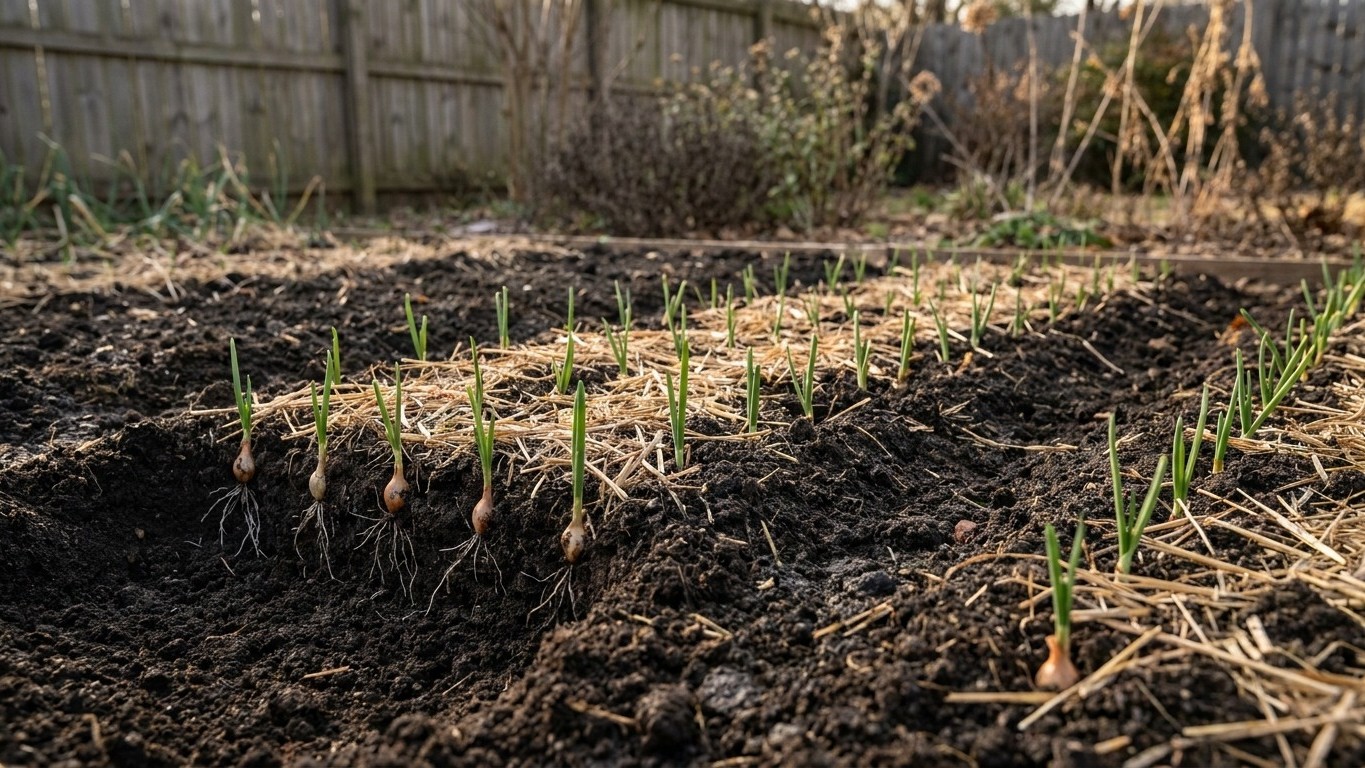

Voles and mice go after the cloves in winter, root maggots go after the bulbs in early summer, and bulb and stem nematodes ride in on seed garlic from elsewhere. That is the short list for Northwest Territories, and each threat has its own season. None of them is unique to the north, but a short, cold year changes the timing. Mulch goes on later, soil thaws later, and the pest calendar gets squeezed against the first frost.
The short answer for Northwest Territories
The first fall frost at Yellowknife A averages September 18, according to Environment and Climate Change Canada’s Canadian Climate Normals for 1981-2010. That date anchors the pest calendar because it anchors the planting. Garlic goes in around it in autumn, sits through winter underground, and is lifted the following summer. Every pest on the list hits at a particular point on that arc.
A caution before anyone circles a date. September 18 is a mean, the midpoint of a window. In one year out of two the frost falls later than that. Treat it as the middle of the range, never as a safe date. A warm September pushes everything back, including the point at which mice start looking for shelter.
Two more caveats come with the figure. It was read from a single station, Yellowknife A (climate ID 2204100), and a territory this size is not one climate. Northern and upland gardens run weeks behind it. And Canadian normals cover 1981-2010, while the US figures elsewhere on this site cover 1991-2020, so a comparison across the border is only approximate.
The threats line up like this. After planting, rodents are the main worry once mulch is down and snow insulates the bed. Through spring and early summer, root maggots take over as the soil warms. Nematodes sit outside the calendar entirely, because they arrive with the seed and live in the soil. For the planting side of this timeline, the page on When to Plant Garlic in Northwest Territories: Counting Back From the First Frost walks through the count. The broader picture is in Growing Garlic in Northwest Territories.
Working it out for your own garden
Start from your own frost date
Take the Yellowknife A figure as a reference point and adjust from there. A garden on higher ground, farther north, or away from the lake will see frost sooner, so its whole sequence slides earlier. A sheltered yard near open water may see it later. The adjustment can reach a couple of weeks in either direction, and that is before you account for any single odd year.
The arithmetic is simple. Your first-frost midpoint sets when planting happens. Mulching follows once the soil surface starts to firm up, not the day the cloves go in. Spring thaw then sets the maggot clock, and the following summer’s harvest closes the loop. Move any one of those dates and the rest shift with it.
No pest-incidence counts for the territory are published here, so what follows is the standard cold-climate list for garlic, not a local survey. The territorial agriculture office, linked at the end, is the place to ask what is actually turning up in your community.
Lay the pest calendar over it
| When | Pest | What it does | What helps |
|---|---|---|---|
| Late fall through winter | Voles and mice | Tunnel under mulch and eat planted cloves | Wait to mulch until the surface cools; keep mulch loose; lay wire mesh over the bed |
| Spring and early summer | Root maggots (onion maggot is the usual one on garlic) | Larvae tunnel into the base and bulb, and plants yellow and wilt | Floating row cover from emergence; rotate beds; pull and discard damaged plants |
| Any time of year | Bulb and stem nematodes | Microscopic worms that distort and soften bulbs, and stunt shoots | Start with clean seed; rotate away from alliums; never replant from an affected bed |
Read the table top to bottom and it tracks the garlic’s year. Rodent trouble starts the moment the bed is dressed for winter. Maggot trouble starts when the ground has warmed enough for flies to lay eggs near young shoots. Lifting the crop the following summer ends the exposure, which is one more reason not to leave mature bulbs sitting in the ground.
What changes across Northwest Territories
The south runs ahead. Hay River and Fort Smith sit at lower latitudes than Yellowknife, and gardens there generally see frost later and thaw earlier. That stretches the planting window, and it also gives maggots a longer, warmer run in spring. Soils in the southern boreal plains tend to be deeper than the thin pockets of the Canadian Shield, which helps drainage and rooting.
Yellowknife itself sits on the north shore of Great Slave Lake, and the lake matters. Big water holds summer heat into the fall, so gardens near the shore can see frost a bit later than gardens inland, while shaded rock outcrops cool off sooner. Gardeners in town often work in raised beds because of shallow soil over bedrock, and raised beds drain and warm sooner in spring. They also give mice an easy overwintering spot if the mulch is thick.
Norman Wells, along the Mackenzie River, and Inuvik, in the Mackenzie Delta, run behind the Yellowknife figure. Both are well north of it, so the first fall frost comes earlier and the growing season closes sooner. A fall planting there has less time to root before the ground locks up, and cold soil in spring thaws slowly, which delays when maggots become active. Deep snow in the north is a double-edged blanket: it protects the cloves from the worst cold, and it protects the rodents tunnelling under it.
Anyone swapping notes with growers on the Atlantic side should keep the differences in mind. Nova Scotia’s winters are milder and wetter, and its calendar and cultivars follow a different logic, as the pages on When to Plant Garlic in Nova Scotia: Counting Back From the First Frost and Garlic Varieties That Suit Nova Scotia Winters show. Advice that works in Halifax does not transfer to the Mackenzie Valley without adjusting the dates.
The mistakes this climate punishes
Mulching too early is the big one. Laying a thick straw or leaf blanket while the ground is still warm creates a cozy shelter, and voles and mice move in before the first hard freeze. Wait until the surface has started to firm, then add the cover. A mesh screen over the bed adds a physical barrier that rodents have to work to get past.
Planting too late to root comes next. Cloves need time to put down roots before the ground freezes. Plant after the soil has locked up and the cloves sit loose, where freeze and thaw can push them toward the surface. Shallow cloves are also the easiest meal for a rodent. The frost date is a midpoint, so count backward from it with room to spare and do not wait for the frost itself to start.
Choosing the wrong type is another cold-winter error. Hardneck garlic is the usual pick for harsh winters, and the page on Garlic Varieties That Suit Northwest Territories Winters covers what to look for. A softneck that struggles through the cold leaves weakened plants that pests find easier to damage.
Buying seed carelessly can cost years. Nematodes travel in infected cloves, and once they are in a bed, cold alone does not clear them. Buy seed garlic from a source you trust, keep a few cloves from a known-clean harvest if you have one, and do not plant store-bought bulbs of unknown origin. Rotating alliums out of a bed for a few seasons after any suspected infestation is far cheaper than fighting it.
Finally, treating one clean year as proof. Maggot pressure swings from season to season, and a cool, wet spring is no guarantee that flies stay away. Row cover costs little compared with a lost bed.
Checking this against your county
The territory has no counties, so the useful question is which community you are closest to. The Department of Industry, Tourism and Investment runs the territorial agriculture services and is the right place to ask about local frost dates, soil conditions and what pests are being reported in your area. Bring your community name and a rough idea of your elevation and distance from the lake or river.
Common questions
When is garlic most at risk from pests in the Northwest Territories?
Two stretches stand out: the first winter after planting, when rodents tunnel under mulch, and the spring and early summer after thaw, when root maggots become active. Nematodes can show up at any time because they live in soil and seed.
Is September 18 a safe planting date?
No. It is the average first fall frost at Yellowknife A, per Environment and Climate Change Canada’s 1981-2010 normals. In one year out of two the frost arrives later, and gardens north or at higher elevation see it sooner.
Does a hard northern winter kill garlic pests?
Not reliably. Cold does not clear nematodes from soil, and rodents often do better under snow cover than in open ground. Clean seed and bed rotation do more than the weather ever will.
Do I need row cover on garlic in the north?
It is a low-cost precaution against root maggots from the time shoots emerge in spring. No territorial pest counts are published here, so check with the territorial agriculture office to see whether maggots are active in your community.