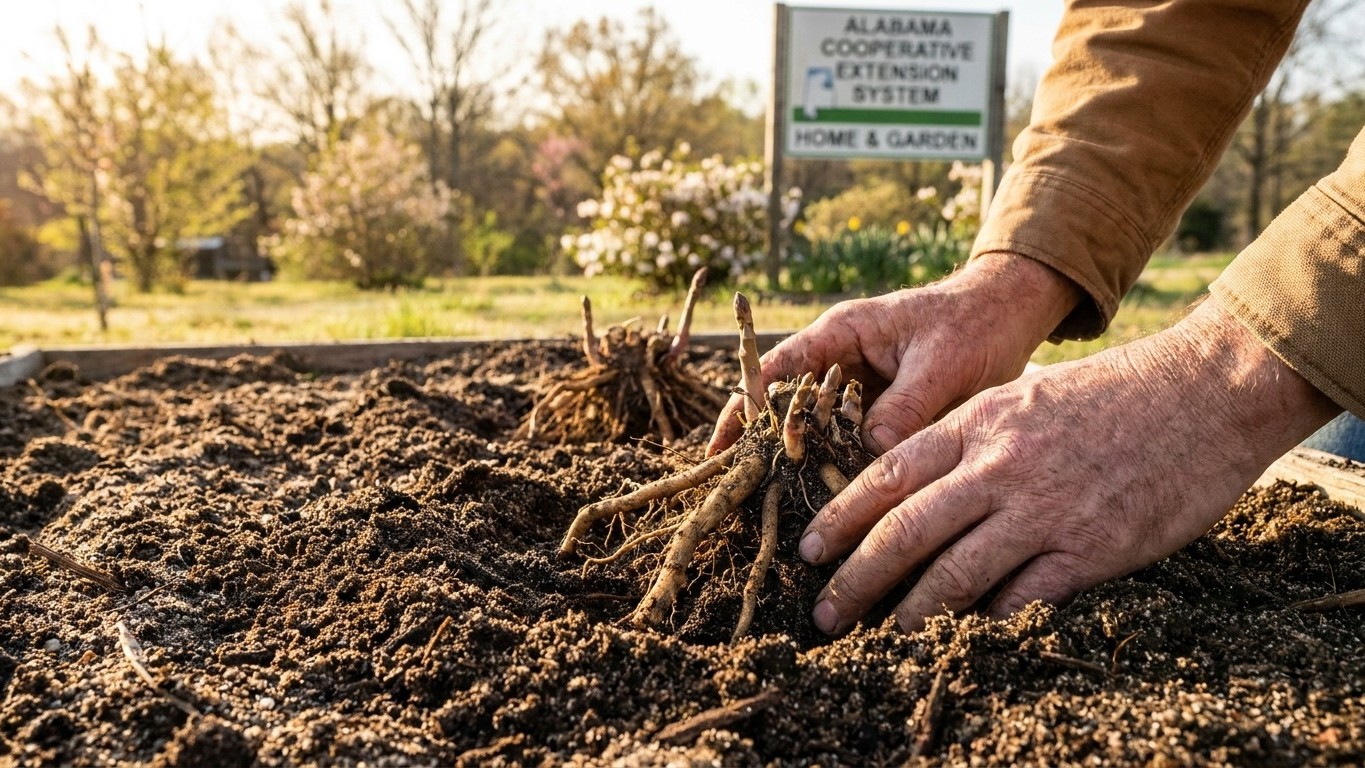

Plant asparagus crowns in Northwest Territories in early spring, timed around the region’s average last frost date of May 25 at Yellowknife. Set the crowns into 8-inch furrows in ground that drains freely, this bed will occupy that spot for 10 to 15 years, so the planting window matters far less than picking the right ground in the first place. No harvest happens before year three.
The short answer
Here’s what actually decides whether that planting date works: not the calendar, but what’s under the crowns. The dominant soil across the mapped agricultural ground of Northwest Territories is a Cryosol, a soil order defined by permafrost sitting somewhere in the profile, with only a shallow active layer thawing each summer above it. That covers 99 percent of the mapped surface here, with Regosolic soils making up most of the rest. Texture-wise it runs loam to silt, close to 55 percent sand, 6 percent clay and 39 percent silt, with organic matter around 2.4 percent. Agriculture and Agri-Food Canada’s Canadian Soil Information Service rates that surface horizon as well drained.
That’s good news on paper, since the only soil requirement Utah State University Extension lists for asparagus is drainage, most soils will grow it, provided water doesn’t sit. But a “well drained” rating on the mapped surface horizon isn’t a guarantee for one particular backyard. The Cryosol classification exists because of what’s underneath: a frozen layer that doesn’t move. Even where the topsoil sheds water fine, a shallow active layer can act like a lid partway down, holding meltwater against the roots through the wettest weeks of spring instead of letting it pass through. River bottoms, low ground, and any soil disturbed by construction fill will behave differently from the median profile entirely, and no pH figure is published for this surface, so don’t guess one.
This is where the fifteen-year commitment changes the math. On an annual vegetable, a soggy pocket is a nuisance you fix or work around next season. On asparagus, it’s a decision that outlives most of a decade and a half, undone only by digging up and starting over. If a test hole fills with water and stays wet, or if the planting site sits low relative to the yard, the fix is a raised bed or raised rows, lifting the crowns’ root zone above whatever is holding water below. A quick check before committing: dig a hole about a foot deep, fill it with water, and see if it drains within a few hours. If it doesn’t, raise the bed rather than gamble fifteen years on a low spot.
Will the summer here water it for you?
an Asparagus Bed wants 1 to 2 inches of water every other week for its first two years, then can stretch to every three weeks once established. Yellowknife’s climate normals show summer arriving light on rain: about 4.3 inches total across June, July and August, with June the driest month at 1.14 inches, July at 1.61 inches, and August at 1.55 inches.
- June, the establishment month: 1.14 inches over the month works out to roughly 0.57 inch per two-week stretch, well under the 1 to 2 inches newly planted crowns need, expect to add water most weeks this month.
- July, the peak growth month: 1.61 inches splits to about 0.8 inch every two weeks, still short of the low end of the target, so supplemental watering stays part of the routine.
- August, as the fern matures: 1.55 inches breaks down to roughly 0.77 inch per two-week period, again below what a first- or second-year bed calls for.
- Every summer month here falls short of the 1-to-2-inch, two-week target on its own, meaning a hose or drip line is doing real work in a Northwest Territories asparagus bed, not just topping off an already generous rainfall.
These are normals for one reference station, not a guarantee for any single yard, a slope, a windbreak, or a spot in the lee of a building shifts things. A rain gauge staked next to the bed is the only way to know what’s actually landing there in a given week, and it’s worth checking before assuming the sky is handling the job.
When to put the crowns in
Crowns go into the ground in early spring, while they’re still dormant, and the natural anchor point for that in Northwest Territories is the region’s average last spring frost, which lands around May 25 at the Yellowknife station. That figure is a mean, not a promise, in roughly one year out of two, the actual last frost falls later than that date. Treat it as the midpoint of a window rather than a green light, and lean toward the later side of “early spring” if the ground is still cold or wet when the date arrives.
Dormant crowns tolerate cool soil better than tender seedlings do, which is part of why they’re planted ahead of the frost-free date rather than after it, the furrow work and early root growth happen while the soil is still waking up. The 8-inch furrow itself isn’t filled in all at once. The crowns go in at the bottom, get a light covering of soil, and the rest of the furrow is backfilled gradually as the season goes on, about 2 inches every other month, rather than buried completely on planting day.
Starting from seed instead of crowns is the alternative route, though it adds time rather than saving any. Seed-grown asparagus has to first grow into a crown-sized plant before it can be set into its permanent bed, which pushes the entire three-year wait for a first harvest out even further. For a region where the frost-free stretch is already tight, most of the practical advantage sits with buying crowns and getting them into the ground once the soil around that late-May marker has opened up and dried enough to work.
Common questions
How long before I get an actual harvest? None comes in year one or two. Year three is the first cutting, and it’s a short one: about 4 weeks of harvest, followed by roughly 6 weeks the year after, then about 8 weeks once the bed is fully established. Each year, harvest stops not on a fixed date but when most of the spears coming up are thinner than a pencil, that’s the signal to let the plant put its energy into fern growth instead.
Do I fill in the whole furrow when I plant the crowns? No. The 8-inch furrow gets only a light covering of soil at planting, and the rest is added gradually over the season, about 2 inches every other month, rather than buried in one pass.
Which asparagus variety should I choose? Utah State University Extension names four commonly grown varieties, distinguished only by whether they’re all-male or male-and-female: Jersey Giant and Jersey Knight are all-male, while UC 157 F1 and Purple Passion produce both sexes. No published data compares them on flavor or yield, so the choice comes down to what’s available rather than a documented advantage of one over another.
What if my soil doesn’t drain well? Given how much of Northwest Territories sits on Cryosol soils with permafrost in the profile, a shallow frozen layer can hold water against the roots even when the surface itself is rated well drained. If a test hole stays wet, build a raised bed to lift the crowns above that layer rather than planting directly into ground that may pool water each spring.