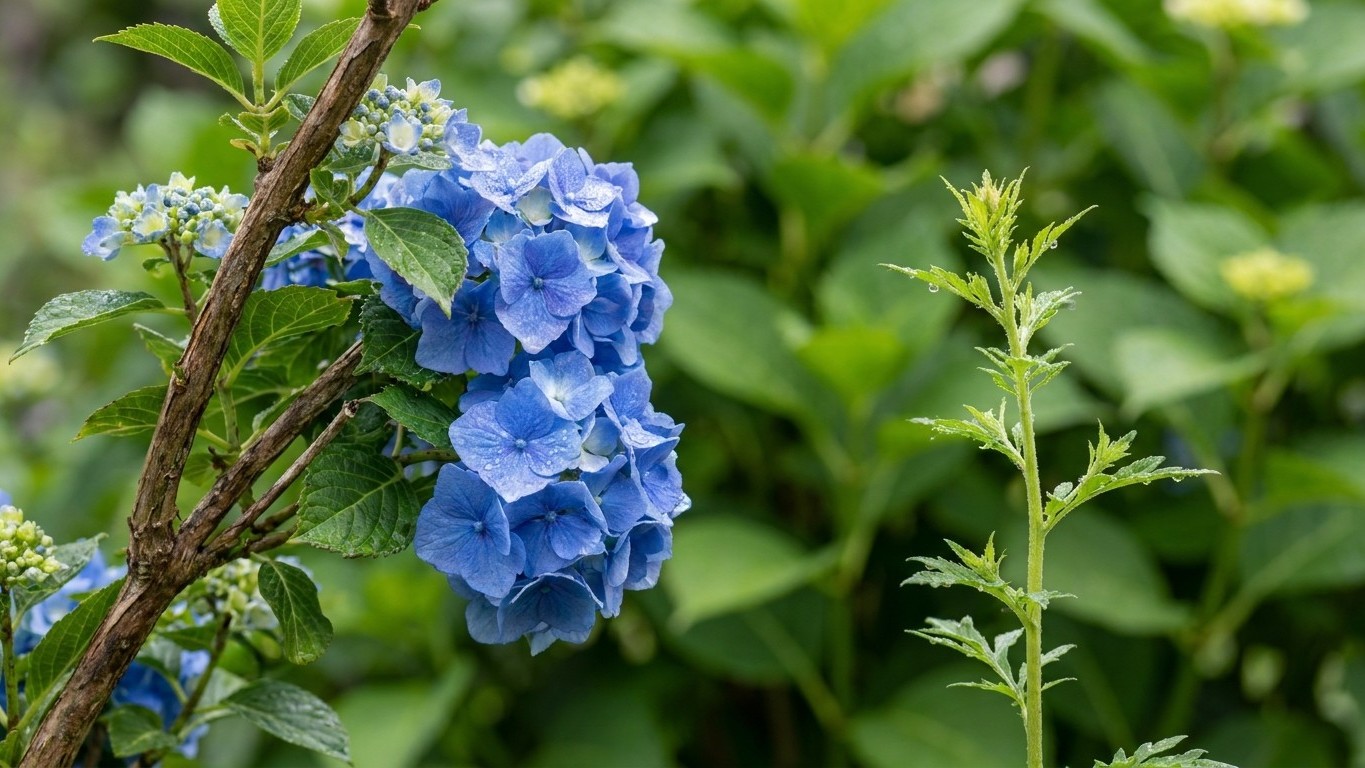

Wait for spring. Hydrangeas in the territory are pruned once buds swell and the first leaves show, which at Yellowknife falls after the late May frost window. A mild spell in March or April is too early. Panicle and smooth types get their real cut then. Bigleaf types get only the dead wood removed, because their flower buds sit on last year’s stems.
What this comes down to in Northwest Territories

Prune hydrangeas in the window that opens around the mean last spring frost, which is May 25 at Yellowknife, the reference city for this territory, and let the buds tell you which stems survived. That date is an average, so in one year out of two the last frost comes later. Late May is the middle of the window, not a guaranteed safe date.
The same station has a mean first fall frost of September 18, which leaves about 116 frost-free days between the two. Yellowknife sits in Canadian hardiness zone 1b. That is a Canadian rating built on seven climate variables, and it does not convert to a USDA zone. It does tell you that winter here is harsh enough to kill most hydrangea stems above the snowline.
That dieback is why timing differs from milder regions. Southern gardeners can prune in late winter because the stems are alive and the only question is where to cut. Here, you cannot judge a stem in March. A branch that looks fine in April may be dead to the base, and one that looks scruffy may be carrying live buds near the snowline. Cutting early means guessing, and a wrong guess costs a season of growth when the season is already short.
Bloom habit sets the rest of the schedule. Panicle hydrangeas (the cone-flowered type) and smooth hydrangeas (the round white mopheads) flower on new wood, so a spring cut does no harm to the bloom. Bigleaf hydrangeas flower mostly on old wood. Cut those stems back and you cut off the flowers. In a zone 1b winter, bigleaf types often die back so far that there is little old wood to protect, which makes them the hardest to flower here at all.
Spent flower heads are the one thing worth leaving on through winter. They catch drifting snow around the crown and shelter the buds below. Remove them in spring when you do the main cleanup.
Working it out for your own garden
The method has three steps. Find your local last-frost midpoint, wait until buds show life, then check how many weeks remain before the first fall frost. The weeks left tell you how hard you can afford to cut.
Use the reference figures as an example. A mean last frost of May 25 means the pruning window starts in the last week of May and runs into mid June. A panicle hydrangea pruned in early June has about fifteen weeks before the mean first fall frost on September 18. One pruned in late June has about twelve. Every week you delay is a week the new shoots do not grow, and new-wood bloom depends entirely on that growth.
Take ‘Limelight’, a panicle type that blooms on new wood, with flowers that open in midsummer and age toward pink in fall. Cut it back in early June, and it still has the rest of the season to grow before the average frost. That is a workable bet. Cut in late June, it has less time, and the blooms may open just as the season closes.
Now take ‘Nikko Blue’, a classic bigleaf that blooms on old wood. If winter kills its stems to the ground, the new shoots that grow back carry no flower buds that year. Cutting back its live stems in spring removes whatever buds did survive. Here the right move is to cut only stems that are clearly dead and accept a leafy, flowerless summer in a hard year.
How do you tell which hydrangea you have?
Look at the flowers and leaves. Panicle types carry cone-shaped clusters and oval, pointed leaves. Smooth types such as ‘Annabelle’ have big round white heads and rounded, soft-green leaves. Bigleaf types have thick, glossy leaves and either rounded mopheads or flat lacy clusters. Oakleaf types have lobed leaves shaped like an oak’s. If the tag is gone, a first season of flowers will tell you.
How do you tell if a stem is alive?
Scratch the bark with a thumbnail. Green and moist underneath means alive. Brown and dry means dead. A live stem also bends before it snaps, while a dead one cracks cleanly. Work from the base up, and cut each dead stem back to the first pair of healthy buds or to the ground.
What changes across the territory
The territory is huge, and the Yellowknife dates move a good deal depending on where you garden. Yellowknife sits on the north arm of Great Slave Lake. The big lake slows spring warming and delays fall freeze-up, which smooths out the extremes close to shore. Gardeners well inland feel a wider swing between warm days and cold nights.
Latitude matters a great deal. Communities in the South Slave and Dehcho regions, such as Fort Smith, Hay River and Fort Simpson, generally run ahead of Yellowknife in spring and hold their season longer in fall. In the Beaufort Delta around Inuvik, the season is shorter and later. In that tundra-edge climate, a hydrangea that needs a long season of growth may not get it.
Snow depth adds a second layer. A reliable snowpack insulates the lower stems, so the part of a shrub that sits under snow often survives when the exposed tips do not. A garden where wind scours the snow away loses more wood than a sheltered yard on the same street. A south-facing wall or a fence that collects drifts can change the pruning picture from one side of town to the other.
Practically, a gardener in the south of the territory can start checking buds somewhat earlier than late May, while one in the far north should expect to wait longer and prune less. In every case, start from the reference dates and adjust by what your own shrubs show you. Spring leaf-out on neighboring native shrubs is a good local signal: when willows and alders are in leaf, the hydrangea is usually ready to be judged.
The mistakes this territory punishes
A common error is pruning on a warm spell. A few mild days in April can tempt you to cut, but frost often returns, and any new growth the cut stimulates freezes back. Wait until the late May window has opened, then wait a little longer if the forecast still shows frost.
Cutting too hard on old-wood types is another common error. A bigleaf cut to the ground in spring has no flower buds left, and in a short season it will not form new ones in time. Remove only what is dead.
Late-season pruning also backfires. Cutting a shrub in late summer or fall pushes soft new growth that has no time to harden before the first frost on or around September 18. Stop shaping by midsummer on every type. For old-wood types, any pruning has to happen right after the flowers fade, because the next year’s buds form not long afterward.
Some gardeners also tidy in fall and cut every stem to the ground. That removes the snow-catching structure and exposes the crown to the full winter. Leave stems standing, and cut in spring once you can see what is alive.
Last, do not trust the calendar over the plant. A frost after the mean date is not unusual, since in about half of all years the last frost falls later than that date. If buds have broken and a frost threatens, cover the shrub overnight and hold off pruning until the damage shows.
Checking this against your community
The Yellowknife dates are a starting point, not an instruction for your yard. The territory has no counties, so a good place to ask is the agriculture team at Northwest Territories Industry, Tourism and Investment, which can tell you how your community’s season compares. Local garden clubs often know which sheltered spots hold snow best. For the basics of planting and care, see the guide to growing hydrangeas in Northwest Territories.
Common questions
Can I prune hydrangeas in fall in Northwest Territories?
Avoid it. Fall cuts stimulate tender growth that frost will kill, and they remove the stems that trap snow around the crown. Leave the plant standing and prune in spring after buds show.
When should I cut back a hydrangea that died to the ground?
Wait until the late May frost window has opened and new shoots appear at the base. Then cut every dead stem back to the ground or to the first healthy bud. A scratch test on the bark confirms which stems are still alive.
Will pruning in spring stop my hydrangea from blooming?
Not for panicle or smooth types, which bloom on new wood. A bigleaf can lose its flowers if you cut live old stems, so remove only the dead ones.
How hard should I cut a panicle hydrangea here?
Take off some of the live growth in early June, after buds are clearly active. A harder cut, or one made later in June, leaves less growing time before the mean first fall frost on September 18, which may mean fewer or later blooms.