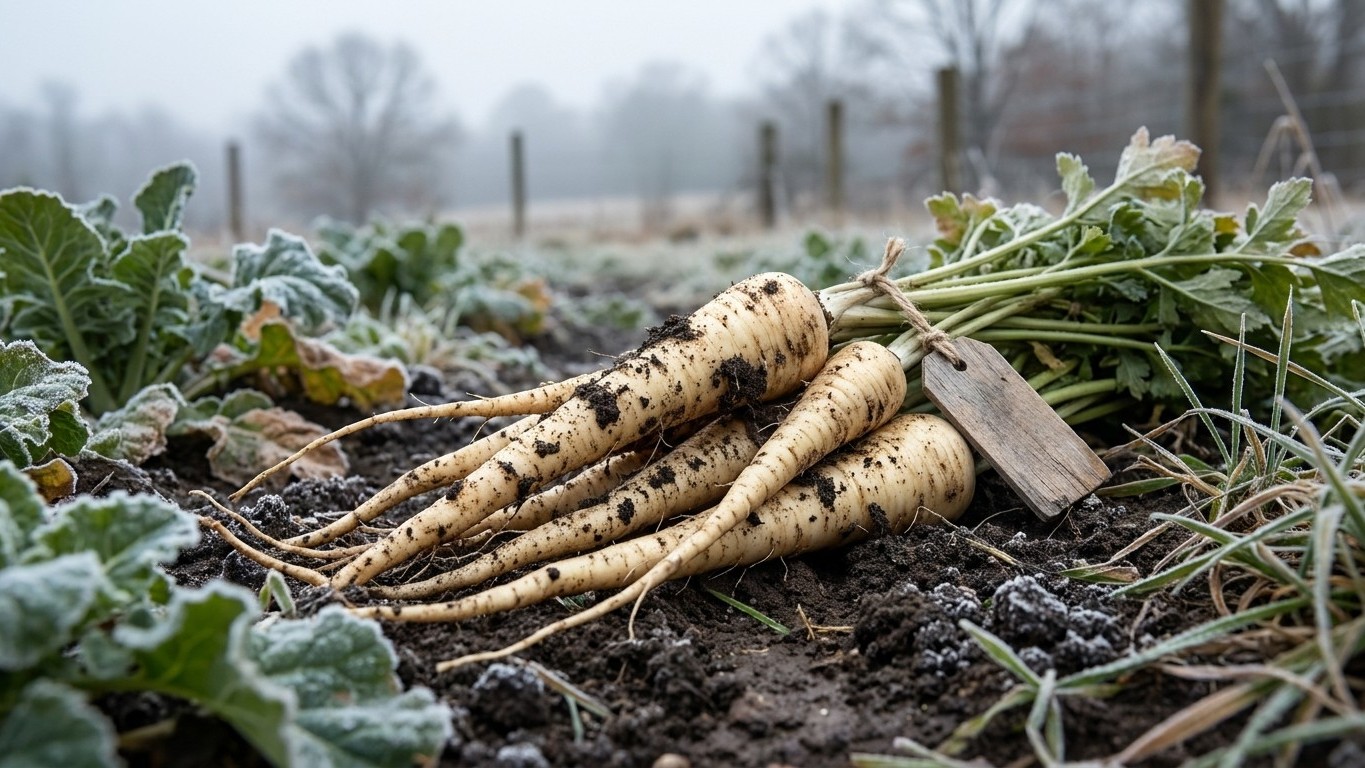

Yes, parsnips grown in the Northwest Territories will sweeten, and they’ll do it thoroughly. The territory’s brutal cold delivers far more than the “several frosty weeks” the crop needs to turn stored starch into sugar. The catch isn’t sweetness. It’s timing the sowing and getting the roots out of the ground before it locks solid.
The short answer
Here’s the question that actually settles this, not “what zone is this” but “does the cold here run deep and long enough to work on a parsnip root sitting in the ground.” The answer for the Northwest Territories is unambiguous. At the Yellowknife reference station, the mean daily minimum temperature for the coldest month sits at -21.1°F. That’s not a record low from one bad night. That’s the average low, night after night, for an entire month.
This distinction matters more than most gardeners realize. A hardiness zone tells you whether a perennial plant’s roots or crown will survive winter in the ground. Parsnip sweetening is a different mechanism entirely: it’s about exposing an already-mature root to a run of cold, frosty days and nights so that enzymes in the root convert starch into sugar. A place can sit in a “mild” zone on paper and still fail to deliver that sweetening if its frosty stretch is short or shallow. A place with a genuinely severe coldest month, like this one, doesn’t have that problem.
-21.1°F as a mean minimum means frost isn’t an occasional visitor here. It’s the baseline condition of the coldest month, and the weeks leading into it are colder than most temperate-zone gardens ever see in their entire winter. Utah State University Extension notes that parsnips taste best after several weeks of cool, frosty weather converts stored starch to sugar. In the Northwest Territories, “several weeks” isn’t a stretch goal. It’s practically guaranteed by the calendar, as long as the roots are left in the ground long enough after the first fall frost to feel that cold before they’re dug.
So the sweetening question resolves quickly here. What takes more thought is whether the growing season, sandwiched between a late spring frost and an early fall one, gives the roots enough time to size up before that cold sets in.
Does the season fit?
Parsnips are sown directly in the garden bed, not started indoors and transplanted, and the standard guidance from Utah State University Extension calls for 100 to 120 days from seeding to maturity, with sowing happening 2 to 3 weeks before the average last spring frost. Here’s how that lines up against this territory’s frost window.
- Start with the last spring frost. At the Yellowknife station, the average date is May 25. Remember this is a mean, not a guarantee: in roughly half of all years, frost arrives later than that.
- Move the sowing date back 2 to 3 weeks. That places seeding somewhere around the first to second week of May, working the soil as soon as it can be dug.
- Count forward to the first fall frost. The average date at the same station is September 18, again a mean rather than a safe cutoff.
- Add up the days between sowing and that first fall frost. From early May to September 18 runs roughly 130 to 137 days, depending on which week in May the seed goes in.
- Compare that to the 100-to-120-day requirement. The window here isn’t tight. It’s comfortably longer than what the crop needs, with a margin of a couple of weeks even in a year that runs slightly cold or late.
- Account for germination before counting on that margin. Parsnip seed is slow, taking 14 to 21 days to germinate. Gardeners who dig up the row after a week and re-sow, assuming the seed failed, are the single most common reason this crop “doesn’t come up” in cold-soil regions. Mark the row, water gently, and wait the full three weeks before deciding anything failed.
Once germination is accounted for, the real growing period, from emergence to root maturity, still fits inside the frost-free stretch with room left over for the roots to sit through cool September and October weather before harvest, which is exactly the exposure that builds sweetness.
What goes wrong here
The sweetening isn’t in doubt in this climate. The failures that show up here are mechanical, tied to soil, water, and the sheer speed with which the ground goes from workable to frozen solid.
- Forked or hairy roots. This has two separate causes, and they call for different fixes. Heavy or stony ground splits the taproot as it pushes down and meets resistance, so soil that isn’t naturally deep and sandy needs to be double dug before sowing, per Utah State University Extension’s guidance. Overwatering is the second cause, entirely unrelated to soil texture: keep watering even and moderate rather than heavy, since saturated soil encourages side-rooting just as much as a rock does.
- Missing the germination window. Cold spring soil slows parsnip seed even further than usual, and the 14-to-21-day germination period can stretch toward the longer end here. Sow shallow, keep the row consistently moist, and resist the urge to re-sow before three full weeks have passed.
- Ground freezing before harvest. With a coldest-month mean minimum of -21.1°F, the soil here doesn’t stay diggable for long once real winter sets in. Roots left too long past the first fall frost, hoping for “just a bit more sweetening,” risk being locked into frozen ground. A heavy mulch layer applied right after the first fall frost slows that freeze and buys extra digging time while still letting the cold reach the roots.
- Sowing too late in spring. Because the frost-to-frost window here, while ample, isn’t limitless, pushing sowing past the recommended 2-to-3-week-before-last-frost mark eats directly into the margin calculated above. Get seed in as early as the ground can be worked rather than waiting for warmer, more comfortable soil.
Common questions
Do parsnips need to freeze to sweeten, or just get cold?
They need real frost exposure over an extended stretch, not just cool weather. Utah State University Extension describes this as several weeks of cool, frosty conditions converting the stored starch to sugar. A handful of mild, chilly days without actual frost won’t do the same job.
Can parsnips be left in the ground all winter in a place this cold?
That depends on how well the ground is protected from freezing solid before harvest. A thick mulch layer applied after the first fall frost slows the freeze and can extend the digging window, but the underlying figure to respect is the -21.1°F mean minimum for the coldest month, which shows just how quickly unprotected ground can lock up here.
What if the seed hasn’t sprouted after two weeks?
Keep waiting. Germination normally takes 14 to 21 days, and in cool spring soil it can run toward the longer end of that range. Digging up the row and re-sowing before three weeks have passed is the most common reason gardeners think their parsnip crop has failed when it simply hasn’t emerged yet.
Does heavy soil mean parsnips can’t be grown here at all?
No, but it does mean extra bed preparation. Utah State University Extension recommends deep, sandy soil for straight roots and calls for double digging heavy ground before sowing. Skipping that step in dense or stony soil is what produces forked roots, separately from any issue with watering.