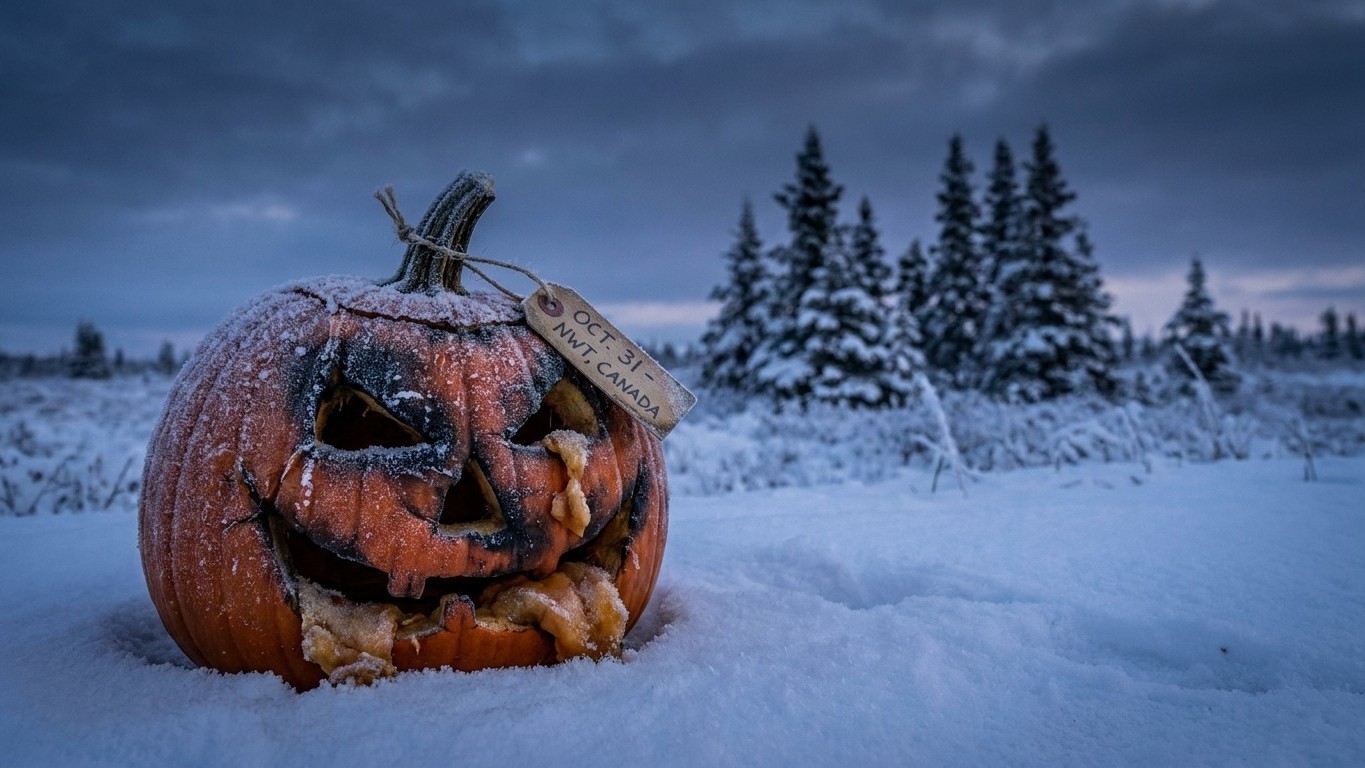

In Yellowknife, the mean first fall frost lands around September 18, more than six weeks before Halloween arrives on October 31. That gap matters more than most carving guides admit. A pumpkin left out from mid-September onward in the Northwest Territories isn’t just risking a light frost, it’s sitting through weeks of hard cold before the holiday even shows up on the calendar.
The short answer

Carve close to Halloween, not weeks ahead of it. That’s the practical answer for this territory, and the frost data explains why. Around September 18 is when the average first frost touches Yellowknife, and that date is a midpoint, not a guarantee. In roughly half the years on record, frost arrives even earlier. By the time Halloween rolls around on October 31, the region has typically been through more than a month of sub-freezing nights already.
What does that mean for a jack-o’-lantern? Everything. A whole, uncarved pumpkin can tolerate cool air far better than a carved one. Once you cut into it, the exposed flesh loses its protection and becomes vulnerable to freezing, which turns firm orange walls into a collapsed, weeping mess almost overnight. In a climate where hard freezes are routine by late October, the carved pumpkin’s clock starts ticking the moment the knife goes in, and cold air speeds that clock up rather than slowing it down.
So the window isn’t measured in weeks here. Think in terms of a handful of days before October 31, ideally close enough that the carved pumpkin only has to survive one or two cold nights outdoors, not a full month of them. If your household tradition is to carve early for a party or a photo, keep the piece indoors at a controlled temperature until display time, and only set it outside on the porch for the final stretch.
This is a case where the calendar date people default to nationwide (early October, or “whenever it feels festive”) simply doesn’t hold up against local conditions. Northwest Territories communities further north or at higher elevation than Yellowknife likely see frost even sooner, which only tightens the window further. The safest approach is to buy or pick your pumpkin with plenty of stem intact, store it whole in a cool dark spot, and save the actual carving for the last few days before the 31st.
Frost or heat: which one gets it here
A whole pumpkin keeps best between 45 and 50 degrees Fahrenheit, according to University of Illinois Extension. That’s a narrow band, and in most of the country the question is whether autumn stays cool enough to hit it. In the Northwest Territories, the question flips entirely.
The cold end
Here the danger isn’t warmth pushing the pumpkin past 50 degrees. It’s the opposite: the air dropping well below 45 and freezing the pumpkin solid. The mean first frost around September 18 already tells you cold arrives early. And the coldest month in this region averages a daily minimum of -21.1 degrees Fahrenheit, a number that has nothing directly to do with October but says everything about how quickly and how hard winter sets in once it starts. A pumpkin left in an unheated outbuilding or on an exposed porch step can go from “stored properly” to “frozen through” in a single cold snap, especially once real winter conditions begin building through late fall.
The warm end
Heat, by contrast, is barely a factor. In most of the Northwest Territories, outdoor air in late October rarely threatens to push a stored pumpkin above 50 degrees. If anything, the risk on the warm side comes from indoors, not outdoors, specifically from a heated house. A pumpkin kept too close to a furnace vent, a wood stove, or a sunny window can warm past the storage band even while it’s freezing outside, which softens it and shortens its usable life.
| Factor | Ideal storage band | Northwest Territories late October |
|---|---|---|
| Low end | 45 F | Often well below, once frost and freezes set in |
| High end | 50 F | Rarely a concern outdoors; possible only near indoor heat sources |
Where to keep it until you carve
Finding a spot that holds steady in that 45-50 degree band takes a little more thought here than in milder climates, since the outdoors goes too cold and the indoors can run too warm. A few practical options:
- An unheated entryway or mudroom, if it stays above freezing but below room temperature, works well as a middle ground between a frigid porch and a heated living room.
- A cold basement or root cellar, common in many northern homes, tends to hold a steady cool temperature year-round and stays dark, which is exactly what a whole pumpkin needs for its three-to-six month storage window.
- An attached but unheated garage can work on milder fall days, but check it regularly once nightly lows start approaching or passing freezing, since an unheated garage can drop well below the safe storage range during a cold snap.
- Keep the pumpkin away from any heating vent, wood stove, or radiator. Indoor heat sources can push the storage spot well past 50 degrees even while the temperature outside sits far below zero.
- Keep it away from ripening fruit and vegetables, including apples, potatoes, and tomatoes. Ripening produce releases a gas that speeds up aging in a stored pumpkin, so a kitchen counter fruit bowl or a pantry shelf next to potatoes is one of the worst spots you could choose.
- Check the stem before you commit to storage. Look for one to two inches remaining. The stem functions as a seal, not a handle, and once it breaks off, that exposed section becomes an entry point for rot. Never lift or carry a pumpkin by the stem.
Checking this against your own county
Frost dates and storage temperatures shift from one community to the next, and Yellowknife’s numbers won’t match conditions in Inuvik, Fort Smith, or Hay River exactly. The Northwest Territories doesn’t run a county-based extension system the way many U.S. states do, but the territorial government’s Industry, Tourism and Investment department maintains an agriculture services page that covers growing and food storage conditions specific to the territory. If you’re in a community that historically sees frost earlier or later than the Yellowknife average, that’s the resource worth checking before you settle on a carving date.
Local knowledge still counts for a lot here too. Neighbors who’ve grown pumpkins or squash in your specific area, or a nearby community garden group, often have a better sense of exactly when the first hard freeze tends to hit their particular yard than any territory-wide average can offer.
Common questions
How long does a carved pumpkin last in the Northwest Territories?
No extension service publishes a fixed number of days for a carved pumpkin, and that’s true nationally, not just here. What’s actually documented is how to choose and store a whole pumpkin: pick one with an intact stem, keep it whole in a cool dark spot between 45 and 50 degrees, and carve it as close to Halloween as your plans allow.
Should I worry about frost damaging my pumpkin before I even carve it?
A whole, uncut pumpkin tolerates cool air far better than a carved one, but a hard freeze can still damage the rind and interior. Since the mean first frost in this region lands around September 18, well before Halloween, store your whole pumpkin somewhere protected from freezing air rather than leaving it outside for weeks on end.
Is my basement too cold for pumpkin storage?
Not necessarily. A basement that stays consistently cool, ideally close to the 45-50 degree range, and dark, is actually one of the better spots available in a cold climate. Just avoid any area near a chest freezer’s exhaust or an exterior wall that runs colder than the rest of the space.
Does the pumpkin’s shape or color affect how well it stores?
No. University of Illinois Extension notes that shape is unimportant when choosing a pumpkin. What matters is that it’s heavy for its size, free of blemishes and soft spots, and still carrying one to two inches of stem.