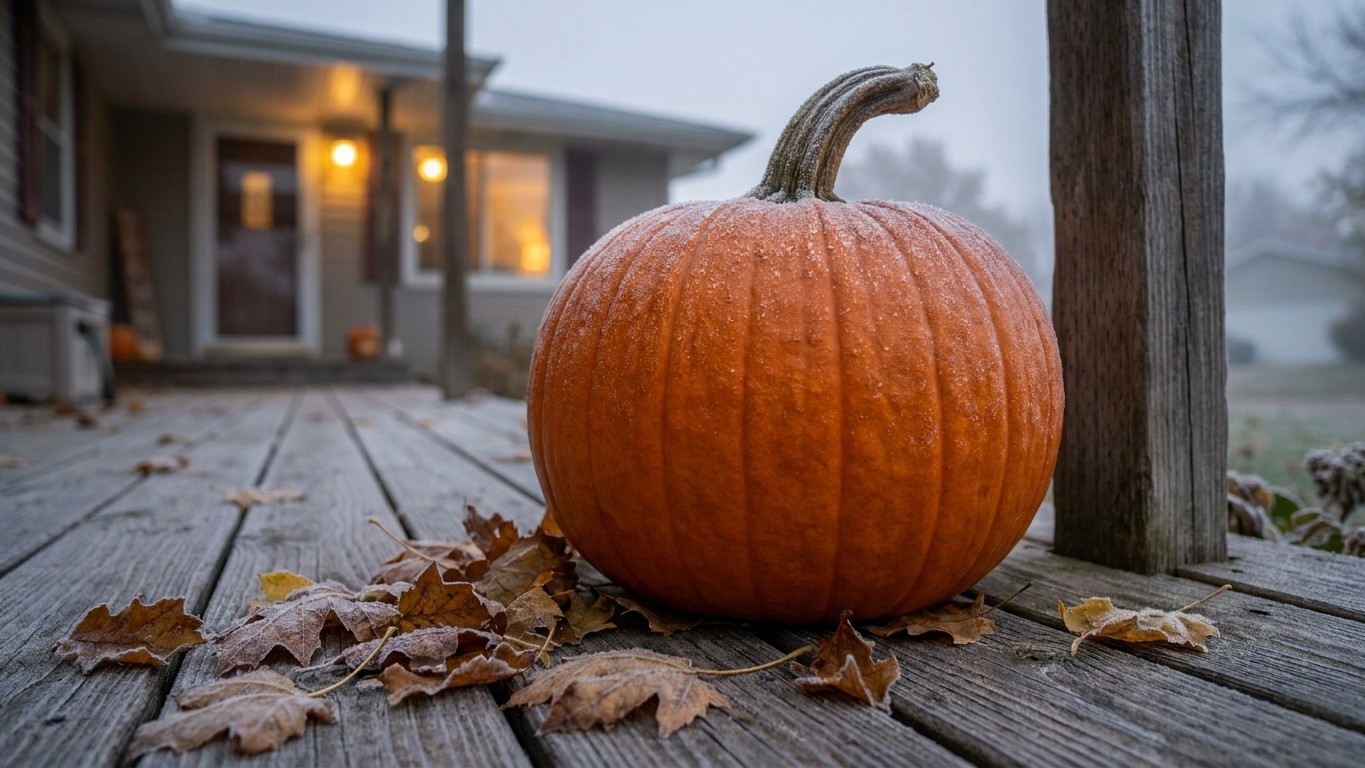

In the Northwest Territories, the thing that eats a pumpkin crop most often is the calendar. The season is short, and the first fall frost arrives before a late fruit can finish. Insects get their own pages on this site, so this one stays on timing: when a flower has to open, when seed can go in, and which failures a short season produces.
The short answer
Start with the frost. At the Yellowknife A station, Environment and Climate Change Canada puts the average first fall frost at September 18. Count back 45 to 55 days from that date and you get a window of roughly July 25 to August 4. A flower that opens inside that window can, in an average year, turn into a ripe pumpkin. A flower that opens after it is gambling.
The count matters because of where it begins. Pumpkins take 45 to 55 days to mature after flowering, according to Utah State University Extension, and not after seeding or transplanting. Plenty of gardeners add 45 to 55 days to the day they sowed, get a comfortable September date, and feel fine about it. That math is wrong. Between seed and first flower sits a stretch of vine growth that this arithmetic ignores, and the fruit clock has not started yet.
Treat September 18 as the middle of a range and not as a safe date. It is a mean, so in one year out of two the first frost lands later than that, and in the other half it lands earlier. A frost on September 8 pulls the whole flower window back by ten days. The late-July to early-August window is where an average year lands, which means roughly half of all years are tighter than it. Anyone who wants a cushion should aim for flowers well ahead of the window, not right at its edge.
The station matters too. Yellowknife A is one point on a very large map, and a territory is not one climate. Northern districts and upland spots run weeks behind it, so their window slides earlier by a similar margin. Gardeners outside Yellowknife should assume a shorter season than these dates show and watch their own first frost closely for a couple of years. One more caveat: the Canadian normals cover an older 30-year period than the US figures used elsewhere on this site, so comparisons across the border are loose.
Harvest rule, from the same Utah State source: cut the pumpkin with the stem attached, and do it before frost. For a fuller look at whether a given planting will make it, see Will Pumpkins Ripen Before Frost in Northwest Territories? The broader overview lives at Growing Pumpkins in Northwest Territories.
When to sow here
Pumpkins are sown when the soil reaches 65 F, and that moment arrives well after the last spring frost. The sequence below shows the arithmetic in words, so you can run it with your own dates.
- Find the last spring frost. At Yellowknife A the average is May 25. Again, that is a midpoint: in one year out of two the last frost comes later. Districts farther north or at higher elevation will run weeks behind this.
- Add the soil lag. Soil trails the air by weeks. A frost-free morning does not mean 65 F at seed depth. Add a few weeks to May 25 and you are into June before the ground is truly ready. This site does not publish a measured soil date for the territory, so the thermometer has the final word.
- Subtract what row covers give back. A row cover buys about two weeks. If your soil would normally warm up in mid-June, covers move that to roughly the start of June. They do not erase the lag, they only shorten it.
- Check the result against the flower window. Sowing does not start the 45-to-55-day clock. The first open flower does. Whatever sowing date you land on, the vine still has to grow and bloom before roughly July 25 to August 4, or the fruit will be short of time.
- Measure instead of guessing. Push a soil thermometer a couple of inches down in the morning, when the ground is at its coldest. Sow when it reads 65 F, not when the calendar says the frost is over.
The two thresholds are separate, and mixing them up is the most common planning error in short-season gardens. A May 25 frost date and a 65 F soil are not the same event. One describes the air, the other describes the ground, and the second one runs later. For a deeper walk through planting dates, see When to Sow Pumpkins in Northwest Territories.
What goes wrong here
A season this short tends to fail in a few predictable ways. Each one has a fix, though not every fix works every year.
- A late flower that never colors. A bloom that opens after the window sets fruit that stays green when frost arrives. The remedy is to be honest about the date: once flowers are opening past the late-July to early-August window, remove new ones so the vine puts its energy into fruit that can still finish. Earlier flowers come from earlier warm soil, which is where row covers and a thermometer earn their keep.
- A fruit caught by frost. Frost can arrive before the average date, since that date is only the middle of the range. Harvest with the stem attached before frost, and watch the forecast through early September. If a cold night is coming and fruit is still out, cover the vines and fruit for that night, then cut as soon as the cold passes. Keep harvested pumpkins indoors, in a place where they will not freeze. That is the only storage guidance Utah State Extension gives, and it publishes no temperature or keeping time.
- A vine that dies back before the skin hardens. Cold nights can finish a vine while the fruit is still soft-skinned. Leave the stem on, bring the pumpkin in, and store it somewhere cool and dry. Treat it as a short-keeper. No published figure says how long an underripe pumpkin lasts, so use it first and don’t stock it away for winter.
- Seed sown into cold soil. Sowing the moment the frost danger seems over, but before the soil reaches 65 F, wastes the early start it was meant to buy. Wait for the reading. Covers can bring the date forward by about two weeks, and no more.
- A good pumpkin stored in the wrong spot. A whole pumpkin keeps for three to six months in a cool, dark place between 45 and 50 F, according to University of Illinois Extension. Keep it away from ripening fruit and vegetables such as apples, potatoes, or tomatoes. Ripening fruit gives off a gas that ages the pumpkin, so the porch beside the apple crate is the worst place in the house. That 45-to-50 F range is for a whole pumpkin only. It says nothing about a carved one.
Common questions
Is September 18 a safe date to count on?
No. It is the average first fall frost at Yellowknife A, so in one year out of two the frost comes later and in the other it comes sooner. Use it as the middle of a window, and plan flowers to open comfortably ahead of the late-July to early-August range. Districts farther north or at higher elevation run weeks behind the station.
Do the 45 to 55 days start when I sow the seed?
They start at flowering. Utah State University Extension gives 45 to 55 days to maturity after flowering, so the count begins when the first fruiting flower opens, not on sowing day and not on transplanting day.
Is 65 F soil the same as the last frost date?
No. The average last spring frost at Yellowknife A is May 25, but soil trails the air by weeks, so 65 F arrives later. Row covers can buy about two weeks, which narrows the gap without closing it.
How long will a harvested pumpkin keep?
A whole pumpkin keeps three to six months in a cool, dark spot between 45 and 50 F, away from apples, potatoes, and tomatoes, per University of Illinois Extension. That range applies to whole, uncut fruit. This page has no figure for a carved pumpkin, so don’t apply the whole-pumpkin number to one.