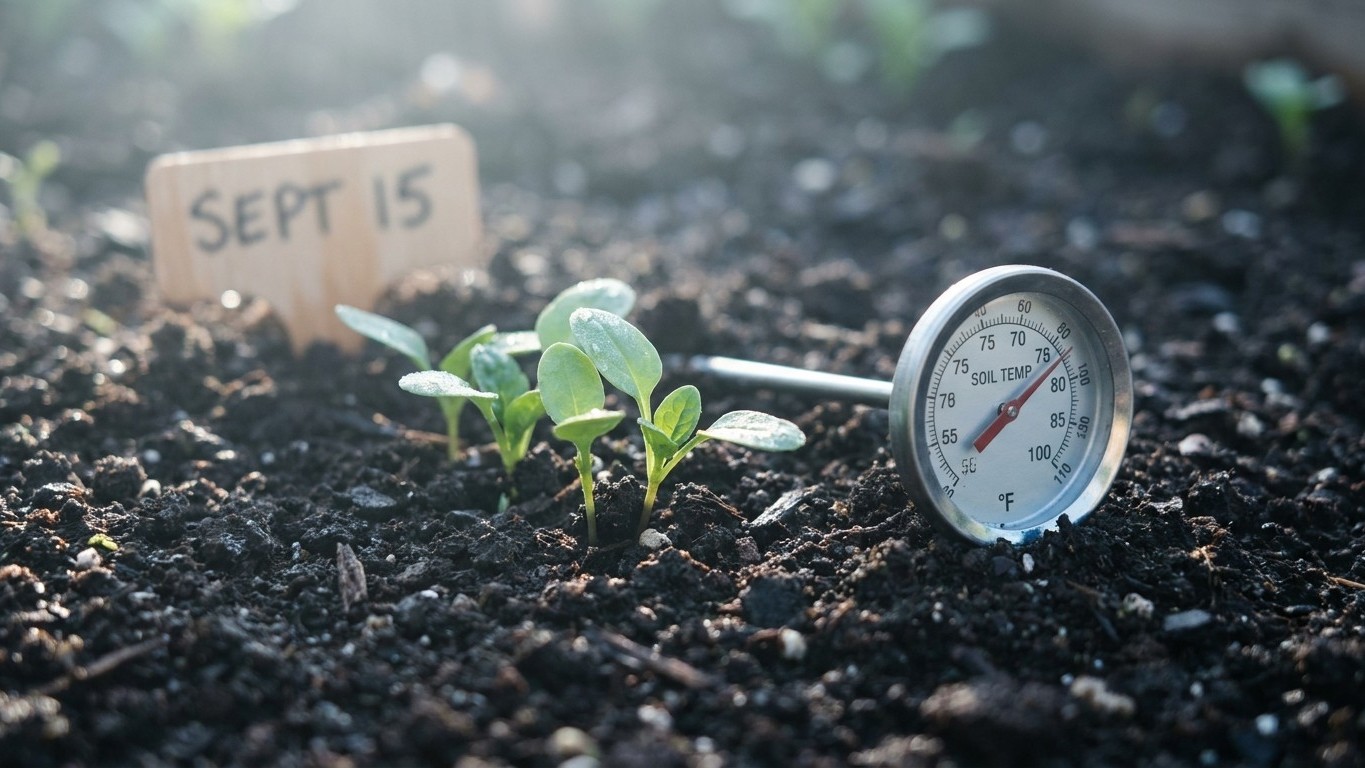

Sow Autumn Spinach in the Northwest Territories between late June and late July, aiming for roughly 50 to 75 days of growth before the region’s average first fall frost on September 18. For a spring crop, sow 2 to 3 weeks ahead of the average last frost of May 25, putting seed in the ground in early May. Neither window is generous: at nearly 19 hours and 30 minutes of daylight on the longest day, the territory’s long summer light pushes spinach toward bolting well before soil warmth ever becomes the limiting factor it is farther south.
The short answer
On the longest day of the year, the Yellowknife area holds close to 19 hours and 30 minutes of daylight. That’s not a curiosity for a gardener working out a spinach schedule, it’s the whole ballgame. Spinach bolts, meaning it sends up a flower stalk and turns bitter, in response to long days as much as to heat. A cool summer with almost no true hot weather does nothing to slow that clock, because the trigger is the sun staying up, not the thermometer climbing.
That distinction matters here more than in most places. The reference station records an average of 0.0 days a year above 90 F. Summer heat, in the sense of days hot enough to stress a cool-season crop or bake garden soil, is close to nonexistent in the Northwest Territories. If spinach struggled here because of heat, a gardener could wait out a hot spell, plant in part shade, or mulch to cool the root zone. None of that helps against day length. Day length doesn’t dip for a week and come back; it climbs steadily toward the solstice and stays high through most of the growing season, whether the air is 55 F or 75 F.
So the plain answer to what limits spinach here is day length, not heat. The 75 F ceiling that Utah State University Extension gives for good spinach growth, and for the point where quality turns bitter, is almost beside the point in a territory that essentially never sees true summer heat. What actually decides whether a planting bolts before it’s worth eating is how close to the solstice it spends its growing weeks. Spring plantings, sown in early May and maturing through late May and June, run straight into the steepest part of that daylight curve. Autumn plantings, timed for late summer and into September, catch daylight on the way back down, which is part of why the fall crop tends to hold longer and taste better even though the season itself is short and ends abruptly in frost.
None of this means heat plays zero role. On a warm afternoon even a 65 F day can nudge a plant that’s already stressed by long light toward bolting faster. But as a scheduling rule for the Northwest Territories, treat day length as the reason spinach windows here are short, and treat the near-total absence of 90 F days as the reason those windows, once open, are otherwise gentle on the plant while they last.
How long the spring window really is
Spinach seed goes into the ground 2 to 3 weeks before the last spring frost, while the soil is still cold and the days are still short enough to keep the plant from rushing to flower. Working that rule against the local climate normals lays out a narrow but usable spring window.
- Start from the frost date, and treat it as a midpoint, not a guarantee. Environment and Climate Change Canada’s 1981-2010 normals put the average last spring frost at May 25 for the Yellowknife station. That’s a mean: in roughly half the years on record, frost arrived after that date, and the figure comes from one station, so northern or upland districts in the territory can run weeks behind it.
- Count back 2 to 3 weeks from that average. From May 25, that lands sowing somewhere between about May 4 and May 11, early May, while nights are still well below freezing on a regular basis.
- Track how fast daylight is climbing from there. Early May in the Northwest Territories already carries long days, and by the June solstice the region is near 19 hours and 30 minutes of daylight. A crop sown in early May spends its entire first month of growth on the steep, rising part of that curve.
- Expect bolting, not frost, to cut the harvest short. With 0.0 days a year averaging above 90 F at the reference station, heat stress is rarely what ends a spring spinach bed in this territory. Long day length does that job well before summer heat would even become a factor.
- Count the realistic harvest weeks. A sowing in the first half of May, growing through a stretch where days keep lengthening toward the solstice, gives a picking window measured in a handful of weeks rather than months, before the plants turn to flower stalks.
The upshot: the spring crop in the Northwest Territories is real, but it’s a short, early-season crop that needs to be sown as soon as the soil allows in the first half of May and harvested promptly, rather than a planting a gardener can stretch out across a long spring.
The autumn crop, and when the soil lets you sow
The fall planting works backward from harvest instead of forward from a frost date, and it runs into a different pair of obstacles than the spring crop does. Neither obstacle is the frost itself, at least not at the sowing stage.
Soil still too warm to germinate
Utah State University Extension notes that spinach seed germinates poorly once soil temperature climbs above 80 F, which is the usual reason gardeners in hot states have to wait out late summer before an autumn sowing goes into the ground. In the Northwest Territories, that obstacle barely applies. With an average of 0.0 days a year reaching 90 F at the reference station, soil here rarely gets anywhere near that 80 F ceiling in the first place, even during the warmest stretch of July. A gardener isn’t waiting for the ground to cool the way someone in a hot southern state would; the more useful question is simply whether there’s enough calendar left before frost, not whether the soil is too hot to let seed sprout.
The frost that ends the season
That calendar question comes down to the average first fall frost, which Environment and Climate Change Canada’s 1981-2010 normals put at September 18 for the Yellowknife station. As with the spring frost date, treat this as a midpoint rather than a safe cutoff: in about half of years on record, frost arrived later than September 18, but in the other half it came earlier, so building in a buffer rather than sowing right up to that average makes sense.
Utah State University Extension’s rule for a fall crop is to sow 50 to 75 days before the date a gardener wants to harvest. Aiming to have spinach ready by early to mid-September, ahead of the average frost rather than right at it, means counting back 50 to 75 days from around September 10 to 15. That lands sowing somewhere between the last days of June and the last week of July, depending on how much margin a gardener wants to build in before that September 18 average frost.
The site’s four commonly grown spinach varieties, Bloomsdale, Melody, Teton, and Olympia, don’t come with published days-to-maturity figures from the sources behind this page, so none of them can be matched to a specific number of days in this window. What the fall crop in the Northwest Territories offers instead is a plant that spends its growing weeks on the falling side of the daylight curve, past the solstice, which is a large part of why the autumn sowing tends to hold in the ground longer and taste better than anything sown in spring.
Common questions
Can spinach be sown twice in one season in the Northwest Territories?
Yes, and the two plantings serve different purposes. A spring sowing in early May uses cold soil and still-moderate day length ahead of the solstice, while a summer sowing between late June and late July targets the falling daylight of early autumn. The two windows are separated by the long, high-daylight stretch of June and early July, when a fresh sowing would likely bolt almost as soon as it germinated.
What happens if the last spring frost comes later than May 25?
May 25 is a mean date from Environment and Climate Change Canada’s 1981-2010 normals, not a guarantee. In roughly half the years on record, frost arrived after that date at the Yellowknife station. A gardener who sows strictly 2 to 3 weeks before May 25 in a year with a late frost risks losing young seedlings, so watching local soil and air conditions in a given spring matters more than following the average date on its own.
Does hot soil ever block a fall spinach sowing in the Northwest Territories?
Rarely, and that sets this territory apart from warmer states. Utah State University Extension’s 80 F germination ceiling is the reason fall sowings get delayed in hot climates, but the Yellowknife reference station averages 0.0 days a year above 90 F, so soil temperatures high enough to stop germination are uncommon here. The bigger constraint is simply fitting 50 to 75 days of growth in before the average first fall frost on September 18.
Which spinach varieties are best suited to the Northwest Territories?
Bloomsdale, Melody, Teton, and Olympia are the varieties named in the sources behind this page, but none of those sources publish days-to-maturity or bolt-resistance data for them. Choosing among them without that information means relying on seed packet details rather than the climate data used to build the sowing windows described above.