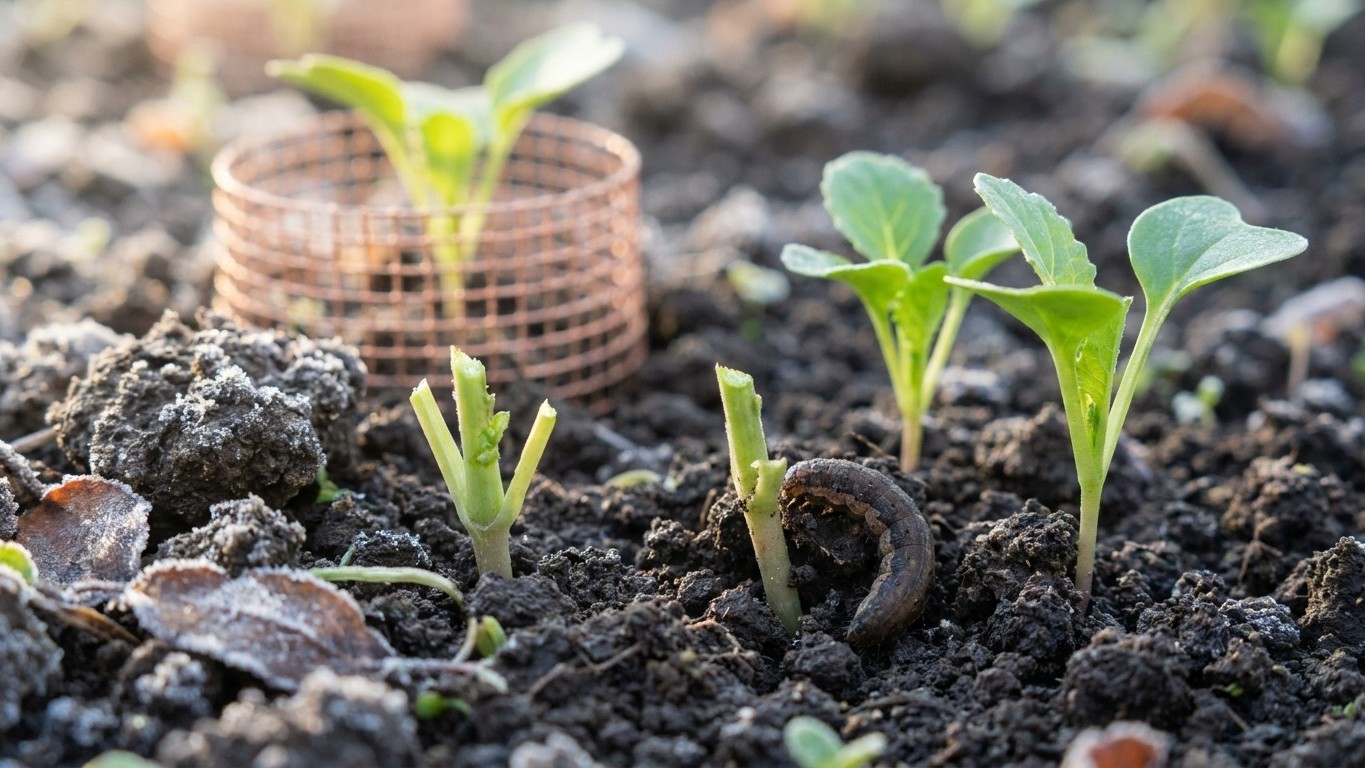

Cutworms in the Northwest Territories show up in a narrow window between late May and mid-July, right after the ground thaws and garden beds get their first real warmth of the year. They’re most active at night, chewing through seedling stems at soil level, and by the time most gardeners spot the damage the larvae have already moved on to the next row. Stopping them means combining physical barriers around stems, timing your transplants to avoid the peak larval stage, and disrupting the soil where the caterpillars hide during the day.
That’s the short version. The longer version involves understanding why a territory known more for permafrost and the aurora than for pest pressure still deals with a reliable cutworm problem every growing season, and why the same tricks that work in a Manitoba backyard don’t always translate north of 60.
Why the Northwest Territories’ Climate Shapes Cutworm Activity

Cutworms are the larval stage of several moth species in the Noctuidae family, and they’re found across nearly every agricultural region in North America. What makes their presence in the Northwest Territories worth a closer look is the compressed timeline they’re working with. Yellowknife and the southern part of the territory get roughly 100 frost-free days in an average year, sometimes fewer. That’s a fraction of what a grower in Ontario or Iowa works with. Cutworms adapted to that reality don’t have the luxury of multiple generations. Most species in the region complete a single life cycle per year, which actually works in the gardener’s favor: there’s typically one wave of damage rather than a rolling series of attacks from spring through fall.
The nearly continuous daylight of a subarctic summer changes behavior too. Cutworms are classically nocturnal, avoiding daytime heat and predators by burying themselves an inch or two below the soil surface until dark. In a place where “dark” barely exists for six or seven weeks around the solstice, larvae shift toward dawn and dusk feeding instead, and some research on high-latitude insect behavior suggests activity gets more diffuse rather than concentrated at night. For a home gardener, that means damage can show up at almost any hour, not just overnight, which throws off the old advice about checking your garden with a flashlight after sunset.
Permafrost and cold, slow-draining soils also mean cutworm larvae overwinter closer to the surface than they might in warmer regions, tucked just below the frost line rather than digging deep. That has a practical upside: fall and early spring soil disturbance, like turning over a bed before the ground fully freezes or right after it thaws, exposes overwintering larvae to birds and to killing frost more easily than in regions where they burrow further down.
Signs of Cutworm Damage in Northern Gardens
The classic sign is a seedling that was standing upright yesterday and lying flat today, severed cleanly at or just below the soil line. It looks almost surgical. That’s different from slug damage, which tends to leave ragged holes in leaves, or from damage caused by root maggots, which kills plants from below without toppling the stem. Cutworms target the stem itself, and a single larva can take out several seedlings in one night as it moves down a row.
Vegetable transplants are especially vulnerable in the first two to three weeks after they go in the ground, before stems thicken and toughen up. In the Northwest Territories, where the growing window is already tight and gardeners often start seeds indoors to get a head start, that vulnerable period lines up almost exactly with the peak of cutworm larval activity in June. Losing a dozen transplants at that point isn’t just an inconvenience. Given how short the season is, there may not be enough time left to start over from seed.
If you dig around a damaged plant, you’ll usually find the culprit within an inch or two of the surface: a grayish or brown caterpillar, often curled into a tight C-shape when disturbed, anywhere from half an inch to nearly two inches long depending on species and how far along it is in its development. That curling reflex is actually one of the more reliable ways to distinguish a cutworm from other soil-dwelling larvae, which tend to just go limp or keep moving.
When Cutworms Show Up During the NWT Growing Season
Early Season: Late May Through Mid-June
This is when overwintered larvae, or newly hatched ones from moths that laid eggs the previous fall, become active as soil temperatures climb. It coincides almost exactly with when most Northwest Territories gardeners are setting out transplants or thinning direct-seeded rows. Three weeks. That’s roughly the overlap between “cutworms are hungriest” and “your seedlings are most defenseless,” and it’s the single most important stretch to protect.
Given the territory’s brief frost-free window, gardeners often push planting dates as early as the soil allows, sometimes using cold frames or row covers to get a jump start. That earlier planting can actually work against cutworm damage, since a transplant with three or four weeks of growth under its belt has a thicker, more resistant stem than one going in the ground at the exact peak of larval feeding.
Mid-Season: Late June Into July
Larval feeding tapers off as caterpillars finish their growth stage and begin pupating in the soil, typically by midsummer. Adult moths emerge later in the season, mate, and lay eggs that will overwinter, but this generation doesn’t produce a second wave of feeding damage before the growing season ends. By August, most established plants in Northwest Territories gardens have outgrown the stage where they’re at serious risk.
What Actually Stops Cutworms
Physical barriers remain the most reliable defense, and they cost almost nothing. A simple collar made from a toilet paper tube, a cut section of cardboard, or a plastic cup with the bottom removed, pushed an inch into the soil around each transplant stem, blocks a cutworm from reaching it entirely. It sounds almost too basic to work, but it’s been a standard recommendation from agricultural extension services across cold-climate growing regions for decades, precisely because it addresses the mechanism of the damage directly rather than trying to repel or poison the insect.
Tilling or turning the soil in early spring, as soon as it’s workable, exposes overwintering larvae to birds and to temperature swings they’re not built to survive once uncovered. In a region with a compressed thaw period, this window is short, but even a single pass with a garden fork through beds that had heavy damage the previous year can meaningfully reduce the population before planting.
Beyond barriers and cultivation, a few other approaches hold up:
- Delayed transplanting by a week or two, when the season allows it, lets seedlings develop sturdier stems before the peak larval feeding period.
- Encouraging ground-foraging birds, which actively hunt cutworms when soil is disturbed, by avoiding broad-spectrum insecticides that would also affect the predator population.
- Crop rotation and avoiding untilled, grassy edges near garden beds, since female moths often prefer laying eggs in areas with existing vegetation cover rather than bare cultivated soil.
- Diatomaceous earth applied in a ring around stem bases can deter larvae mechanically, though it needs reapplication after rain and works best combined with a physical collar rather than as a standalone fix.
Beneficial nematodes, applied to moist soil in early spring before larvae mature, are another option used in some northern growing regions, though cold soil temperatures in the Northwest Territories can limit their effectiveness compared to warmer climates where they’re more commonly recommended. Timing the application to coincide with a soil-warming stretch, rather than applying it the moment the ground thaws, tends to produce better results.
What doesn’t work particularly well up north: broad chemical insecticide applications timed for southern growing calendars. Product labels and application windows are frequently calibrated for regions with longer seasons and different soil temperature curves, and a treatment applied on a calendar date that made sense in a warmer province may miss the actual peak larval activity in the Northwest Territories by several weeks. Checking soil temperature and actual larval presence, rather than a printed date, gives a better read on when intervention actually matters.
One detail that surprises a lot of transplant gardeners in the region: cutworm damage often looks worse in raised beds and containers with imported topsoil than in ground plots, simply because commercial soil blends can carry eggs or small larvae that arrive already established before a single seed goes in the ground.
Related guides
- Cutworms in Yukon: When It Shows Up and What Stops It
- Cutworms in British Columbia: When It Shows Up and What Stops It
- Cutworms in Ohio: When It Shows Up and What Stops It
- Cutworms in Ontario: When It Shows Up and What Stops It
- Spruce beetle in Northwest Territories
- Cutworms in Alaska: When It Shows Up and What Stops It