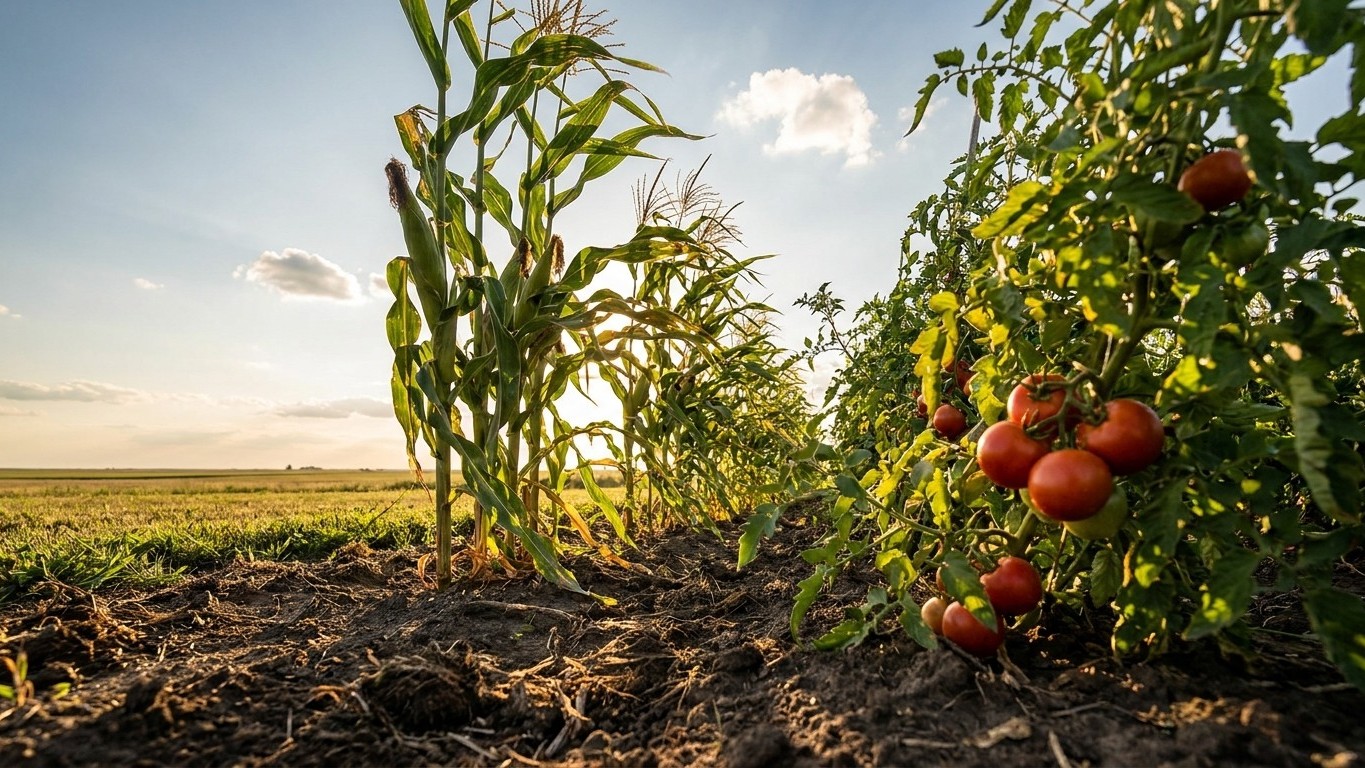

Sweet corn is ready when the silks have dried brown, the husks are still green and moist, and a punctured kernel gives milky juice. All three signs have to agree. In Northwest Territories that usually happens late, from the back half of August into September, and only if the crop got going early enough. After picking, a second clock starts: the sugar begins draining out of the kernel.
When sweet corn are ready in Northwest Territories
Pick when the silks at the tip of the ear are dry and brown, the husk is still moist and green, and a kernel pressed with a thumbnail spurts milky juice. The window runs from mid-August in the best case to mid-September, and it only opens if the corn gets 60 to 90 days between planting and the first hard frost.
Two clocks are running, and they answer different questions. The 60 to 90 days counted from planting tell you whether a variety fits the season at all. A second count, from the day silks first appear, tells you when to start testing ears. Write the silk date on the calendar when you see it. A date picked from a seed packet will mislead you, but a marked silk date rarely does.
Why the soil matters more than the calendar
Corn does not start on the last frost date. Yellowknife A, the reference station, shows a mean last spring frost of May 25. That is a midpoint, so in one year out of two the final frost falls later. Soil warms well after the frost is gone. Utah State University Extension says sweet corn needs soil above 60 °F. Clemson Cooperative Extension sets a floor of 50 °F “at the 4-inch depth” for ordinary sweet corn and says to wait until soil reaches 65 °F for extra-sweet types. A surface reading runs warmer than the 4-inch depth, so push the thermometer down.
The two thresholds are not interchangeable. An extra-sweet (sh2) seed sown into 50 °F ground tends to rot instead of sprouting, which is why a gardener can succeed one year and fail the next after switching varieties. In a place where spring ground warms slowly, the 65 °F rule can push sowing noticeably later. When to Sow Sweet Corn in Northwest Territories covers that decision in detail.
How much season is there?
The reference station has about 116 frost-free days between the mean last spring frost of May 25 and the mean first fall frost of September 18. Neither date is a safe date. In half of all years the first frost arrives earlier than September 18. Those normals also come from an earlier thirty-year stretch than the US ones, and districts farther north or on higher ground run weeks behind Yellowknife.
Heat is not what limits the crop. Yellowknife A averages 0.45 days a year above 30 °C and 0.03 days a year above 32 °C, so scorching days are rare. What decides the harvest is how soon the soil warms and how many frost-free weeks remain after it does. A 90-day type sown into 65 °F soil can end up right against the mean first frost date, while a type near the 60-day end has room to spare. For the wider picture, see Growing Sweet Corn in Northwest Territories.
Keeping them, and for how long
Clemson Cooperative Extension states it this way: “Sweet corn loses sugar from the kernel rapidly at high temperatures… Sweet corn can be stored under optimal conditions for about five days, but will lose sweetness with each day of storage.” Treat that as a ceiling. About five days is the best case with ideal handling, and the same sentence says sweetness slips every day along the way.
That is the real reason behind the old advice to start the water boiling before you walk to the garden. Sugar leaves the kernel, and heat speeds it up. An ear left on a warm counter loses sweetness faster than one kept cool, so the habits that help are simple. Pick in the cool part of the day, leave the husk on, and cool the ears quickly.
Which sweet corn type keeps its sugar longest?
The genetics of the kernel set how fast the sugar drains. Standard (su) types lose it fastest, sugar-enhanced (se) types hold it longer, and extra-sweet (sh2) types hold it longest. For a gardener who cannot eat everything the day it is picked, that is the practical reason to choose one over another.
| Type | Sugar loss after picking | Soil at 4 inches before sowing |
|---|---|---|
| su (standard) | Fastest | At least 50 °F |
| se (sugar-enhanced) | Slower than su | At least 50 °F |
| sh2 (extra-sweet) | Slowest | 65 °F |
The trade-off is the soil. The type that stores best is also the one that wants the warmest ground, and in this territory that warmth arrives late. A su or se type sown at the 50 °F floor may reach the table faster than an sh2 type that had to wait.
Can different sweet corn types be planted together?
Sweetness is also decided in the garden. Utah State University Extension warns that sweetness is lost if su, se and sh2 types tassel at the same time. Cross-pollination can cost the sweet kernels their sweetness. The source gives no distance for this, so build the plan on timing. Keep types from tasseling together by sowing them in separate plantings, or grow a single type. The extension also calls for blocks of three or more rows, which gives the pollen a better chance of landing on the silks. With only 60 to 90 days to work with, there is rarely room for a second planting, and one type per garden is the simplest answer.
Where in the house that actually is
The refrigerator comes closest. Heat drives the sugar loss from the kernel. The usual problem is space and drying out. Keep the ears in their husks, bag them loosely, and give them a shelf or crisper drawer where nothing crushes them.
A heated room is the wrong place. Houses in this territory run warm for a long heating season, and a kitchen counter or a sunny windowsill sits far above what slows sugar loss. An ear that waits there is spending its sugar the same way the Clemson quote describes.
A garage or unheated porch swings. Outdoor air in the territory rarely gets hot (Yellowknife A averages 0.45 days a year above 30 °C), so the swing comes from other things: sun on a south wall, a closed garage warming through the afternoon, and clear nights that edge toward frost as September approaches. An ear in a spot like that is cool in the morning, warm by mid-afternoon, and sometimes chilled hard overnight.
Whichever spot you pick, set a thermometer where the ears will sit and read it in the morning and again late in the afternoon before the first ear comes off the stalk. Skipping that check means paying for lost sugar you cannot see until you bite in. If the readings swing widely or climb through the afternoon, the refrigerator wins.
A big harvest rarely fits on one shelf, and it does not keep for a week in any room. Eat what you can in the first day or two, and freeze the surplus the same day it is picked. Ears that ripen faster than you can handle also attract animals, a problem covered in What Eats Corn in Northwest Territories, and When.
Common questions
How can I tell sweet corn is ripe without opening the ear?
Look at the silks first. Dry and brown is the first sign, but it is not enough alone. Feel the husk, which should still be green and moist. Then peel back a strip at the tip and puncture one kernel. Milky juice means ready, and clear juice means wait a few more days. Use all three signs together, and use the 17 to 24 days from first silk to know when to begin checking.
What if frost arrives before the corn is ready?
The mean first fall frost at Yellowknife A is September 18, and in half of all years frost comes sooner. If your silks appeared late, test the kernels right away. Ears short of the milky stage will not catch up. Next season, sow as soon as the soil allows (50 °F at 4 inches for ordinary types, 65 °F for extra-sweet) and lean toward the 60-day end of the range.
Do ripe ears hold on the stalk?
Pick them when the signs agree. Waiting does not improve the ear, and animals tend to find ripe corn quickly. Harvest in the cool of the day and move the ears indoors to a cool spot at once.
Does the five-day limit apply to every type?
No. About five days is the Clemson figure for optimal storage, and it is a ceiling. Standard su types fall behind fastest, so eat them the day they are picked or the next. Sugar-enhanced types hold longer, and extra-sweet types hold longest, though they still lose sweetness each day they sit.