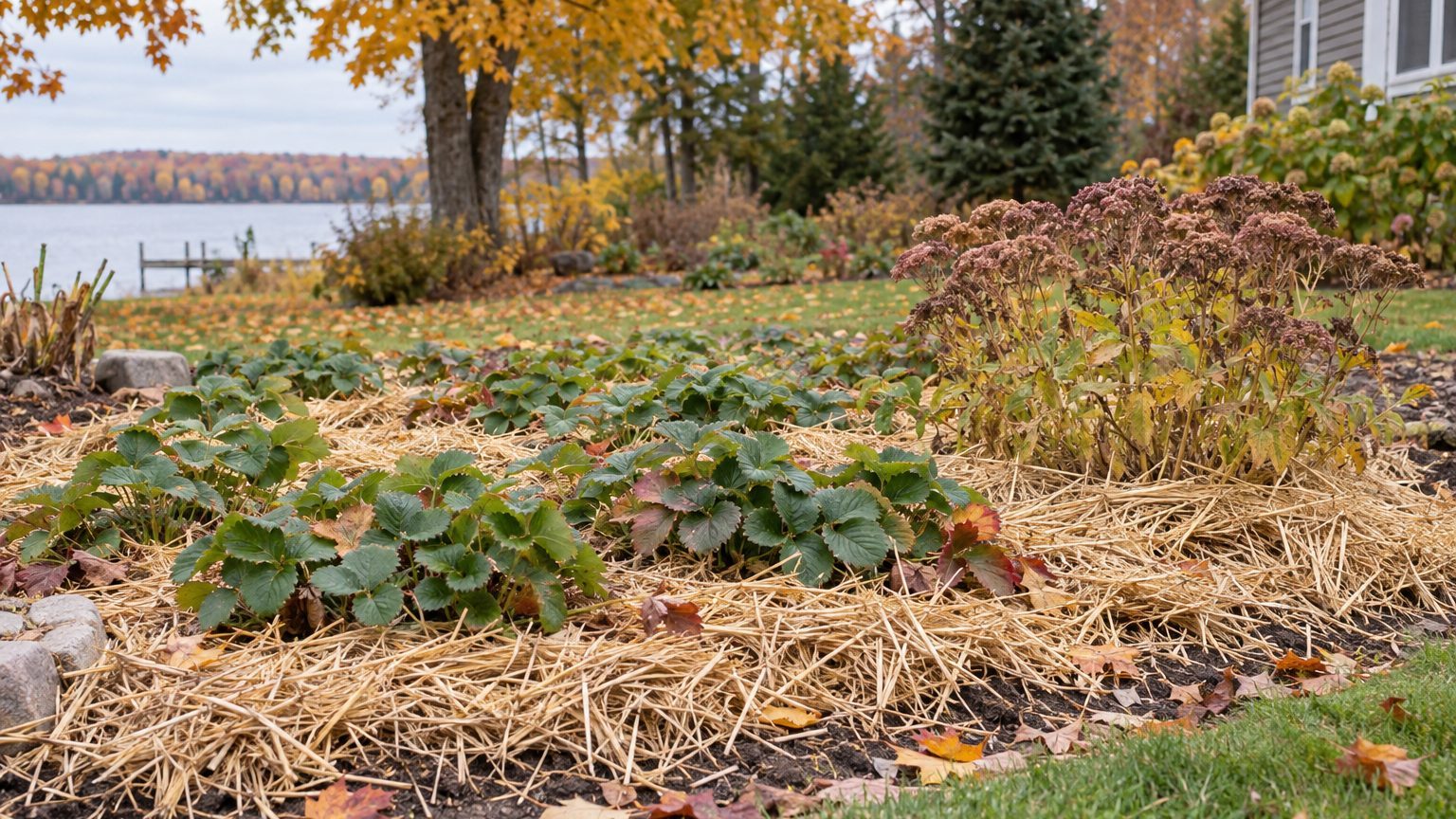

In the Northwest Territories, winter mulch goes on after the soil begins to freeze, not before. At Yellowknife A, the average first fall frost is September 18, but that date only starts the clock. Mulch strawberries and borderline perennials some weeks later, once the surface stiffens and nights stay cold. Pull the cover back in spring when growth wakes up. Below: the mechanism, the plants that need it, and the mistakes that cost gardeners their crowns.
When to put winter mulch down in Northwest Territories
Winter mulch is not a blanket for warming plants. Its job is to keep the soil frozen once it has frozen, so it doesn’t thaw on a sunny day and refreeze overnight. Those repeated swings are what push shallow crowns up out of the ground. Mulch spread on warm soil in September does the opposite of what you want. It holds heat, keeps plants half-active, and gives rot and rodents a cozy place to settle.
The climate leaves no doubt that the ground freezes here. Environment and Climate Change Canada’s 1981-2010 normals for Yellowknife put the mean daily minimum of the coldest month at -29.5 °C (-21.1 °F). That is the mean low, not the record, so the worst nights go well beyond it. Natural Resources Canada places Yellowknife in zone 1b of the Canadian plant hardiness system, which is not a USDA zone and does not convert to one.
For timing, start from the first fall frost. The same ECCC normals, from the Yellowknife A station (climate ID 2204100), give September 18 as the average first fall frost, so plan to mulch some weeks after it, once the soil surface is freezing and before snow settles in for good. Treat that date as the midpoint of a window, not a safe date. Because it is a mean, the frost arrives later in about one year out of two, and the mulch window slides later with it.
Frost and frozen ground are different events. A first frost kills tender leaves and flowers, but the soil underneath is still warm and wet. The ground freezes after a run of cold nights, and you can check it directly. If the top of the soil is crusty and stiff in the morning and stays that way through the afternoon, it’s time. A soft, workable surface means wait.
Location matters across a territory this big. The colder districts farther north see their first frost earlier than Yellowknife does, so mulching moves earlier there too. Never push fall tasks later because a southern district’s date says so. For your own town, the First and Last Frost Dates in Northwest Territories page is the place to start, then watch your own soil.
Snow complicates the picture, in a good way. A deep, early snowpack insulates the ground much as mulch does, which is why mulch earns its keep in years when the cold arrives before the snow. If your garden is exposed or windswept and the snow blows off, mulch matters more.
Strawberries
Strawberry plants carry their growing point in a crown that sits right at the soil surface. That’s a vulnerable spot. Heaving can lift the whole plant partway out of the ground and tear its roots. Bare, snowless cold can kill the crown outright, and the territory’s coldest-month mean low of -29.5 °C (ECCC, Yellowknife, 1981-2010) leaves very little margin for an unprotected plant.
The best material is clean straw. “Clean” is the key word: straw with few weed seeds, not hay, which is full of them. Straw is hollow and springy, so it traps air, sheds water, and doesn’t compact into a soggy mat the way fine leaves or grass clippings do. Whole leaves from larger trees can pack down into a wet sheet, which is the last thing a strawberry crown needs. Shredded leaves are better than whole ones, but straw is the safer choice.
On depth, the only figure with a source behind it comes from NC State Extension, which says in its Extension Gardener Handbook: “A 2-inch to 3-inch layer of mulch suppresses most annual weed seeds and makes it easy to hand-pull any that do germinate.” That sentence is about weeds, not winter cold, and it comes from a much milder state. Still, it gives a sensible order of magnitude for a loose layer, and more is not better. Straw fluffs up when you spread it and settles after the first snow, so lay it loosely and check after the first few weeks. Don’t pile it up in the belief that thicker means warmer.
Timing follows the general rule: wait until the ground is freezing. Strawberries need some cold to harden off, so a frost or two on the leaves is useful. The foliage goes dormant, the soil surface firms up, and then the straw goes over the whole bed, crowns included. If you’re still unsure how your strawberries should be set up before winter, the Growing Strawberries guide covers the plants themselves.
Pulling it back in spring
Uncovering is as important as covering. Pull the straw off the crowns once the snow is gone and the first new leaves appear, then rake it into the aisles. Leaves that grow under straw come up pale and weak, and a bed left covered stays cold and wet at the crown. Don’t strip it all at once if hard frost is still likely. Draw it aside gradually, and keep it handy at the edge of the bed so you can pull it back over open flowers on a frost night. The straw you rake into the paths then does a second job, suppressing weeds and keeping berries clean.
Perennials and borderline plants
The Canadian system classes Yellowknife as zone 1b, according to Natural Resources Canada’s plant hardiness site (1991-2020 normals, by municipality). That is a Canadian zone built on several climate variables, and NRCan states plainly that there are no simple conversions between its system and the USDA’s. So a plant tagged for a USDA zone can’t be matched to your garden by looking up a number. The practical approach is to sort your plants into two groups: those that are truly native or northern-bred, and everything else.
Established, locally adapted perennials usually don’t need winter mulch. They have deep roots, they go fully dormant, and they’ve lived through the cold for years. The plants that benefit most are the ones at the edge of what they can take:
- Perennials planted this year, whose roots haven’t anchored yet and are easy to heave
- Shallow-rooted plants such as coral bells, which tend to push up out of the ground
- Anything sold for a milder climate than yours
- Shrub roses and other woody plants with a tender crown
Put the mulch on after the soil starts freezing, as you did for the strawberries. For depth, NC State Extension’s handbook gives two sentences that point to the same range. For beds: “A 2-inch to 3-inch layer of mulch suppresses most annual weed seeds and makes it easy to hand-pull any that do germinate.” For woody plants: “Provide a 3-inch layer of mulch to reduce water loss and maintain uniform soil moisture and temperature around roots.” Those are general mulching depths from North Carolina, written for weeds and moisture, not winter. They are still a useful ceiling. Don’t go deeper than that range.
Mulch in a ring around the plant, not a mound on top of it, and keep the crown itself open. Mulch piled against a crown or stem holds moisture against the bark and tissue, which invites rot and gives voles cover to chew. Leave a clear gap right around the base and spread the material outward from there. Mulching Without Killing the Plant covers the ring method in detail, including how to keep it from turning into a volcano.
Herbs follow the same logic. Perennial herbs that are marginal for the north may need the ring, a lighter cover, or a different strategy altogether. Getting Perennial Herbs Through the Winter walks through which ones need what.
What goes wrong
The mistakes are predictable, and most show up in spring, when it’s too late to fix them. Four come up again and again.
Mulching too early is the most common. It looks like crowns that turn soft and brown by spring, with a sour smell, or plants that never went dormant and leafed out into the first hard freeze. The soil stayed warm under its cover, rot got a head start, and rodents moved in. The prevention is simple: wait for the ground to freeze, not for the calendar. September 18 is only the average first frost at Yellowknife A (ECCC, 1981-2010), and the mulch comes weeks after it.
Matted mulch fails differently. Wet whole leaves, grass clippings, or compacted material form a layer that holds water against the crown. You’ll find a slimy, dark mat in spring with rotted tissue underneath. The fix is a loose material like clean straw, laid in the 2-inch to 3-inch range from NC State Extension, and not heaped.
Voles are a risk wherever mulch sits tight against stems. They nest in the insulated layer and eat bark and roots over the winter, and you only find out when the snow melts and you see girdled stems and tunnels. Keep mulch pulled back from trunks and crowns, keep the layer thin and loose, and don’t let tall grass stand around the bed’s edge.
The last mistake is forgetting to uncover. Pale, stretched, weak growth under old straw is the sign. The cure is a habit: set a reminder to uncover once the snow is gone and the soil has thawed, and then remove the cover gradually, keeping it close in case frost returns.
Common questions
Can I mulch strawberries right after the first frost?
Not yet. A first frost, on average September 18 at Yellowknife A according to ECCC’s 1981-2010 normals, only kills tender growth. The soil is still warm and the plants are still hardening off. Mulch applied then keeps the ground from cooling and invites rot and rodents. Wait until the soil surface is freezing, which is typically some weeks later.
Is straw or leaves better for winter mulch?
Clean straw is the safer choice because it stays loose and sheds water. Whole leaves from larger trees tend to mat into a wet layer that rots crowns. If you use leaves, shred them first and apply them loosely. Avoid hay, which carries weed seed, and avoid grass clippings, which pack down and turn slimy.
Does snow replace mulch?
A deep, early, steady snowpack insulates the ground and does much of the same work, which is why many established northern plants get by without added mulch. Mulch is the insurance for years when the cold comes before the snow, or in exposed beds where wind strips the snow away. Strawberries and young or borderline perennials are the plants most worth covering.
Do these dates work for my town?
Only as a starting point. The September 18 figure comes from the Yellowknife A station, and districts farther north have an earlier first fall frost, so mulching moves earlier there. You can find more seasonal timing in the Northwest Territories guides. One more caution when comparing with American sources: the Canadian normals cover 1981-2010, while US figures commonly cover 1991-2020, so the two sets of numbers aren’t measured over the same years.