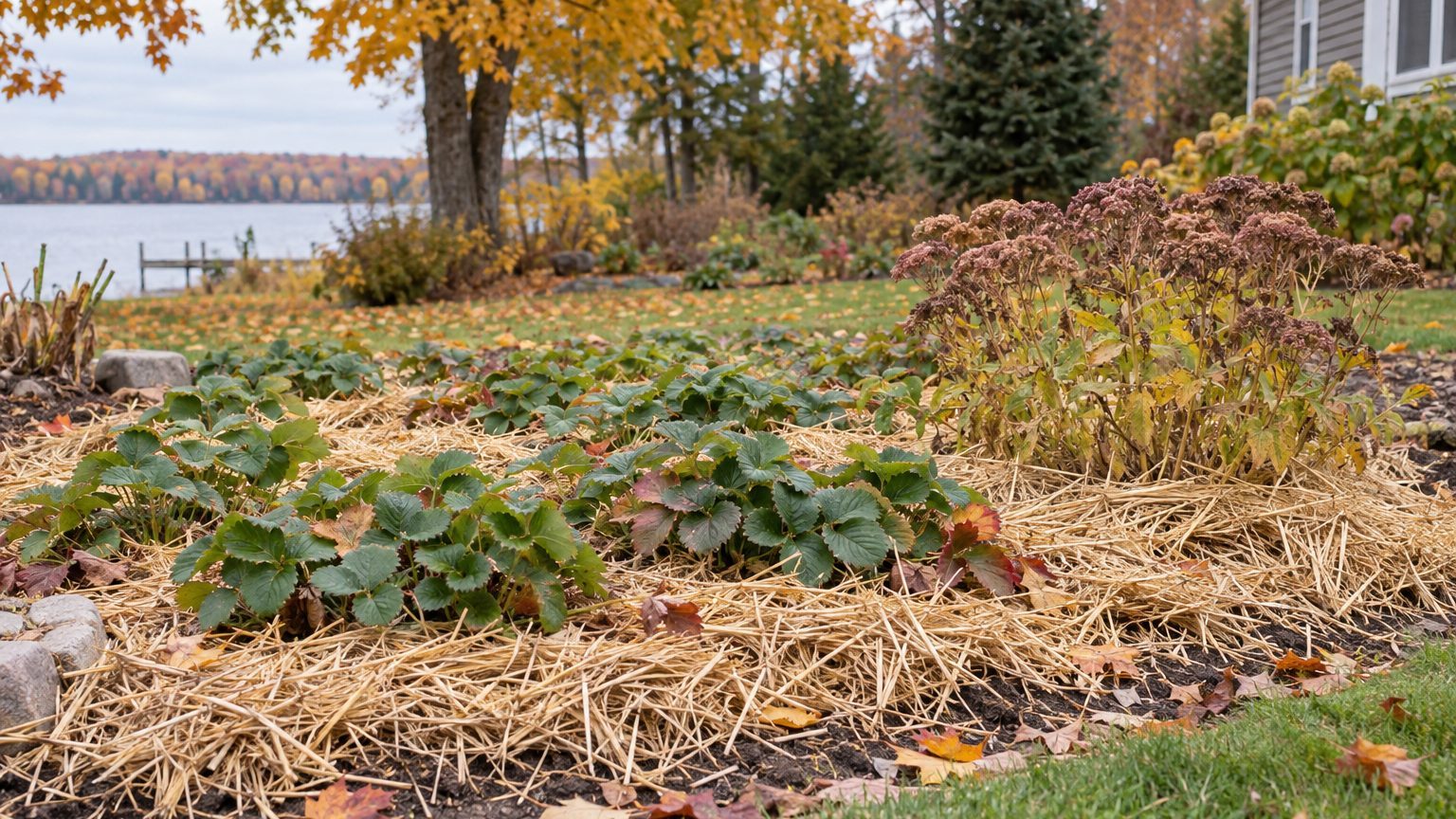

Wait for the ground. Winter mulch in Yukon goes on after the soil starts to freeze, not when the first frost shows up. At Whitehorse the average first fall frost falls on August 25, so the mulching window opens well after that date, once the top of the soil stiffens and stays stiff. Strawberries get a layer of clean straw, borderline perennials get a ring around the crown, and taking it off in spring matters as much as putting it on.
When to put winter mulch down in Yukon
Why the ground sets the date, not the calendar
Most people assume mulch works like a blanket that keeps plants warm. In a northern garden it does the opposite job. Its purpose is to keep the soil frozen once it freezes, so the ground doesn’t thaw on a mild spell and refreeze a week later. Those repeated cycles heave shallow roots upward and tear them. A plant sitting in solid, steady cold is in far better shape than one on a freeze-thaw roller coaster.
Mulch laid down too early undercuts that logic. Warm soil under a thick cover stays damp and mild, which suits crown rot and gives rodents a cozy place to settle before winter. So the target is the moment the ground begins to freeze, then a short stretch after that to get the work done before heavy snow.
Reading the window for your garden
Environment and Climate Change Canada’s 1981-2010 normals for the Whitehorse A station put the average first fall frost on August 25. That is a mean, not a safe date. In about one year out of two the first frost comes later, and a frost in late August is a long way from frozen ground. Treat August 25 as the middle of a spread, and treat the frost itself as a signal to start watching, not to start spreading. (Canadian normals cover 1981-2010, while the US figures you may see elsewhere cover 1991-2020, so the two aren’t a perfect match.)
Here is the decision to write on your calendar: mulch after the soil has started to freeze, well past the average August 25 first frost, and before deep snow makes the job miserable. A trowel tells you more than a date. If the top inch or so is firm and stays firm through the afternoon, you’re in the window.
The same station gives a mean daily minimum of -19.2 °C (-2.6°F) for the coldest month, and Natural Resources Canada rates Whitehorse at hardiness zone 1b in the Canadian system, using 1991-2020 normals. That Canadian zone does not convert to a USDA zone, so don’t shop by US numbers. The cold is deep enough that the soil does freeze solid, which is exactly why the northern logic applies here.
Whitehorse is one station, not the whole territory. Districts farther north or higher up get their first fall frost earlier, so freeze-up arrives earlier there too and fall chores shift earlier with it. The First and Last Frost Dates in Yukon page lays out how those dates vary, and our Yukon guides cover the rest of the garden calendar. Hardy established perennials and most native plants don’t need any of this. The next two sections cover what does.
Strawberries
Strawberries are the plant that most clearly earns winter mulch in Yukon. The growing point, called the crown, sits right at the soil surface. Bare, it takes the full force of cold air and drying wind. If the ground thaws and refreezes, the soil lifts the whole plant and snaps the fine roots underneath. Come spring you find plants perched on little pedestals with their roots in the air, and those rarely recover.
Use clean straw. Clean means free of weed seed and not moldy, which rules out a lot of cheap hay. Straw is hollow and springy, so it holds air against the cold without packing into a soggy mat the way whole leaves do. Wait until the soil has started to freeze, then cover the plants and pull some straw into the gaps between them.
How deep? The only depth figures I can give you come from NC State Extension, and they speak about weeds and moisture, not strawberries or northern winters. Its Extension Gardener Handbook says: “A 2-inch to 3-inch layer of mulch suppresses most annual weed seeds and makes it easy to hand-pull any that do germinate.” That is the order of depth to aim for once the straw has settled. Loose straw compresses, so fluff it on, then check the finished layer instead of heaping it up. More is not better, because a thick, wet pile is where rot starts.
Spring removal is where timing flips. Straw stays on through the hard-frost stretch, then comes off as the plants begin to grow. The leaves under it will look pale yellow, which is normal. Pull the straw back from the crowns when new growth starts, not on a fixed date, and rake it into the aisles, where it works as weed-suppressing mulch around the plants. Keep some nearby. Flowers are the tender part, and a cold night after bloom is easier to handle if you can toss straw back over the bed.
Watch the spring nights against the last-frost range on the frost dates page, since colder districts get their last frost later and uncover later. For variety choice, bed layout and everything else about the crop, see Growing Strawberries.
Perennials and borderline plants
Not every perennial needs help. Plants that are well matched to Yukon’s cold come through on their own, and smothering them in mulch buys you rot instead of protection. Natural Resources Canada’s plant hardiness map (planthardiness.gc.ca) lists Whitehorse as zone 1b in the Canadian system. Use that zone to judge a plant’s tag, and remember it describes the reference city, not every valley and hillside in the territory.
The plants that benefit tend to fall into a few groups:
- Perennials planted this season, whose roots haven’t spread deep enough to ride out a freeze-thaw swing.
- Plants sold for milder places than yours, which are borderline by definition.
- Shallow-rooted crowns that sit near the surface, as strawberries do.
- Perennial herbs with woody or evergreen growth. Getting Perennial Herbs Through the Winter covers those in detail.
The shape of the mulch matters as much as the depth. Build a ring, like a doughnut, around the crown, and leave a small gap right at the stems. A pile heaped against the crown holds moisture against the bark or the growing point and invites rot and gnawing. NC State Extension’s handbook gives the same range for woody plants and adds: “Provide a 3-inch layer of mulch to reduce water loss and maintain uniform soil moisture and temperature around roots.” The source is a North Carolina publication, so read it as a depth ceiling, not a northern recipe. Stay between 2 and 3 inches and spread the ring out to the drip line instead of piling it up (the handbook chapter has the full text).
The timing is the same as for strawberries. Mulch borderline perennials only after the soil has begun to freeze, and only the new or doubtful ones. If you’re unsure how to lay a ring without smothering the plant, Mulching Without Killing the Plant walks through it. Shredded bark and similar coarse materials work for woody plants, while light, airy materials suit the soft crowns of herbaceous ones.
What goes wrong
Winter mulch fails in a handful of predictable ways, and each leaves a recognizable trail. Most trace back to the same root cause: it went on at the wrong time or in the wrong shape.
| Problem | What it looks like | What prevents it |
|---|---|---|
| Mulching too early | Soft, dark crowns in spring, a damp smell, rodent tunnels under the cover | Wait for the soil to begin freezing, well past the average first frost |
| Matted, rotting mulch | A slick, gray layer that doesn’t spring back when you lift it | Use airy straw, not whole leaves or wet hay, and keep the layer within 2 to 3 inches |
| Voles and mice nesting | Chewed stems or bark at the base, runways in the snow, hollowed nests | Keep mulch off stems and bark, put it on late, and clear heavy grass nearby |
| Forgetting to uncover | Pale, stretched growth, wet crowns, slow starts | Pull it back when new growth begins, then keep it handy for frost nights |
Mulching early is the most common mistake, and the most tempting, because the first frost in late August feels like a deadline. On average that frost comes by August 25 at Whitehorse. The ground is nowhere near frozen then. Anything laid down that early sits on warm soil for weeks, which is exactly the setup that breeds rot and invites nesting.
Rodents are the quiet risk. Voles don’t much care what the mulch is for, only that it’s dry, thick and sheltered. Pulling it away from stems and bark and holding off until the cold has arrived removes most of the appeal. Look at the base of a few plants in mid-winter. A neat little tunnel in the snow tells you something is already home.
Spring is the other trap. Plan on uncovering as soon as growth shows, even if the weather still feels wintry, because plants smothered by straw wake up weak and wet. Coming off a long winter, it’s easy to put off a chore that seems optional. It isn’t.
Common questions
Should I mulch strawberries right after the first frost?
No. The average first fall frost at Whitehorse is August 25, and in one year out of two it comes later. The ground is nowhere near frozen at that point. Wait until the soil begins to freeze, then mulch. Frost on the leaves is your cue to start watching the ground, nothing more.
How do I tell that the ground has started to freeze?
Push a trowel into the bed. If the top layer is firm and stays that way through the afternoon, the soil has started to freeze, and that is the moment to mulch. A single frosty morning that thaws by lunch doesn’t count. A garden in a colder, higher or more northern district will reach that point earlier than one near Whitehorse.
Do hardy perennials need winter mulch?
Usually not. Well-adapted, established plants handle Yukon winters unaided, and extra cover can cause rot. Mulch helps new plantings and plants meant for milder places. Check any zone on a plant tag against Canada’s own system, since Whitehorse is zone 1b there and that doesn’t convert to a USDA zone.
When do I take the mulch off in spring?
When new growth starts. Pull straw back from strawberry crowns as the pale leaves begin to green, and open the rings around borderline perennials. Keep the straw close by for cold nights after flowers open. Colder districts get their last frost later than Whitehorse, so uncover there later too, and keep covering material within reach until the last-frost range has passed.