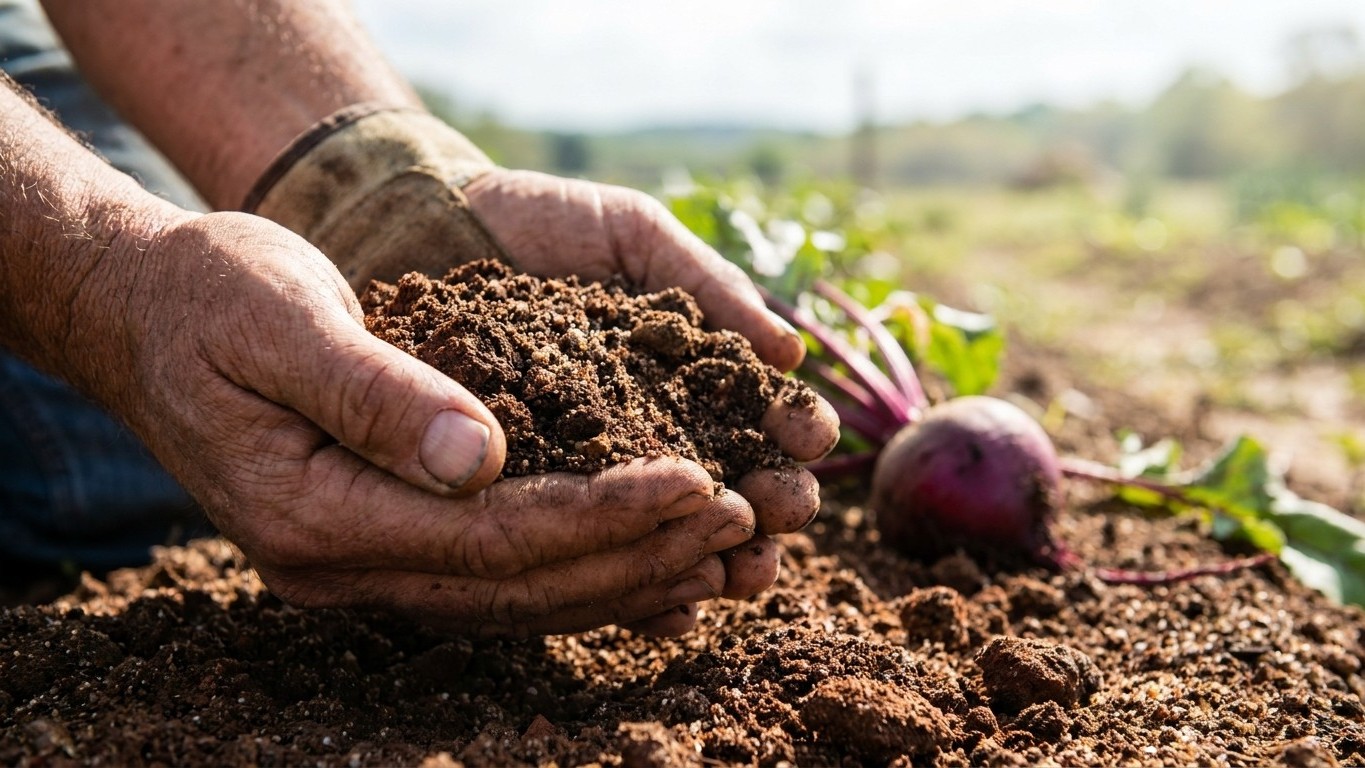

Nova Scotia’s dominant mapped soil is a strongly acid Podzol, sitting around pH 5.2, with a texture that leans loamy (52 percent sand, 10 percent clay, 38 percent silt) and drainage rated imperfect. That’s not the deep, loose, well-drained ground beets ask for. It’s workable, but it needs correction before a root crop settles in comfortably.
The short answer
Start with what the province’s own soil survey actually measured. Across 472 mapped agricultural components, the commonest profile in Nova Scotia is a Podzol, the acid, leached soil type that forms under conifer cover, where centuries of rain have stripped the bases out of the topsoil. The median surface pH lands at 5.2, which is strongly acid by any garden standard. Organic matter runs about 2.1 percent, texture comes out to 52 percent sand, 10 percent clay and 38 percent silt (a loam leaning sandy), and drainage is classed imperfect, meaning water neither races through nor sits for long, it lingers.
For a beet, that combination cuts two ways. The sandy-loam texture is close to what Utah State University Extension calls for: beets want deep, sandy, well-drained ground rich in organic matter. Nova Scotia’s texture is workable. The acidity is the bigger problem. Beets are far more tolerant of neutral to mildly alkaline soil than of anything pushing toward pH 5, and strongly acid ground tends to lock up boron and calcium, two nutrients a beet root cannot do without. Skip a pH correction and you’re fighting the soil before the seed even swells.
On heat, this page doesn’t have a published count of how many days a year the reference weather station passes 90 F, so no number is given here. What can be said is that Nova Scotia’s climate is shaped by the Atlantic close on every side, which tends to keep summer extremes shorter and less frequent than in continental regions. That matters because Utah State’s research ties beet woodiness to heat above 85 F combined with water stress, not to heat alone. A maritime province still gets warm stretches, and any one of them can trigger the same woodiness if watering lapses during it.
None of this describes any one backyard. Nova Scotia’s agricultural soil survey covers hundreds of distinct mapped units, from tidal marsh clays to gravelly upland loams, and the 5.2 median pH is drawn from that whole range, not from a single field. A garden built on fill, a river-bottom plot, or ground near the coast can sit far from that median. The province-wide figure is a place to start reading your own dirt, not a stand-in for a soil test.
The six weeks that decide it here
Beets are direct-sown, never transplanted, and the clock on their 60 to 80 days to maturity starts the moment seed goes into the ground. Utah State’s guidance is to sow 2 to 3 weeks ahead of the last expected frost, which in Nova Scotia means working backward from a mean last frost date of May 7 at the Halifax Stanfield station. That puts the seed in the ground somewhere in mid to late April in an average year, and it puts the first six weeks of root development, the window where water stress does the most damage, squarely inside the province’s cool, changeable spring.
That word “mean” carries weight the calendar doesn’t show. A mean last frost date is a midpoint, not a guarantee, so in roughly half the years on record the last frost at that station falls later than May 7. Sow on the average date and a cold snap can still catch young beet seedlings off guard. That’s less a bolting trigger by itself than a stand-establishment risk, but a stressed, damaged seedling is more prone to bolt later if it also runs short of water in the same stretch.
Nova Scotia’s spring, shaped by the Atlantic on three sides, tends to arrive slowly and unevenly rather than in a hard, dry run. Cool, damp stretches are common through April and into May, and soil this imperfectly drained holds onto that moisture rather than shedding it fast. For beets, that generally works in the gardener’s favor during the critical first six weeks: the thirst-driven water stress that Utah State links to premature flowering is less likely to build up when the ground is naturally slow to dry. The tradeoff is that the same damp, cool soil can also slow germination and invite the rot problems covered below, so the six-week window isn’t risk-free, the risk just shifts from drought stress toward cold, wet-soil stress.
A dry spell can still happen even in a generally damp spring, and when it does, on this soil the effect is compounded rather than buffered, because sandy-leaning texture with low organic matter doesn’t hold reserve moisture the way a richer loam would. Watching the first six weeks after sowing, rather than trusting the province’s general dampness to cover for you, is the practical takeaway here.
What goes wrong here
- Boron and calcium lockout from acid soil. At a median pH of 5.2, nutrients beets rely on for smooth, unblemished roots become less available. Work in lime ahead of sowing to bring the bed closer to neutral, and retest before assuming one application solved it, since Podzol soils resist a quick pH shift.
- Thin, low organic matter starving root development. At roughly 2.1 percent organic matter, this soil has little reserve for a heavy feeder like a beet. Utah State’s guidance caps compost at 1 inch per 100 square feet worked into the bed before sowing; more than that risks excess nitrogen pushing leafy top growth at the root’s expense.
- Imperfect drainage causing forked or rotten roots. Water that lingers rather than draining cleanly through can rot a developing taproot or split it into forks around wet pockets. Raised rows or raised beds correct this without changing the underlying soil chemistry.
- Cold, wet soil delaying germination after an early sowing. Sowing 2 to 3 weeks before the May 7 mean last frost puts seed into ground that may still be slow and cold, especially on imperfectly drained soil. A floating row cover over the row can add enough soil warmth to speed germination without moving the sowing date later.
- Woodiness from an unwatched warm, dry stretch. Even in a generally cool maritime climate, a run of heat above 85 F paired with skipped watering is what Utah State ties directly to woody, fibrous roots. This is a separate failure from early bolting, caused later in the season by heat and thirst together, not by the cold-season stress that triggers premature flowering.
Common questions
Is Nova Scotia’s soil pH too acid for beets?
At a median of 5.2, the province’s dominant mapped soil sits well below what beets tolerate comfortably. Beets do better closer to neutral, so lime worked into the bed ahead of sowing, followed by a retest, is the standard correction rather than something to skip.
How much compost should I add before sowing beets in Nova Scotia?
Utah State University Extension’s figure is no more than 1 inch of composted organic matter per 100 square feet. Given this province’s soil averages only about 2.1 percent organic matter, that addition matters, but going beyond the recommended amount risks pushing top growth over root growth.
Does Nova Scotia’s climate cause beet bolting or beet woodiness?
These are two separate failures with two separate causes. Bolting comes from water stress in the first six weeks after sowing, a risk this soil’s imperfect drainage tends to soften somewhat, since it holds moisture. Woodiness comes later, from heat above 85 F combined with skipped watering, and can still occur during any warm, dry stretch regardless of the province’s generally cool summers.
When should I sow beets in Nova Scotia?
Utah State’s guidance is 2 to 3 weeks before the last expected frost. The mean last frost at the Halifax Stanfield station is May 7, but that date is a midpoint, not a safe cutoff, since roughly half of all years see frost arrive later. Local microclimates inland or at elevation will run behind that coastal station’s timing.