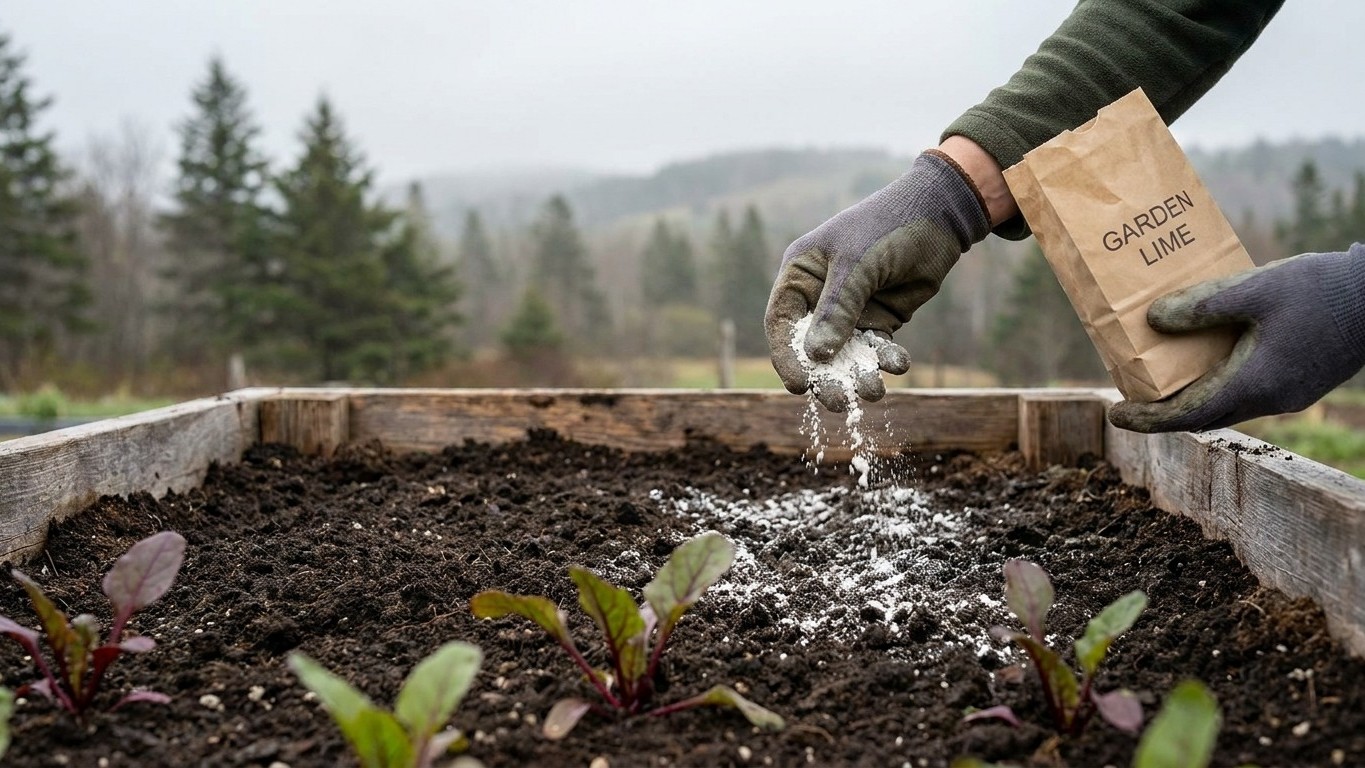

Nova Scotia’s ground runs acid and holds water more than beets prefer, so the fix starts with lime and raised, loosened beds rather than hoping the native soil will do the work. Sow two to three weeks before the mid-May frost window closes, and the real risk isn’t summer heat, it’s a dry stretch in those first six weeks after seeding.
The short answer
Across the mapped agricultural land of Nova Scotia, the dominant profile is a Podzol, the acid, leached soil that forms under conifer cover once rain has stripped the bases out of the topsoil. That single soil order covers 53 percent of the mapped surface, with Gleysolic soils as the second most common. The median surface pH sits around 5.2, which is strongly acid, well below what a beet wants. Texture runs 52 percent sand, 10 percent clay and 38 percent silt, a loam-to-silt mix that isn’t heavy clay but isn’t the deep sandy loam beets ask for either. Organic matter averages about 2.1 percent, and drainage is classed as imperfect, meaning water moves through slowly enough to leave the root zone soggy after a wet spell.
None of that is a diagnosis of any one garden. Nova Scotia’s agricultural soils span hundreds of mapped series, and the province’s own soil survey covers only the farmed regions, not the far reaches of the mainland or Cape Breton’s uplands. A backyard plot near a river, on filled ground, or on land a previous owner graded will read nothing like this median. What the province-wide numbers do tell you is the direction to correct in: expect acid soil that needs lime brought toward neutral, and expect drainage that needs help, not soil that’s already loose and fast-draining the way beets want, a point covered in more depth in this breakdown of Beet Soil in Nova Scotia.
Utah State University Extension is specific about what beets need: deep, sandy, well-drained soil rich in organic matter, built up with no more than 1 inch of composted organic matter worked into every 100 square feet. Against a strongly acid, imperfectly drained loam-silt mix, that means raised or mounded rows, an annual but modest compost addition, and a lime application based on an actual soil test rather than a guess. On the heat side, the same source pins 85 F combined with water stress as the point where a beet root turns woody. Nova Scotia’s climate data on how many days a year the region spends above 90 F isn’t published here, so no number should be assumed for that threshold. What can be said plainly is that a coastal, maritime climate like this one rarely stacks the long, dry heat runs that push interior gardens over 85 F for days at a stretch, which shifts the practical risk in Nova Scotia away from heat-driven woodiness and toward the water-stress side of the same USU warning.
The six weeks that decide it here
The average last spring frost at Halifax Stansfield sits at May 7, based on Environment and Climate Change Canada’s 1981 to 2010 climate normals for that station. Sowing beets two to three weeks ahead of that date puts seed in the ground in the second half of April for anyone gardening near that reference point, with earlier or later windows for warmer or cooler pockets of the province. That mean date is not a guarantee. It’s a midpoint. Frost falls later than May 7 in roughly half of all years on record, so a garden that goes by the calendar alone is gambling on the coin landing right.
What matters more than the date itself is what happens in the six weeks right after seeding, because that’s the window Utah State University Extension flags for bolting risk: water stress in that early stretch is what pushes a beet to flower prematurely instead of building a root. Nova Scotia’s spring near the coast is a maritime one, prone to fog, damp spells and cool, changeable stretches rather than the long dry runs that some interior climates get in April and May. That pattern cuts two ways for a beet seedling. A cool, damp spring reduces the odds of the kind of sharp early drought that triggers bolting, which is a point in the region’s favor. But a swing the other way, a dry, breezy week riding in behind a cold snap, can dry out a shallow seedbed fast, especially in the sandy-leaning end of that 52 percent sand texture where water doesn’t hold long near the surface.
The practical read for this six-week window is to treat the soil’s own drainage class as the thing to watch, not just the calendar. An imperfectly drained soil that’s been mounded and loosened for beets will still shed water between rains faster than the flat, native ground it came from, so a seedbed that looks fine on a damp Nova Scotia morning can be dry by mid-afternoon once the sun and wind pick up. Checking the top inch of soil by hand in that early stretch matters more here than trusting the frost date or the season’s general reputation for dampness.
What goes wrong here
- Acid soil stunts the crop before it’s visible above ground. A median pH of 5.2 is well outside what beets tolerate well. The remedy is a soil test through the provincial agriculture service before planting, followed by lime worked in at the rate the test recommends, not a flat rate applied by habit.
- Imperfect drainage keeps the root zone wet after rain. Beets sitting in soggy, slow-draining ground are more prone to root rot and misshapen roots. Raised rows or mounded beds, built up with the compost addition Utah State University Extension recommends, give water somewhere to go instead of pooling around the taproot.
- A dry snap in the first six weeks triggers early bolting. This is the water-stress bolting risk Utah State University Extension describes, and it has nothing to do with later summer heat. Checking soil moisture by hand through that early window, and watering before the top inch turns dust-dry, is the fix, not a general watering schedule set once and forgotten.
- Sowing off a frost date treated as fixed rather than average. Because May 7 is a mean, not a guarantee, a bed sown strictly by that date can still meet a late frost in roughly half of all years. Watching a short-range forecast in the days around planting, rather than trusting the calendar alone, catches the years that run late.
- Thin, low-organic topsoil limiting root size. At roughly 2.1 percent organic matter, the province’s typical agricultural surface soil has less to feed a root crop than a well-built garden bed. Keeping the compost addition within the 1-inch-per-100-square-foot limit Utah State University Extension sets, applied yearly rather than all at once, builds that up without overdoing it.
Checking this against your own county
Everything above comes from province-wide medians and a single climate station near Halifax. A garden in the Annapolis Valley, on Cape Breton, or along the South Shore can sit on completely different soil and see a different frost timeline. Before relying on the pH, texture or frost date used here, get a soil test done for the actual plot, and check current planting guidance for the local district through the Nova Scotia Department of Agriculture. Their site is a direct starting point for provincial extension resources: novascotia.ca/agri.
A test result and a local planting calendar will do more for a specific bed than any provincial average, including the ones in this article.
Common questions
How many days from seeding to harvest for beets in Nova Scotia?
Beets are sown directly in the ground, not transplanted, and the 60 to 80 day window that Utah State University Extension gives runs from the seeding date itself. Counting from a transplant date instead will throw off the harvest estimate.
Does Nova Scotia’s soil need lime for beets every year?
Not necessarily every year, but given a median pH around 5.2 across the province’s mapped agricultural soils, most plots will need lime at least once before beets go in, and a soil test is the only way to know the actual rate needed for a specific bed rather than the provincial median.
Is bolting in Nova Scotia caused by heat or by drought?
By drought, specifically water stress in the first six weeks after seeding, according to Utah State University Extension. Woodiness is the separate problem tied to heat above 85 F combined with water stress later in the season. Treating them as one issue and just “watering more” misses which stage of the plant’s life each risk applies to.
Can I trust May 7 as my planting date?
Treat it as the middle of a range, not a safe date. Environment and Climate Change Canada’s own normals mean that frost falls after May 7 in close to half of all years at the Halifax Stansfield station, and a garden farther inland or at higher elevation should expect an even later window.