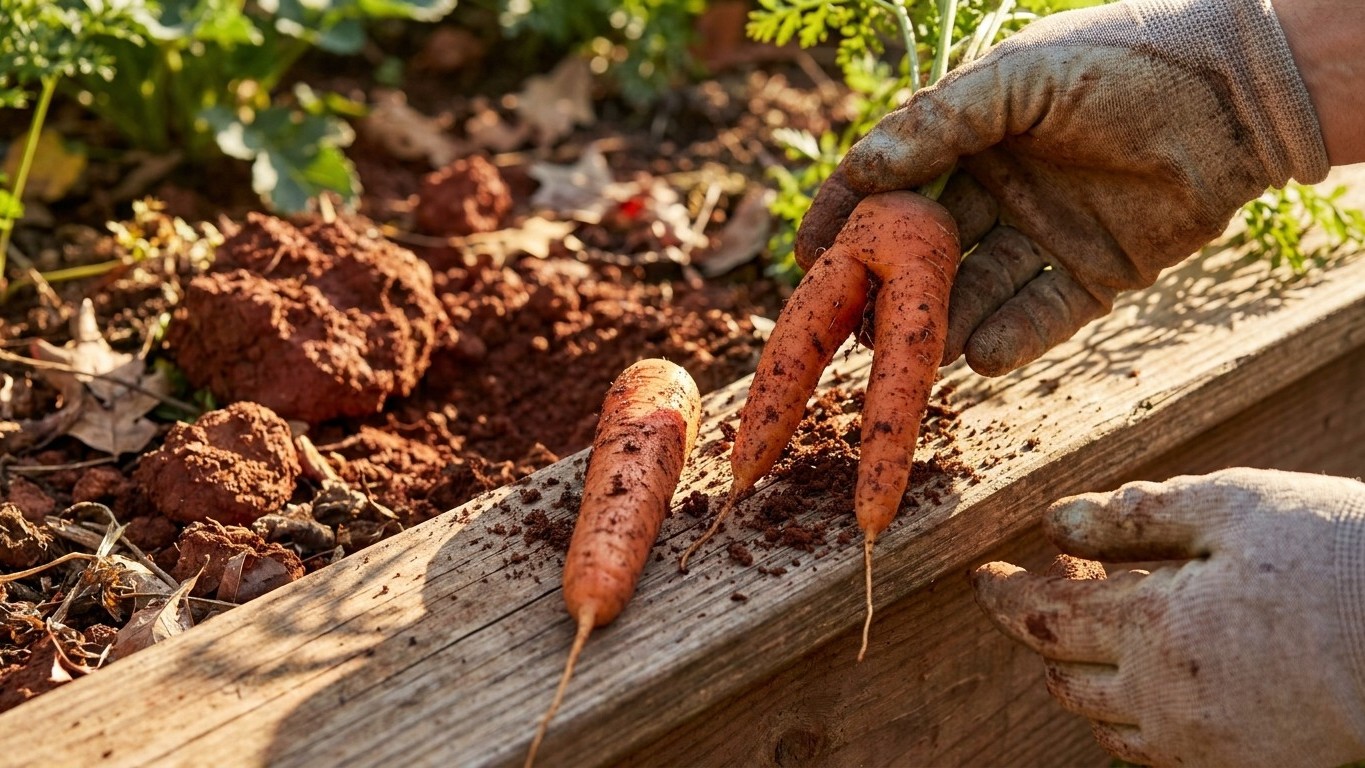

Nova Scotia’s most common soil, a Podzol, runs light on clay and heavy on drainage trouble. A median plot here won’t fork a carrot from clay alone, but the acidity and the “imperfectly drained” label mean the answer changes plot to plot. Compost, double digging, or a raised bed settle it either way.
The short answer
Agriculture and Agri-Food Canada’s Canadian Soil Information Service, working from 472 mapped soil components across the province’s agricultural regions, finds that the single most common soil order in Nova Scotia is a Podzol, the acid, leached soil that forms under conifers once rain has washed the bases out of the surface layer. Podzols cover 53 percent of the mapped surface; Gleysolic soils, which form where water sits and drainage is poor, come in second. The median surface reading for that dominant profile is a strongly acid pH of about 5.2, a texture of 52 percent sand, 10 percent clay and 38 percent silt (a loam-to-silt blend), organic matter around 2.1 percent, and a drainage class described as imperfect.
Run that against what carrots actually want. Utah State University Extension is blunt about it: carrots need deep, sandy, well-drained soil rich in organic matter, and heavy or rocky ground is what makes the root fork. At only 10 percent clay, the median Nova Scotia profile is not the heavy clay that classically splits a taproot in two. That’s the good news. The catch is the other half of the description, “imperfectly drained.” A Podzol’s leached layer can sit above a denser band lower down, and if a root meets resistance or a wet, oxygen-starved pocket partway down, it can still stall, branch, or curl rather than run straight. Where the soil shifts toward the Gleysolic type instead, that risk goes up, because those soils form specifically where water doesn’t move through freely.
So the practical answer for a typical Nova Scotia bed leans favorable but isn’t a guarantee. USU Extension’s fix for heavy or obstructed ground applies directly here: work in plenty of compost and double dig the bed to break up any compacted or poorly draining layer before you sow. If a spot stays wet longer than the rest of the yard after rain, skip the digging and build a raised bed instead, since raised beds sidestep the drainage problem rather than fighting it season after season.
None of this is a verdict on your own garden. Nova Scotia spans hundreds of individual soil series, and the survey behind these numbers covers the province’s farmed regions, not every backyard, riverbank, or filled lot within it. A median pH of 5.2 and a median texture of mostly sand describe a tendency across the province, not a reading for your raised bed or your side yard. Treat this section as a starting point for what to expect, then confirm it on your own ground.
The test that settles it in your own garden
The state’s soil survey can tell you what Nova Scotia tends to do. It can’t tell you what’s under your own carrot bed, especially if a builder ever graded, filled, or trucked in topsoil there. A short hands-on check answers that in an afternoon.
- Dig a test hole as deep as a full-grown carrot root. Most storage carrots run long, so dig at least that deep in the spot you plan to sow. Stop and look the moment the soil changes color or texture, since that’s the layer a root will hit.
- Check what’s sitting at that depth. Loose stones, gravel, or a dense, compacted band at root depth are the classic cause of a forked or stubby carrot, regardless of what the surface soil looks like.
- Feel a handful of moist soil from mid-depth. Sandy soil feels grainy and falls apart when squeezed. Clay-heavy soil feels smooth and holds a shape, even forms a ribbon when pressed between your fingers. The more it behaves like clay, the more compost and loosening it needs before sowing.
- Watch how water moves through the hole. Fill the test hole with water and see how it drains. Water that sits for a long stretch instead of soaking away points to the same imperfect drainage the provincial data flags as common, and it’s the strongest single sign that a raised bed will outperform an in-ground row.
- Repeat in more than one spot. Soil changes across a single yard, sometimes across a single bed. Testing one corner and assuming the rest matches is how gardeners get surprised at harvest.
Do this before you invest a season’s seed and effort. It costs nothing but a shovel and twenty minutes, and it answers the fork question far than any provincial average can.
What goes wrong here
- Forking in heavy or compacted ground. Wherever a plot leans toward the province’s second most common soil type, the Gleysolic order, or simply carries more clay than the median, roots meet resistance and split rather than run straight down. Utah State University Extension’s remedy is direct: work in generous compost and double dig the bed to loosen and aerate it before sowing, or move the crop to a raised bed filled with a lighter mix if the native ground stays wet and dense no matter how much you amend it.
- Poor germination during a stretch of hot, dry weather. Carrot seed is small and sits near the surface, so it depends on steady moisture to sprout. A dry spell that crusts the surface can stop germination cold even in soil that would otherwise grow a straight root. Keep the seedbed consistently damp from sowing until the seedlings are up, and a light mulch or fine covering over the row helps hold that moisture without smothering the sprouts.
- Splitting from uneven watering. A root that grows through a dry spell and then gets hit with heavy rain can expand faster than its skin allows, cracking open along the side. This is a watering-schedule problem more than a soil problem, and the fix is the same either way: water on a consistent schedule rather than letting the bed swing between drought and soaking, and use mulch to even out how fast the surface dries between waterings.
Common questions
Does Nova Scotia soil naturally fork carrots?
Not automatically. The province’s most common soil profile carries only 10 percent clay, well below the heavy, rocky ground that Utah State University Extension identifies as the cause of forking. The bigger risk in a typical Nova Scotia bed is the imperfect drainage that often comes with that soil, which is worth checking with the hands-on test above rather than assuming based on the provincial average.
What does a pH around 5.2 mean for carrots?
The median surface pH for Nova Scotia’s dominant soil profile is 5.2, which is strongly acid. That figure comes from the Canadian Soil Information Service’s mapped soil data, not from a test of any individual garden, so it should be read as a regional tendency rather than a number to plan a bed around without testing your own soil first.
Should I build a raised bed for carrots in Nova Scotia?
It depends on what your own test hole shows. If water sits in the hole rather than draining away, or if you hit a dense, compacted layer at root depth, a raised bed filled with a lighter, sandier mix sidesteps both problems more reliably than amending the native ground season after season.
How do I know if my carrot soil is too heavy?
Squeeze a moist handful from around root depth. Soil that holds together and ribbons between your fingers is heavier and more clay-rich than carrots prefer; soil that crumbles apart is closer to the sandy, well-drained texture Utah State University Extension recommends. Pair that feel test with the drainage check, since heavy texture and poor drainage often show up together.