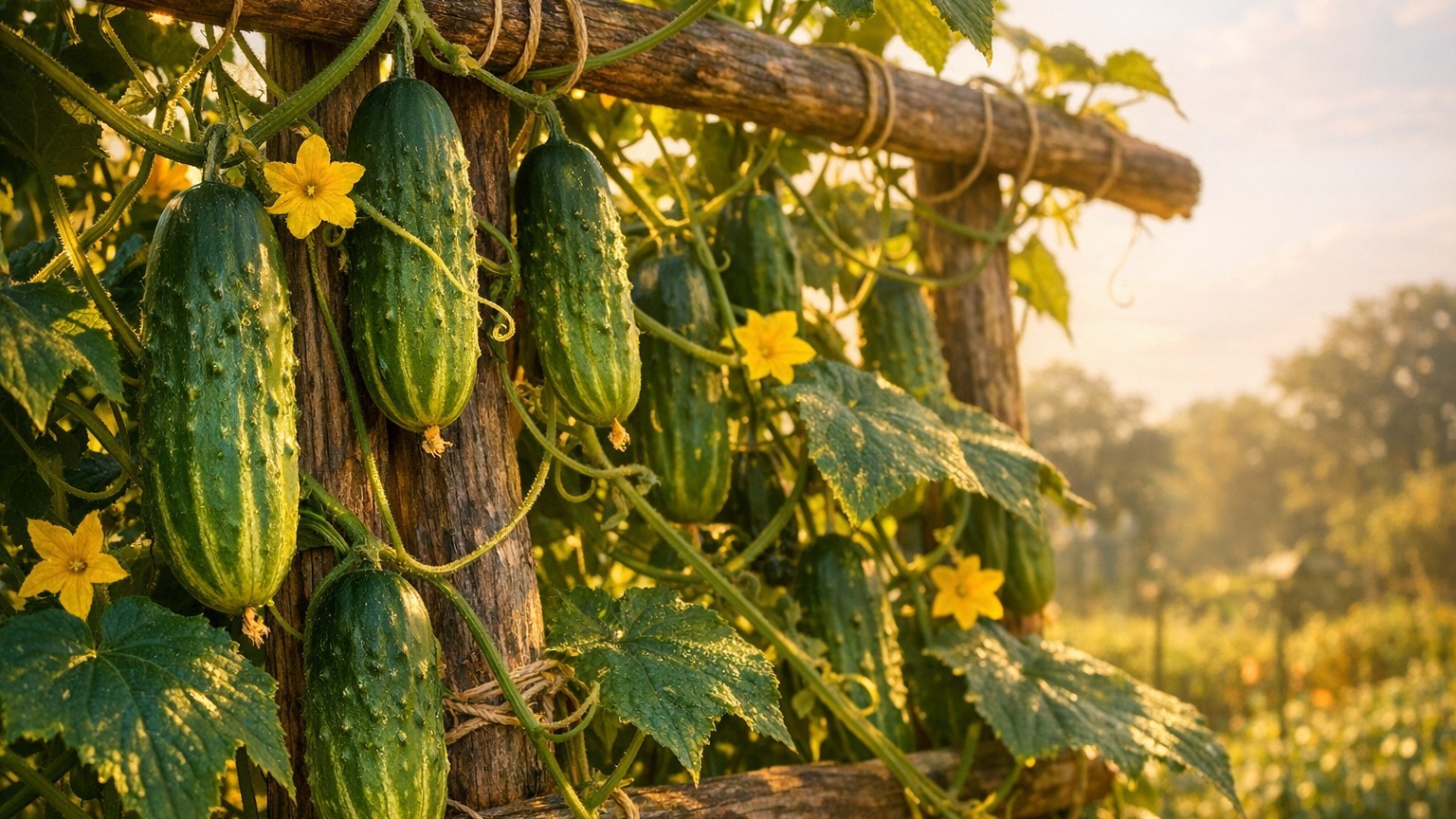

Nova Scotia’s cool, humid summers (zero days a year averaging above 90°F at the Halifax reference station) favor fast-maturing pickling and bush cucumbers over long-season heat-loving slicers. Parthenocarpic, burpless types trellised for airflow do best given the province’s steady summer rainfall and shortened frost-free window. Vining types need support to dodge fungal disease in the damp air.
The short answer for Nova Scotia
Start with what the numbers actually say. The frost-free window here runs, on average, from May 7 to October 18, a span of roughly five and a half months. That sounds generous until you read the fine print: both dates are means, not guarantees. Environment and Climate Change Canada’s own data means that in one year out of two, the last spring frost falls later than May 7, and the first fall frost arrives before October 18 just as often. So the real planting season is narrower and less predictable than the raw date range implies, and any cucumber type that needs every one of those days to finish ripening is gambling against a coin flip.
Layer on the heat picture. Halifax averages zero days a year at or above 90°F. Cucumbers are warm-season plants that push growth hardest in real heat, and a summer that never delivers a 90-degree day is a summer of slower, steadier growth rather than explosive growth. That argues for types bred to mature quickly and reliably in moderate warmth, not the long-vine, heat-hungry slicers that put on their best fruit during a string of sweltering afternoons.
What this means by type
Pickling cucumbers, generally bred for compact plants and quicker turnaround, fit a short, cool-summer climate better than sprawling slicing types that expect a long run of heat to size up properly. Bush forms also make sense here: they take up less space, mature earlier as a rule, and are easier to manage if the season runs short at either end. Parthenocarpic varieties, the ones that set fruit without needing pollinators, are worth serious consideration too, they’re often marketed for greenhouse or cool-climate production precisely because they don’t depend on a long stretch of pollinator activity, which matters when a cool spring delays bee activity.
Burpless, thin-skinned types bred for milder flavor and easier digestion are a matter of taste rather than climate, but many of the same breeding programs that produced burpless types also leaned into disease resistance and quicker maturity, so they’re not a bad place to look. Whatever the type, the decision should be made by reading the variety description for days-to-maturity and heat requirements, not by picking whatever’s on the seed rack, and that description should come from trial results for Nova Scotia specifically, which is what the extension section below covers.
What will not work here

Long-season vining slicers built for hot, sprawling Midwestern or southern summers are the clearest mismatch. They’re often bred assuming a stretch of 90-degree days to push vine growth and ripen fruit quickly; Nova Scotia offers none of those days in an average year. Planted here, they’ll grow, but slowly, and a plant that’s still sizing up its first fruit in late September is racing a frost date that, in half of all years, arrives before October 18 anyway.
Direct-seeding on the strength of the May 7 average is the second trap. Because that date is a midpoint, not a floor, seeding directly into the ground on May 7 means a real chance of frost or near-frost damage to seedlings in a below-average year. Cucumber seed also germinates poorly in cold soil regardless of air temperature, so an early sowing into ground that hasn’t caught up with the calendar often just rots rather than sprouts.
Where humidity does the damage
The summer rainfall figures look moderate on paper, about 11.2 inches across June, July and August, spread fairly evenly at 3.79, 3.76 and 3.68 inches per month. That’s not a drought pattern. But moderate, evenly spread rain in a maritime climate also means persistent humidity, and cucumbers grown low to the ground with tight spacing in that kind of air are prone to powdery and downy mildew. Dense plantings that might get away with it in a drier, breezier climate will struggle here if there’s no airflow around the leaves.
The practical failure mode, then, isn’t usually drought stress, it’s foliar disease from crowding, combined with a long-season variety that never finishes before the cold returns. Skip both, and skip trusting the average frost date as a hard line rather than a probability.
What changes across Nova Scotia
The hardiness zone figure available for this territory, 6b, comes from the Halifax Stanfield reference station alone, and it’s a Canadian zone, not a USDA one. Natural Resources Canada builds its zones from seven climate variables rather than the single winter-minimum figure the US system uses, so this number can’t be compared to a USDA zone rating on another page, and it shouldn’t be read as describing the whole province. A coastal, airport-adjacent site like Halifax Stanfield is about as mild and moderated as Nova Scotia gets.
Move inland, upland, or further north and the picture shifts, later last frosts, earlier first frosts, and a shorter effective season than the Halifax averages suggest. What can be said plainly: Nova Scotia is not one climate, and a single hardiness zone or single frost-date pair can’t stand in for the whole province.
The practical takeaway for anyone outside the immediate Halifax area is to treat the May 7 and October 18 dates as a coastal reference point, then shift both start and end conservatively based on their own local knowledge or the resources named below, later start, earlier finish, if they’re further from the coast or at higher elevation. Rather than guess at a zone number for a specific location, check the interactive map published by Natural Resources Canada, which is built for exactly this kind of local lookup and covers every municipality in the province.
Where to check this for your own county
Nova Scotia’s provincial agriculture department maintains the extension resource for growers here, at novascotia.ca/agri/.
Two things are worth hunting for once there. First, a local planting calendar, if one is published for the grower’s specific county or district, something that accounts for local frost patterns rather than the Halifax airport average. Second, any list of varieties actually trialled in Nova Scotia conditions, which is the closest thing to real evidence for how a specific cucumber type performs against this province’s short, cool, humid summer, rather than how it performs on a seed catalog’s national description.
A county-level recommendation will always beat a provincial one, for the simple reason that it’s built on conditions closer to the actual garden. A county extension office or master gardener program works from local trial plots and years of grower feedback specific to that district’s soil and microclimate.
Checking this against your own garden
Every date and average describes a reference station, not a specific backyard, so the garden itself is the better judge once seeds are in the ground. Soil warmth is the first check, and it can be read by feel: cucumber seed wants soil that feels warm to the hand, not just air that feels warm on the skin, and a cold, damp patch of soil in early May will sit and rot seed regardless of what the calendar says.
The first flush of male flowers is the second signal worth watching. Cucumber plants typically produce a wave of male flowers before the female flowers that actually set fruit appear, and the timing of that first flush says something about how the plant is reading the season’s accumulated warmth so far. An unusually late or sparse first flush is a hint that the local microclimate is running cooler than the provincial averages.
The appearance of the first true leaves, the ones that emerge after the initial seed leaves and actually look like miniature cucumber foliage, marks the point where a plant has moved from surviving on stored seed energy to actively growing on its own. A slow, delayed appearance of true leaves after transplant or germination is often the clearest on-the-ground evidence that a garden’s real conditions are running behind the reference-station numbers used to plan the season in the first place.