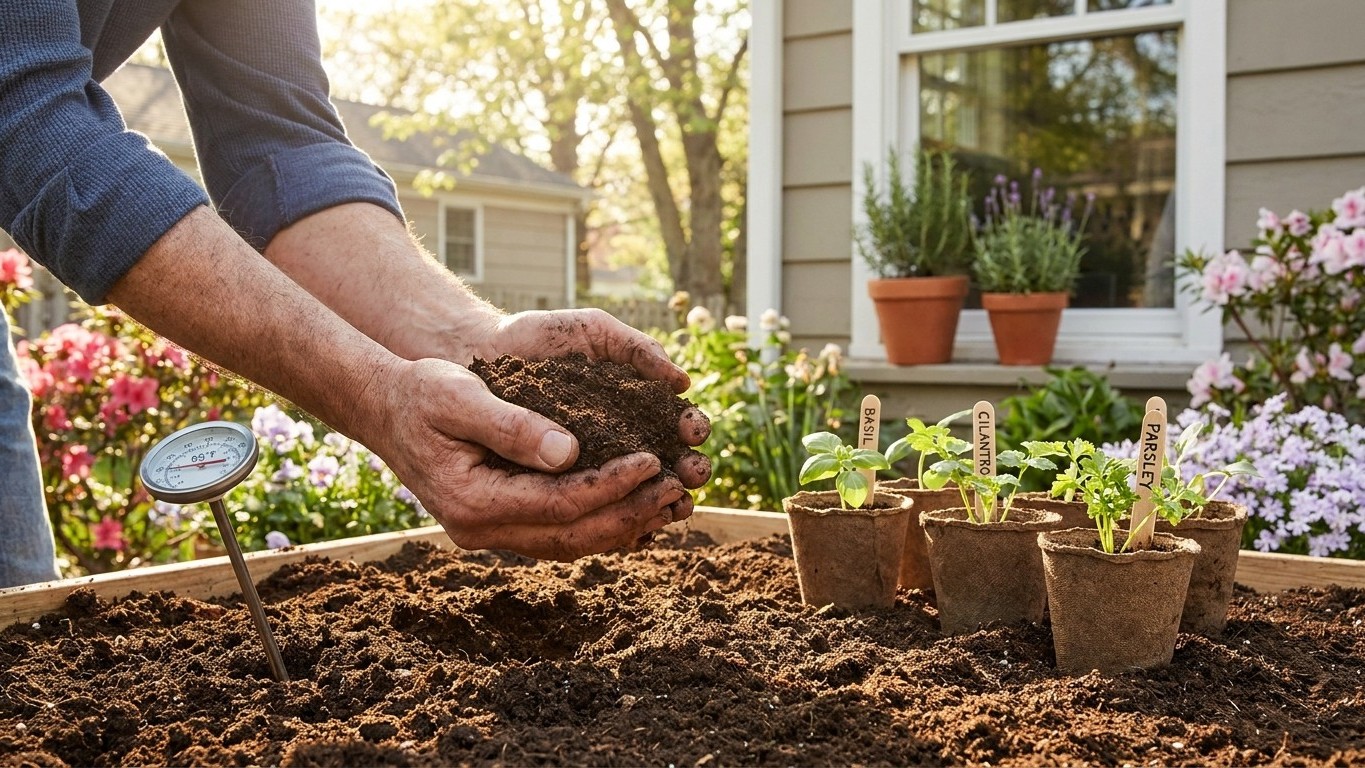

In Nova Scotia, herb seedlings shouldn’t go into open ground until soil temperatures climb well past the mean frost mark, typically late May into early June for tender types, while hardy perennial herbs and cold-tolerant leafy herbs can go earlier. Winter survival, not summer heat, is what really sorts perennial herbs from pot-grown annuals here.
When the soil is warm enough in Nova Scotia

Everyone wants a single date. The honest answer is that soil temperature, not the calendar, is what tender herbs like basil or lemongrass actually respond to, and soil lags behind air temperature by weeks in a maritime province like this one. The frost date is useful only as an anchor point for that lag.
Environment and Climate Change Canada’s Climate Normals for 1981-2010, drawn from the Halifax Stanfield Int’l A station, put the average last spring frost at May 7. That’s a mean, not a guarantee: in roughly half the years on record, frost has arrived after that date. Treat May 7 as the midpoint of a window that can stretch into late May in a cool spring, not as a green light to plant.
Halifax Stanfield sits in the Halifax area. Nova Scotia isn’t one climate zone stitched onto a map; the Annapolis Valley warms up differently than the Cape Breton highlands, and low-lying inland pockets can hold frost pockets long after the coast has cleared. If you garden away from the Halifax reference point, push your own planting window later rather than earlier until you’ve watched a season or two of your own soil behavior.
What this means for different herb types
Cold-hardy herbs in the leafy and biennial category (think parsley-type and chive-type herbs) tolerate a light frost and can go in the ground several weeks before that May 7 mean, sometimes started from transplants even earlier under cover. Tender annual herbs, the basil family especially, sulk or die outright below roughly 50°F soil temperature, so gardeners here usually wait until soil has had a solid stretch of settled warmth after the mean frost date, often into late May or the first week of June, before setting them out.
Perennial woody herbs, the rosemary and bay type of plant, are a separate conversation entirely, and it has nothing to do with spring planting dates. It has to do with whether they survive the following winter at all, which the next sections cover.
None of this page names a specific variety, and for good reason: cultivar performance is decided by trial gardens, not by a general climate article. What matters at this stage is simply understanding that “frost-free” and “soil warm enough for herbs” are two different lines on the calendar, and the second one always comes later.
How long the season lasts here
Run the subtraction using both figures from the same station and you get the shape of the whole season. The mean last spring frost sits at May 7; the mean first fall frost, also from Halifax Stanfield Int’l A on the 1981-2010 Climate Normals, lands at October 18. That’s a frost-to-frost window of roughly five and a half months, close to 164 days, on average.
That’s a meaningfully generous window by Canadian standards, and it changes what’s worth attempting with herbs. A season this long allows a second sowing of quick-cycling herbs, fast leafy types like cilantro or dill that bolt in summer heat and benefit from a fresh round started in mid to late summer for a fall harvest before that October frost closes things down. It’s long enough that a single spring sowing isn’t the only option on the table, which is not true in shorter-season Canadian provinces further north or at higher elevation.
The flip side matters just as much. Because both ends of the window are averages, not guarantees, a grower who plans a second sowing right up against the mean fall frost date is gambling on a season that runs slightly longer than typical. Building in a two- to three-week buffer before that October 18 mean, rather than sowing right up to it, is the more realistic approach given that frost has historically arrived earlier than the mean in plenty of years.
This window length also affects whether transplanting is worth the trouble versus direct-sowing. With roughly five months of frost-free time to work with, there’s enough runway to start tender herbs indoors, harden them off, and still get a full harvest window after transplant shock has passed. In a shorter season, that head start indoors becomes almost mandatory rather than optional, since there’s no slack left for a slow-to-establish direct-sown crop. For the mechanics of timing a second round of sowing against a known frost window, the site’s succession sowing guide walks through the spacing and timing logic in more depth.
Worth repeating: neither frost date is a hard boundary. Both are the middle of a spread, and a prudent Nova Scotia gardener treats the edges of that five-and-a-half-month window as soft, not fixed.
Heat and water in Nova Scotia

For most of the United States, this section would be about counting the days above 90°F and comparing that to summer rainfall totals, because heat stress and drought stress are what break a herb bed in July. Nova Scotia’s Atlantic coastal climate rarely puts that kind of heat pressure on a herb garden. Summers here run mild and humid rather than hot and dry, which flips the usual set of problems on its head.
In a climate where extreme heat isn’t the recurring threat, the real risk to herbs through the growing season is cool, damp air sitting in the foliage: powdery mildew on the leafy herbs, slow ripening on anything that wants real summer warmth to develop flavor and oil content, and fungal disease pressure on densely planted beds that don’t get enough airflow. Spacing plants generously and watering at the soil line rather than overhead does more good here than any drought-proofing strategy would.
Why winter, not summer, decides the herb bed
The number that actually reorganizes a Nova Scotia herb garden is the hardiness zone and the coldest-month figure, not anything about summer heat. Natural Resources Canada places the reference city used in these facts at zone 6b on the Canadian hardiness system, built from seven climate variables rather than the single minimum-temperature figure the USDA system uses. NRCan is explicit that there’s no clean conversion between the two systems, so this number shouldn’t be read against USDA zone maps used elsewhere.
The more concrete figure is the mean daily minimum of the coldest month: 13.3°F, per the 1981-2010 Canadian Climate Normals for the Halifax reference station. That’s the temperature that decides, plant by plant, whether a woody perennial herb survives a Nova Scotia winter outdoors or needs to come inside as a container plant. A rosemary-type shrub that would happily overwinter outdoors in a milder zone is, at 13.3°F average cold-month minimums, a serious risk left in open ground here without protection, and many gardeners in this zone simply treat those woody Mediterranean-type herbs as pot plants that migrate indoors or into an unheated but frost-buffered space for winter.
That single number does more to shape a Nova Scotia herb bed than any summer heat or rainfall statistic would. It’s the line between herbs planted once as permanent fixtures and herbs planted every year as annuals, or grown in containers that get carried indoors each fall.
Which herbs suit Nova Scotia
Reasoning from this province’s own numbers, three things sort what belongs here: a frost-to-frost window of roughly five and a half months, a cool damp growing season rather than a hot dry one, and a coldest-month minimum of 13.3°F that rules out unprotected outdoor survival for tender woody perennials.
Herb types with a short cycle to usable leaf, the fast leafy and annual herbs, fit the window well and can often be sown twice given how much frost-free time is available. Types that like airflow and resist fungal pressure have a real advantage in a humid coastal summer, since disease resistance matters more here than heat tolerance ever will. Hardy perennial herbs from the chive and mint families generally handle a 13.3°F winter minimum outdoors without special treatment, while woody Mediterranean-origin herbs are the ones best treated as containers that move indoors before the coldest month sets in.
- Fast-cycling leafy herbs suited to a second summer sowing
- Cold-hardy perennial herbs that tolerate the coldest-month minimum outdoors
- Woody perennial herbs better grown in containers and brought in for winter
- Herbs chosen for disease resistance over heat tolerance, given the humid summer pattern
What this page won’t do is name a specific variety within any of those types. That’s a deliberate choice, not an oversight. Variety trials, the kind that actually test which strains of a given herb resist mildew or handle a short Maritime summer well, are run locally by extension services and agricultural research stations, and their results are the only variety recommendation with real weight behind it. A general climate article guessing at cultivar names would be offering false precision dressed up as advice.
The Nova Scotia Department of Agriculture, reachable at novascotia.ca/agri, is the right next stop for anyone deciding between named varieties within these herb types, since that’s where locally trialled recommendations actually live. This page’s job stops at the climate logic; theirs starts where the cultivar-level detail begins.