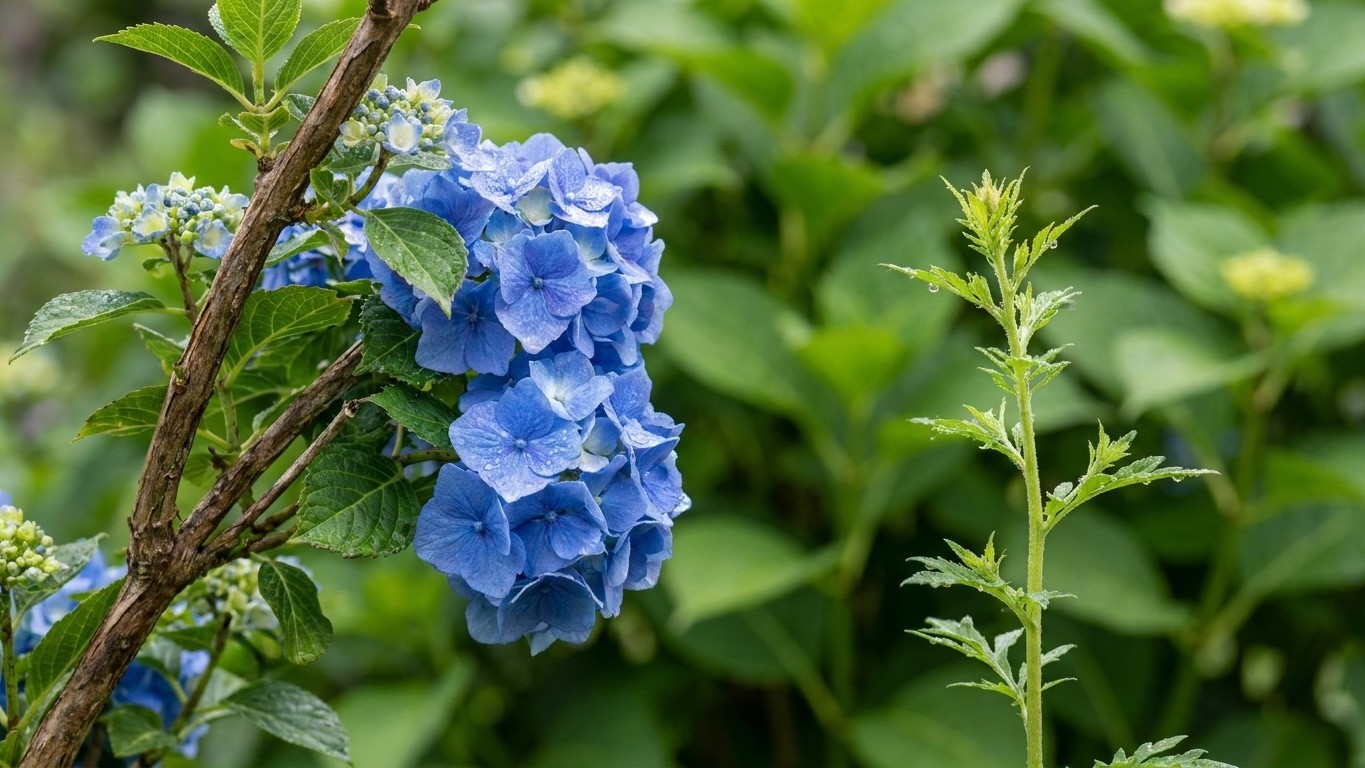

Hydrangeas turn out pink in Nova Scotia gardens when the plant cannot take up aluminum, and that depends on soil chemistry rather than on the plant itself. Blue flowers need acidic soil, with a pH of roughly 5.5 or lower, plus aluminum the roots can reach. Raise the pH, add too much phosphorus, or plant a cultivar bred for pink, and the same shrub flowers pink. The fix is slow and seasonal, and it only works on bigleaf and mountain types.
What this comes down to in Nova Scotia

The working season for changing hydrangea color runs from the mean last spring frost on May 7 to the mean first fall frost on October 18, as recorded at Halifax Stanfield, a commonly used reference station for the Halifax area (published normals differ somewhat by station and period). Both dates are midpoints. In one year out of two the last frost comes later than May 7, and in one year out of two the first fall frost comes earlier than October 18. The reference station has about 164 frost-free days between them.
Halifax sits in Canadian hardiness zone 6 (6a or 6b depending on the map edition and the exact location), per Natural Resources Canada. That is a Canadian zone and does not convert to a USDA zone, because the Canadian system weighs seven climate variables and the USDA system weighs one. It matters here because bigleaf hydrangeas carry their flower buds on old wood, and a hard winter can kill those buds. A shrub with no buds has no color to change.
What makes a hydrangea pink or blue?
The pigment in a bigleaf (Hydrangea macrophylla) or mountain (Hydrangea serrata) sepal is the same in both colors. When aluminum is dissolved in the soil water and the roots absorb it, the pigment shifts to blue. When aluminum stays locked in the soil, the sepals stay pink or red. Aluminum dissolves in acidic soil, around a pH of 5.0 to 5.5. At a pH of about 6.0 to 6.2 and higher, it is mostly locked up. In between, you get purple, or a mix of pink and blue heads on one plant.
Why would hydrangeas be pink where soil is acidic?
Much of the province has naturally acidic soil, so pink flowers usually have a local cause. Lime spread on a nearby lawn is a common one, and so are concrete foundations and walkways, which leach alkaline compounds into the soil beside them. Bone meal and other high-phosphorus fertilizers can tie up aluminum even in acidic soil. Garden beds in parts of the province with limestone under them can also run higher in pH than the typical acidic soil. And some cultivars are bred to lean pink, so they will not go fully blue however acidic the bed.
White hydrangeas will not change at all. Panicle types (Hydrangea paniculata) and smooth hydrangeas (Hydrangea arborescens) do not respond to soil pH. The rest of the growing basics are covered in our guide to growing hydrangeas in Nova Scotia.
Working it out for your own garden
Start by measuring. A home pH kit or a lab test tells you where the bed stands, and guessing from flower color alone misleads, since a pink head can come from high pH or from phosphorus. If the reading is above about 6.0, acidifying is a real option. If it is already 5.5 or lower and the flowers are still pink, look at phosphorus, the cultivar, and whether a foundation or lime source sits nearby.
How do you time aluminum sulfate or sulfur in Nova Scotia?
Count from the frost window. The mean last spring frost is May 7 at Halifax Stanfield, and because that is only the middle of the range, the real last frost may come a week or more later in a cool spring. Leaves on a bigleaf hydrangea usually open after the worst frost risk has passed, though a late frost can still damage them. A first treatment goes on once the plant is leafed out and the ground is workable, so in a typical year that is mid-May, and later at upland or northern sites.
Aluminum sulfate is usually applied as a drench, commonly about 1 tablespoon per gallon of water (follow the label on your product), onto moist soil around the root zone. Repeat about every four weeks for two or three doses. Stop by roughly mid-July. That is well before the mean first fall frost on October 18, which leaves the plant time to set buds and harden off without a late push of soft growth. Ground sulfur works more slowly and is better for a gradual shift over a season or more.
What if the bloom does not come in time?
Take a classic old-wood mophead such as Nikko Blue, planted this spring in a cold pocket. It sets its buds the previous summer, so soil changes this year affect mostly the color of next year’s flowers, and a hard winter can wipe out the buds entirely. A reblooming type such as Endless Summer flowers on both old and new wood, so a new-wood flush this year can pick up the color change, as long as the treatments start in spring. In a cool year with a late frost, the old-wood plant may give you foliage only, and the color question waits another season.
What changes across the province
Nova Scotia is a long, narrow peninsula with water on most sides, and the frost dates above belong to Halifax Stanfield, which sits inland from the Atlantic coast. Gardens near the coast may see a later fall frost and a cooler spring, since the ocean holds heat in autumn and delays warming in spring. Northern and upland districts, including the Cape Breton highlands, run weeks behind the reference station, so the treatment window shrinks at both ends there.
Soil changes just as much as climate. Acidic soil underlies much of the South Shore and the interior, and bigleaf hydrangeas there often lean blue with little help. Areas with higher pH soil, such as parts of the northern mainland where limestone sits close to the surface, tend toward pink, and gardeners there fight pink more often. Neighbors a few miles apart can have different soils, and so can two beds on one lot (one beside the foundation, one out in the yard). The pH test settles it better than the region does.
The mistakes this province punishes
Applying aluminum sulfate to dry plants burns roots. Water the bed well the day before and again after, especially in the warm, dry spells that can come with summer. Overdoing the rate is the second trap, since too much aluminum harms the plant, and a larger dose does not get you a bluer flower any faster.
Feeding with a high-phosphorus fertilizer undoes the work, because phosphorus ties up aluminum. Choose a fertilizer with a low middle number, and skip bone meal near hydrangeas. Lime has the same effect on the soil, so keep lawn lime away from the bed’s drip line and avoid planting right against a concrete foundation.
Pruning in spring is a quieter loss. Bigleaf types bloom on buds formed the previous summer, and cutting stems back after a cold winter removes those buds. Wait until leaf buds open, and then trim only what is clearly dead. Finally, do not expect results in one season. Soil pH moves slowly, and many gardeners need a full season or two to see blue take over.
Checking this against your county
The Halifax Stanfield dates and the Canadian zone 6 rating are starting points for the province and no substitute for your own site. For local frost timing, check Environment and Climate Change Canada climate normals; for soil testing, contact the Nova Scotia Department of Agriculture, which can direct you to a provincial soil lab and to advice for your district. Garden centers in your own county will also know whether local soils run acidic or limy.
Common questions
Can I turn a pink hydrangea blue in one season?
Sometimes the flowers shift partly within a season if aluminum is available early, but most gardeners see a full change over a year or two. Bloom color depends on the soil conditions when the buds form, so a change started in spring may show mostly next summer.
Do all hydrangeas change color?
No. Only bigleaf and mountain hydrangeas respond to soil pH. White varieties, panicle types and smooth hydrangeas keep their color whatever the soil does.
Can coffee grounds or pine needles make hydrangeas blue?
Their effect is small and slow. A pH test and a measured sulfur or aluminum sulfate program work far more reliably than mulches or kitchen scraps.
Is it better to keep hydrangeas pink in an alkaline bed?
If your soil already runs high in pH, keeping the plant pink costs less effort than fighting the soil all year. Garden lime can deepen the pink, but test the soil first so you do not overshoot.